Review
. 2017 Jul;74(13):2395-2411.
doi: 10.1007/s00018-017-2477-1. Epub 2017 Feb 21.

Nucleic acid sensing pattern recognition receptors in the development of colorectal cancer and colitis

Affiliations
Review

Nucleic acid sensing pattern recognition receptors in the development of colorectal cancer and colitis

Liangmei He et al. Cell Mol Life Sci. 2017 Jul.

Abstract

Colorectal cancer (CRC) is a leading cause of cancer-related deaths that is often associated with inflammation initiated by activation of pattern recognition receptors (PRRs). Nucleic acid sensing PRRs are one of the major subsets of PRRs that sense nucleic acid (DNA and RNA), mainly including some members of Toll-like receptors (TLR3, 7, 8, 9), AIM2-like receptors (AIM2, IFI16), STING, cGAS, RNA polymerase III, and DExD/H box nucleic acid helicases (such as RIG-I like receptors (RIG-I, MDA5, LPG2), DDX1, 3, 5, 7, 17, 21, 41, 60, and DHX9, 36). Activation of these receptors eventually leads to the release of cytokines and activation of immune cells, which are well known to play crucial roles in host defense against intracellular bacterial and virus infection. However, the functions of these nucleic acid sensing PRRs in the other diseases such as CRC and colitis remain largely unknown. Recent studies indicated that nucleic acid sensing PRRs contribute to CRC and/or colitis development, and therapeutic modulation of nucleic acid sensing PRRs may reduce the risk of CRC development. However, until now, a comprehensive review on the role of nucleic acid sensing PRRs in CRC and colitis is still lacking. This review provided an overview of the roles as well as the mechanisms of these nucleic acid sensing PRRs (AIM2, STING, cGAS, RIG-I and its downstream molecules, DDX3, 5, 6,17, and DHX9, 36) in CRC and colitis, which may aid the diagnosis, therapy, and prognostic prediction of CRC and colitis.

Keywords: Cell proliferation; Colitis; Colorectal cancer; Nucleic acid sensing pattern recognition receptors; Type I interferon.


Figures
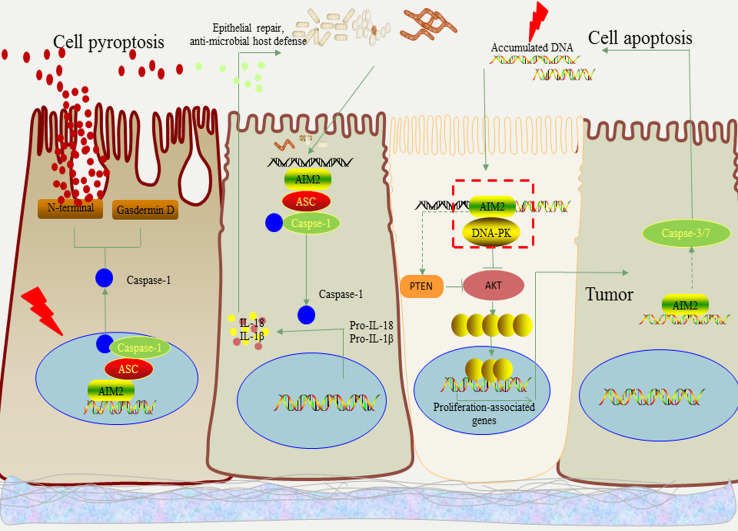
Fig. 1
Fig. 1
The model of AIM2 signaling pathway in the development of colitis and colorectal cancer. AIM2 in intestinal epithelial cells (IECs) can be activated by dsDNA in cytoplasm or nucleus. The activation of AIM2 can further assemble inflammasome by recruiting ASC and pro-caspase-1. AIM2 inflammasome maturates caspase-1 in turn. Caspase-1 maturated by cytoplasmic AIM2 inflammasome activated by microbiota and dying cell-derived dsDNA can further cleave pro-IL-1β and pro-IL-18 into IL-1β and IL-18, respectively. IL-18 promotes the repair of damaged IECs and induces an anti-microbial host defense, which potently alleviates the development of colitis. AIM2 can also assemble inflammasome in nucleus where AIM2 encounters damaged dsDNA induced by radiotherapy and chemotherapy. The activated caspase-1 cleaves the substrate gasdermin D and drives the pyroptosis of IECs by its N-terminal fragment. On the other hand, AIM2 binds to DNA-PK directly and inhibits the AKT-induced proliferation of IECs as well as intestinal stem cells to prevent the development of CRC. Moreover, AIM2 inhibits the activity of AKT by enhancing the level of its negative regulator PTEN. Additionally, AIM2 also accelerates the caspase3/7-dependent apoptosis of IECs
Fig. 2
Fig. 2
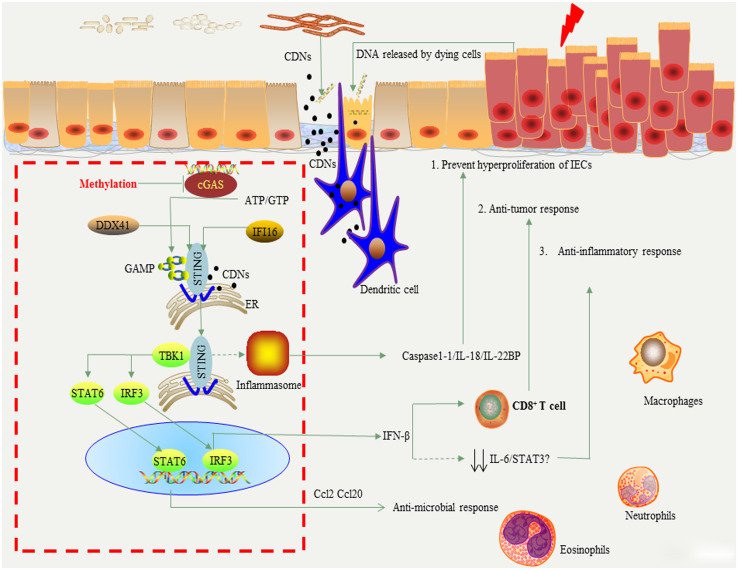
The model of cGAS-STING signaling pathway in the development of colorectal cancer.The ER-anchoring protein STING is an important adaptor for immune responses to DNA stimulation. STING in antigen presenting cells, especially in dendritic cells, directly binds to cyclic di-nucleotides (CDNs) that are specifically presented in bacteria or generated from ATP/GTP by cGAMP synthase (cGAS). The upstream candidate DNA receptors of STING include DDX41 and IFI16. STING is activated and shuttled to perinuclear compartment where it binds to and phosphorylates TBK1 when tumor-derived DNA is captured by cGAS. The phosphorylation of TBK1 leads to the activation of IRF3 and STAT6, which in turn leads to the production of type I IFN (IFN-β) and Ccl2/20, respectively. IFN-β is required for priming of tumor-specific CD8+T cell and can induce the tumor regression. On the other hand, STING may reduce the inflammatory response in intestine by inhibiting the expression of IL-6 and STAT3. Notably, STING may also induce the activation of inflammasome and suppress the proliferation of intestinal epithelial cells via activating inflammasome-derived IL-18
Fig. 3
Fig. 3
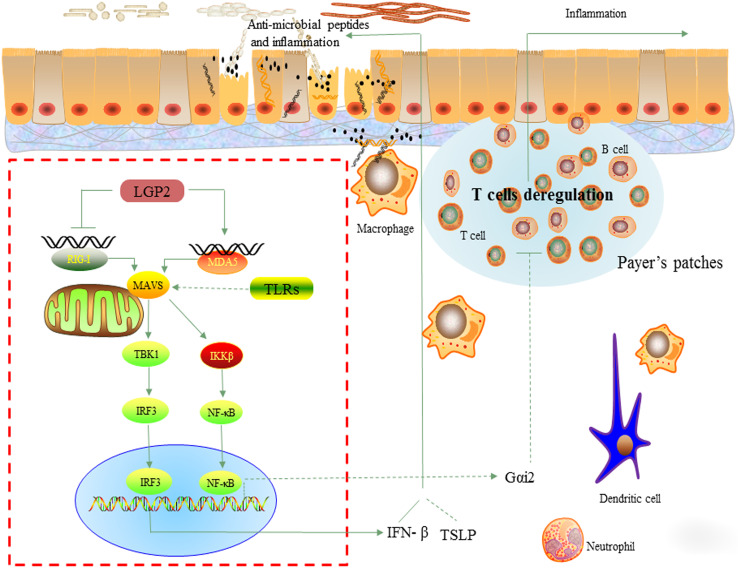
The model of RLR signaling pathway in the development of colitis. RIG-I-like receptors (RLRs) are required for cytoplasmic RNA detection. Upon activation, both RIG-I and MDA5 recruit the adaptor-mitochondrial antiviral signaling protein (MAVS) via their CARD domains and form a platform to activate TRAF. This in turn leads to the phosphorylation of IRF3 and NF-κB signaling to promote the production of IFN-β and pro-inflammatory genes, respectively. RIG-I enhances the promoter activity of Gαi2, partially through NF-κB, to reverses the deregulation of T cell subsets in Payer’s patches—an important instigator for colitis development. On the other hand, MDA5 senses RNA from invasive gut microbiota to maintain intestinal homeostasis by inducing the expression of IFN-β and antimicrobial peptides. Moreover, IRF3 can also directly bind to TSLP to protect host from colitis
Fig. 4
Fig. 4
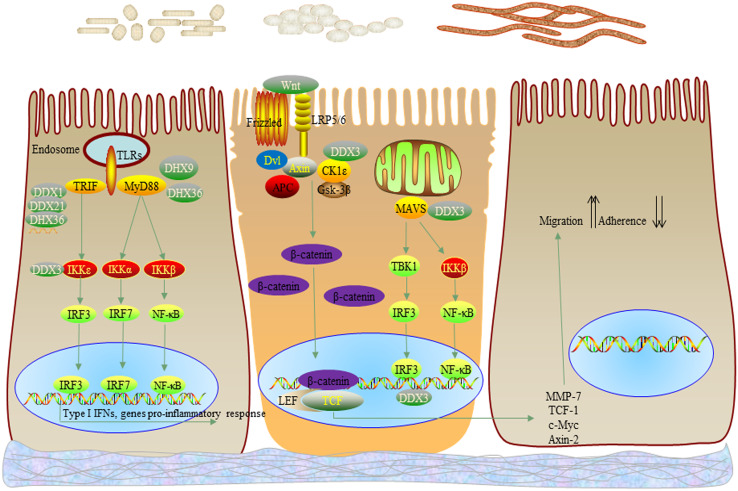
DExD/H box helicases signaling pathway in the development of colorectal cancer. DExD/H box helicases, including DDX1, DDX3, DDX5, DDX6, DDX17, DDX21, DDX41, DHX9, DHX36, DDX41, and DDX60, are involved in pathogen recognition, immune responses, and cancers (including CRC) progression, in addition to their functions in the regulation of nucleic acid metabolism. DHX36 responds to dsRNA and forms a complex with DDX1 and DDX21. The complex can signal via TRIF, or detect CpG-A DNA and trigger immune response via MyD88. DHX9 can respond to both CpG-B DNA and dsRNA, and signal via MAVS and MyD88, respectively. DDX60 interacts with RIG-I and sensitizes the binding of RIG-I and dsRNA. DDX3 can interact with dsRNA and signal via MAVS, in addition to acting as a mediator of downstream of TBK, IKKε and a transcriptional regulator of the IFN-β promoter. Furthermore, DDX3 can promote the CRC invasion by increasing activity of CK1ε/Dvl2/β-catenin/TCF signaling pathway. Except DDX3, the signaling pathways of DExD/H box helicases in CRC are largely unknown

References

    1. Torre LA, Bray F, Siegel RL, Ferlay J, Lortet-Tieulent J, Jemal A. Global cancer statistics, 2012. CA Cancer J Clin. 2015;65:87–108. doi: 10.3322/caac.21262. - DOI - PubMed
    1. Arnold M, Sierra MS, Laversanne M, Soerjomataram I, Jemal A, Bray F. Global patterns and trends in colorectal cancer incidence and mortality. Gut. 2016 - PubMed
    1. Chen W, Zheng R, Baade PD, Zhang S, Zeng H, Bray F, Jemal A, Yu XQ, He J. Cancer statistics in China, 2015. CA-Cancer J Clin. 2016;66:115–132. doi: 10.3322/caac.21338. - DOI - PubMed
    1. Brenner H, Kloor M, Pox CP. Colorectal cancer. The Lancet. 2014;383:1490–1502. doi: 10.1016/S0140-6736(13)61649-9. - DOI - PubMed
    1. Takeuchi O, Akira S. Pattern recognition receptors and inflammation. Cell. 2010;140:805–820. doi: 10.1016/j.cell.2010.01.022. - DOI - PubMed

Publication types

Substances