. 2017 Jun;18(3):495-512.
doi: 10.1007/s10162-016-0613-5. Epub 2017 Feb 21.

Forward Masking in Cochlear Implant Users: Electrophysiological and Psychophysical Data Using Pulse Train Maskers

Affiliations

Forward Masking in Cochlear Implant Users: Electrophysiological and Psychophysical Data Using Pulse Train Maskers

Youssef Adel et al. J Assoc Res Otolaryngol. 2017 Jun.

Abstract

Electrical stimulation of auditory nerve fibers using cochlear implants (CI) shows psychophysical forward masking (pFM) up to several hundreds of milliseconds. By contrast, recovery of electrically evoked compound action potentials (eCAPs) from forward masking (eFM) was shown to be more rapid, with time constants no greater than a few milliseconds. These discrepancies suggested two main contributors to pFM: a rapid-recovery process due to refractory properties of the auditory nerve and a slow-recovery process arising from more central structures. In the present study, we investigate whether the use of different maskers between eCAP and psychophysical measures, specifically single-pulse versus pulse train maskers, may have been a source of confound.In experiment 1, we measured eFM using the following: a single-pulse masker, a 300-ms low-rate pulse train masker (LTM, 250 pps), and a 300-ms high-rate pulse train masker (HTM, 5000 pps). The maskers were presented either at same physical current (Φ) or at same perceptual (Ψ) level corresponding to comfortable loudness. Responses to a single-pulse probe were measured for masker-probe intervals ranging from 1 to 512 ms. Recovery from masking was much slower for pulse trains than for the single-pulse masker. When presented at Φ level, HTM produced more and longer-lasting masking than LTM. However, results were inconsistent when LTM and HTM were compared at Ψ level. In experiment 2, masked detection thresholds of single-pulse probes were measured using the same pulse train masker conditions. In line with our eFM findings, masked thresholds for HTM were higher than those for LTM at Φ level. However, the opposite result was found when the pulse trains were presented at Ψ level.Our results confirm the presence of slow-recovery phenomena at the level of the auditory nerve in CI users, as previously shown in animal studies. Inconsistencies between eFM and pFM results, despite using the same masking conditions, further underline the importance of comparing electrophysiological and psychophysical measures with identical stimulation paradigms.

Keywords: detection threshold; electrical stimulation; electrically evoked compound action potential; neural adaptation; recovery from forward masking; stimulation rate.


Conflict of interest statement

Conflict of Interest

The authors declare that they have no conflict of interest.

Figures
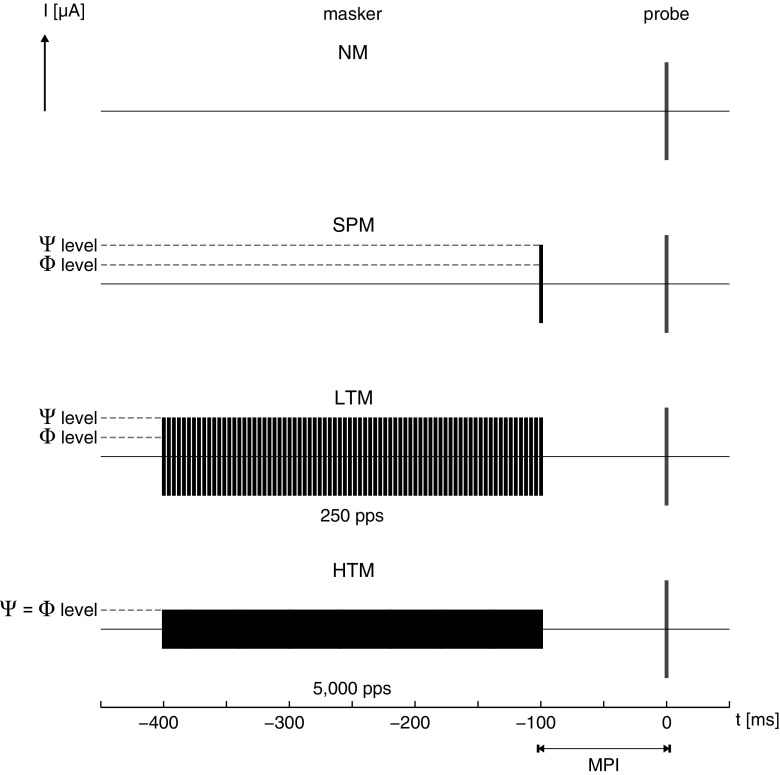
FIG. 1
FIG. 1
Overview of the masking conditions: no masker (NM), single-pulse masker (SPM), low-rate pulse train masker (LTM) at 250 pps, and high-rate pulse train masker (HTM) at 5000 pps. Pulse train maskers were presented at the same physical current level (Φ) or at the same psychophysical loudness (Ѱ). SPM was presented at current levels equal to those of LTM. The masker-probe interval (MPI; here, 100 ms) was varied as an experimental condition.
FIG. 2
FIG. 2
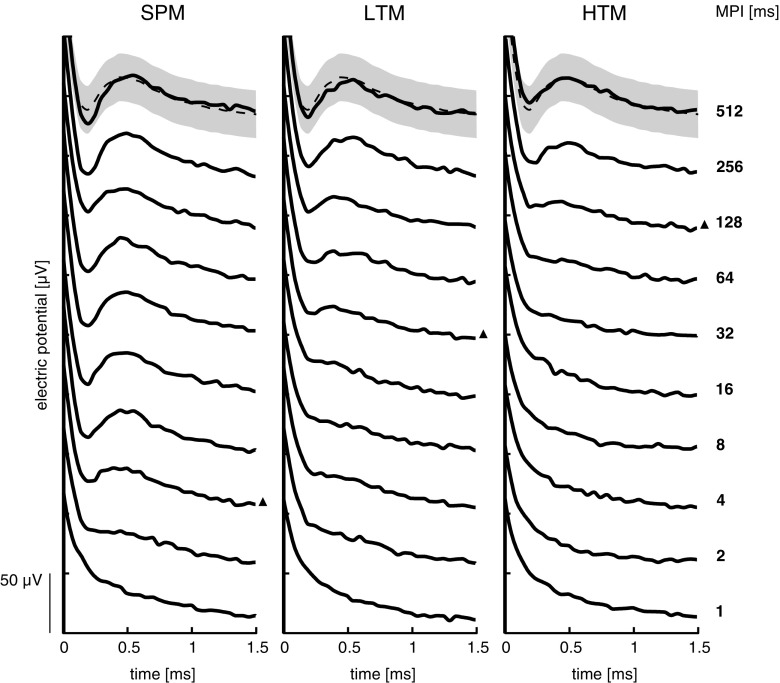
Illustrative example (subject U05, middle electrode) of eCAP traces in response to the masked probe as a function of the masker-probe interval (MPI), for the masking conditions: single-pulse masker (SPM), low-rate pulse train masker (LTM), and high-rate pulse train masker (HTM). Pulse train maskers were presented at the same psychophysical loudness level (Ѱ). SPM was presented at current levels equal to those of LTM. For each masking condition, the first response judged as “eCAP present” is marked by a black triangle on its right. Mean eCAP and ±1 standard deviation of all responses in the no masker (NM) condition are shown as a dashed line and shaded area, respectively. A 50-µV scale bar is shown in the bottom left corner.
FIG. 3
FIG. 3
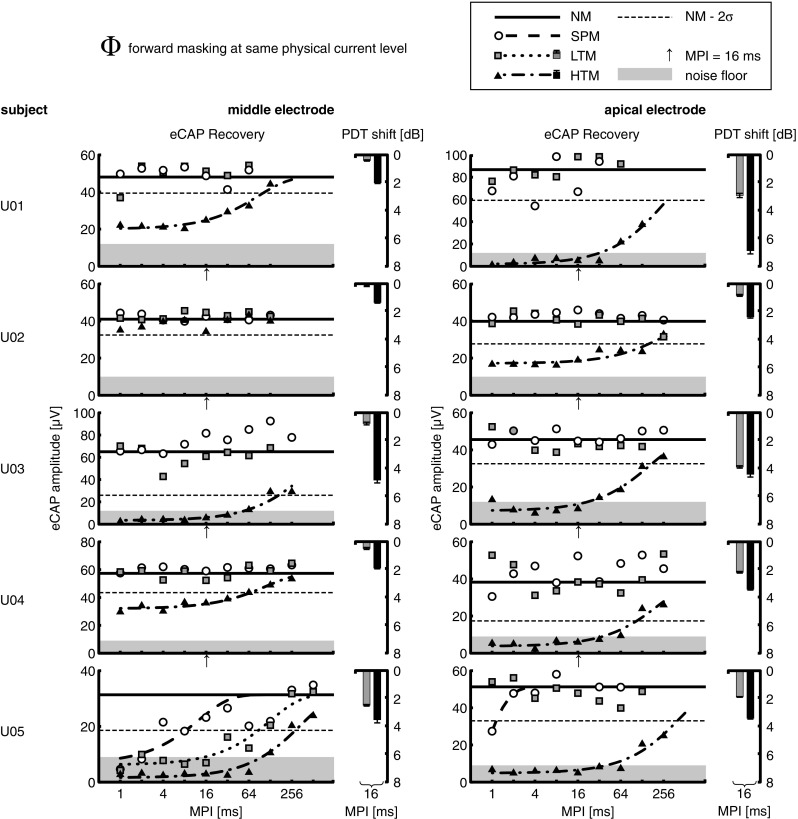
Individual results for the masking conditions: no masker (NM), single-pulse masker (SPM), low-rate pulse train masker (LTM), and high-rate pulse train masker (HTM), for each electrode position (apical and middle). The average of all amplitude estimates in the NM condition is shown as a solid horizontal line, and two times the standard deviation (σ) below that as a dashed horizontal line. The noise floor, which was defined when 25% or less traces were valid eCAP responses, is shown as a shaded area. Pulse train maskers were presented at the same physical current level (Φ), corresponding to a current level evoking comfortable loudness for HTM. SPM was always presented at current levels equal to those of LTM. Electrophysiological forward masking (eFM) was measured using eCAP amplitude estimates as a function of the masker-probe interval (MPI). Fitted exponential models of the eCAP recovery functions are only shown when eFM occurred. Psychophysical forward masking (pFM) results are shown as shifts in the probe detection threshold (PDT) at an MPI of 16 ms. Error bars indicate the standard error of the mean. Note that the ordinate is inverted.
FIG. 4
FIG. 4
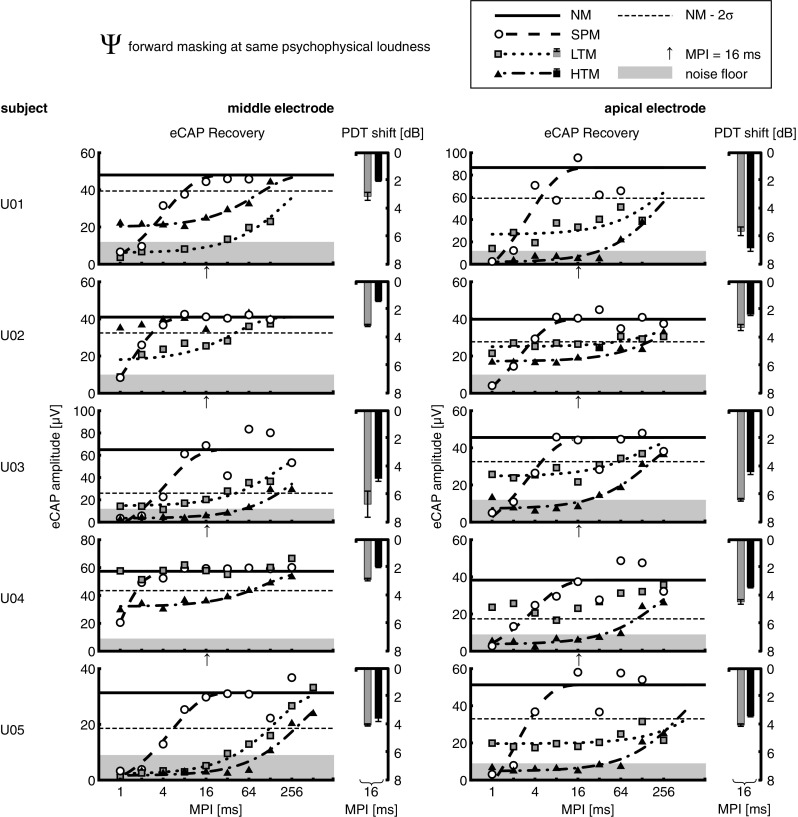
Same as Figure 3, but with pulse train maskers presented at the same psychophysical loudness level (Ѱ). SPM was always presented at current levels equal to those of LTM.
FIG. 5
FIG. 5
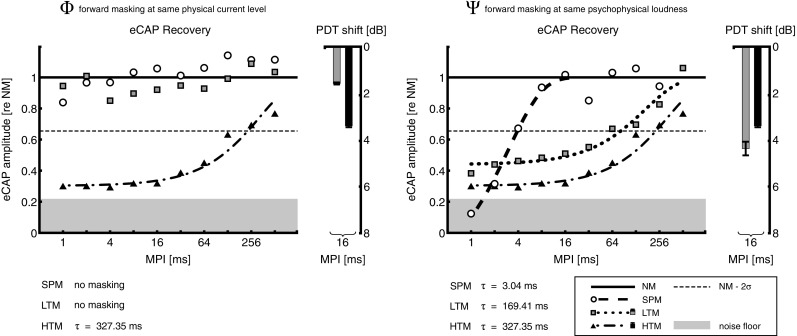
Same as Figures 3 and 4, but with data normalized re the respective no masker (NM) level and collapsed across subjects. Results are shown for pulse train maskers presented at the same physical current level (Φ, left panel) and at the same psychophysical loudness level (Ѱ, right panel). SPM was always presented at current levels equal to those of LTM. Time constants (τ) of the exponential eCAP recovery functions are shown at the bottom.

References

    1. Abbas PJ, Brown CJ. Assessment of responses to cochlear implant stimulation at different levels of the auditory pathway. Hear Res. 2015;322:67–76. doi: 10.1016/j.heares.2014.10.011. - DOI - PMC - PubMed
    1. Baudhuin JL, Hughes ML, Goehring JL. A comparison of alternating polarity and forward masking artifact-reduction methods to resolve the electrically evoked compound action. Potential Ear Hear. 2016;37:e247–e255. doi: 10.1097/AUD.0000000000000288. - DOI - PMC - PubMed
    1. Bierer JA, Deeks JM, Billig AJ, Carlyon RP. Comparison of signal and gap-detection thresholds for focused and broad cochlear implant electrode configurations. J Assoc Res Otolaryngol. 2015;16:273–284. doi: 10.1007/s10162-015-0507-y. - DOI - PMC - PubMed
    1. Botros A, Psarros C. Neural response telemetry reconsidered: II. The influence of neural population on the ECAP recovery function and refractoriness. Ear Hear. 2010;31:380–391. doi: 10.1097/AUD.0b013e3181cb41aa. - DOI - PubMed
    1. Boulet J, White M, Bruce IC. Temporal considerations for stimulating spiral ganglion neurons with cochlear implants. J Assoc Res Otolaryngol. 2015 - PMC - PubMed

LinkOut - more resources