Increasing Resistance to Extended-Spectrum Cephalosporins, Fluoroquinolone, and Carbapenem in Gram-Negative Bacilli and the Emergence of Carbapenem Non-Susceptibility in Klebsiella pneumoniae: Analysis of Korean Antimicrobial Resistance Monitoring System (KARMS) Data From 2013 to 2015
- PMID: 28224769
- PMCID: PMC5339095
- DOI: 10.3343/alm.2017.37.3.231
Increasing Resistance to Extended-Spectrum Cephalosporins, Fluoroquinolone, and Carbapenem in Gram-Negative Bacilli and the Emergence of Carbapenem Non-Susceptibility in Klebsiella pneumoniae: Analysis of Korean Antimicrobial Resistance Monitoring System (KARMS) Data From 2013 to 2015
Abstract
Background: National surveillance of antimicrobial resistance becomes more important for the control of antimicrobial resistance and determination of treatment guidelines. We analyzed Korean Antimicrobial Resistance Monitoring System (KARMS) data collected from 2013 to 2015.
Methods: Of the KARMS participants, 16 secondary or tertiary hospitals consecutively reported antimicrobial resistance rates from 2013 to 2015. Data from duplicate isolates and institutions with fewer than 20 isolates were excluded. To determine the long-term trends, previous KARMS data from 2004 to 2012 were also considered.
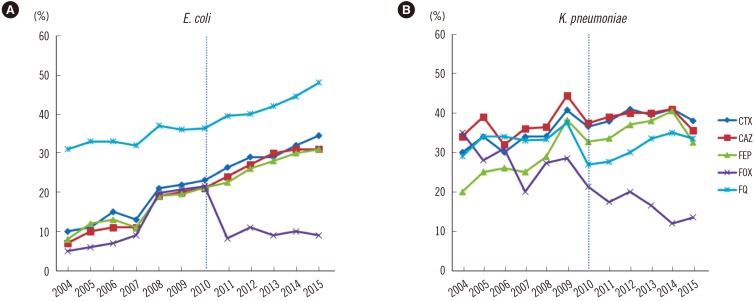
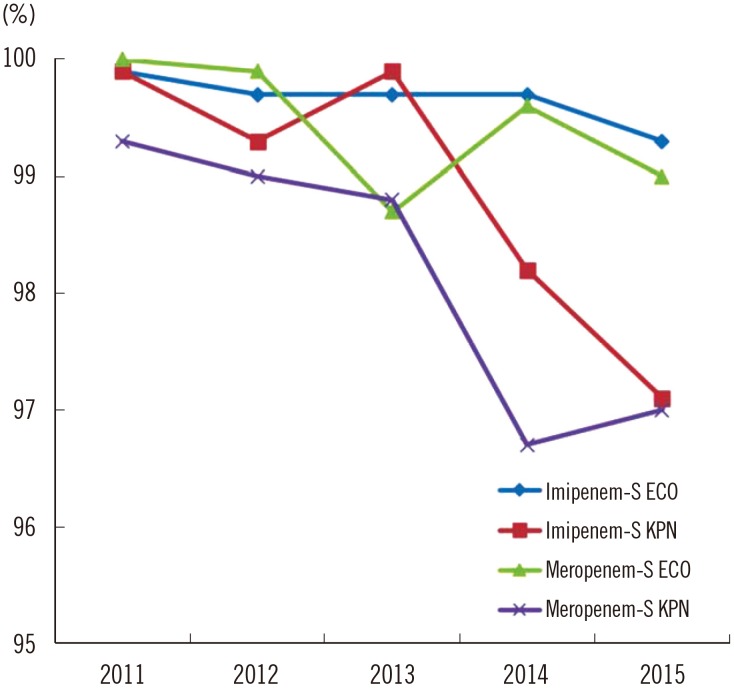
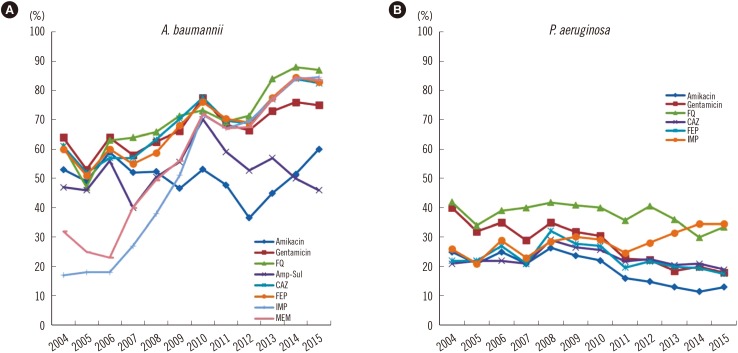
Results: The prevalence of methicillin-resistant Staphylococcus aureus and vancomycin-resistant Enterococcus faecium from 2013 to 2015 was 66-72% and 29-31%, respectively. The resistance rates of Escherichia coli to cefotaxime and cefepime gradually increased to 35% and 31%, respectively, and fluoroquinolone resistance reached 48% in 2015. The resistance rates of Klebsiella pneumoniae to cefotaxime, cefepime, and carbapenem were 38-41%, 33-41%, and <0.1-2%, respectively, from 2013 to 2015. The carbapenem susceptibility rates of E. coli and K. pneumoniae decreased from 100% and 99.3% in 2011 to 99.0% and 97.0% in 2015, respectively. The resistance rate of Pseudomonas aeruginosa to carbapenem increased to 35% and the prevalence of carbapenem-resistant Acinetobacter baumannii increased from 77% in 2013 to 85% in 2015.
Conclusions: Between 2013 and 2015, the resistance rates of E. coli to third- and fourth-generation cephalosporins increased continuously, while carbapenem-susceptibility gradually decreased, particularly in K. pneumoniae. The prevalence of carbapenem-resistant P. aeruginosa and A. baumannii increased significantly; therefore, few treatment options remain for these resistant strains.
Keywords: Acinetobacter baumannii; Antimicrobial drug resistance; KARMS; Surveillance.
© The Korean Society for Laboratory Medicine
Conflict of interest statement
Figures
References
-
- Centers for Disease Control and Prevention. Antibiotic resistance threat in the United States, 2013. Atlanta, GA: Centers for Disease Control and Prevention, US Department of Health and Human Service; 2013.
-
- Hong SG, Yong D, Lee K, Kim EC, Lee WK, Jeong SH, et al. Antimicrobial resistance of clinically important bacteria isolated from hospitals located in representative provinces of Korea. Korean J Clin Microbiol. 2003;6:29–36.
MeSH terms
Substances
LinkOut - more resources
Full Text Sources
Other Literature Sources
Medical