


Management of vesicovaginal fistulas (VVFs) in women following benign gynaecologic surgery: A systematic review and meta-analysis
- PMID: 28225769
- PMCID: PMC5321457
- DOI: 10.1371/journal.pone.0171554
Management of vesicovaginal fistulas (VVFs) in women following benign gynaecologic surgery: A systematic review and meta-analysis
Abstract
Background: Vesicovaginal fistulas (VVF) are the most commonly acquired fistulas of the urinary tract, but we lack a standardized algorithm for their management. Surgery is the most commonly preferred approach to treat women with primary VVF following benign gynaecologic surgery.
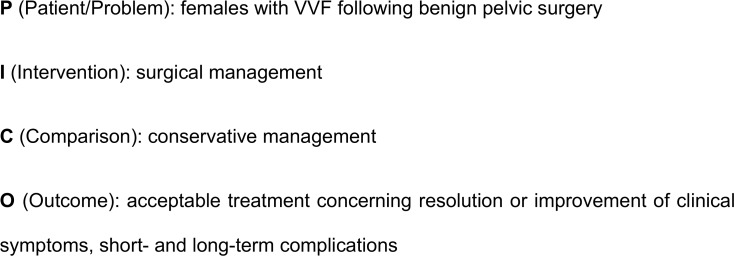
Objective: To carry out a systematic review and meta-analysis on the effectiveness of operative techniques or conservative treatment for patients with postsurgical VVF. Our secondary objective was to define the surgical time and determine the types of study designs.
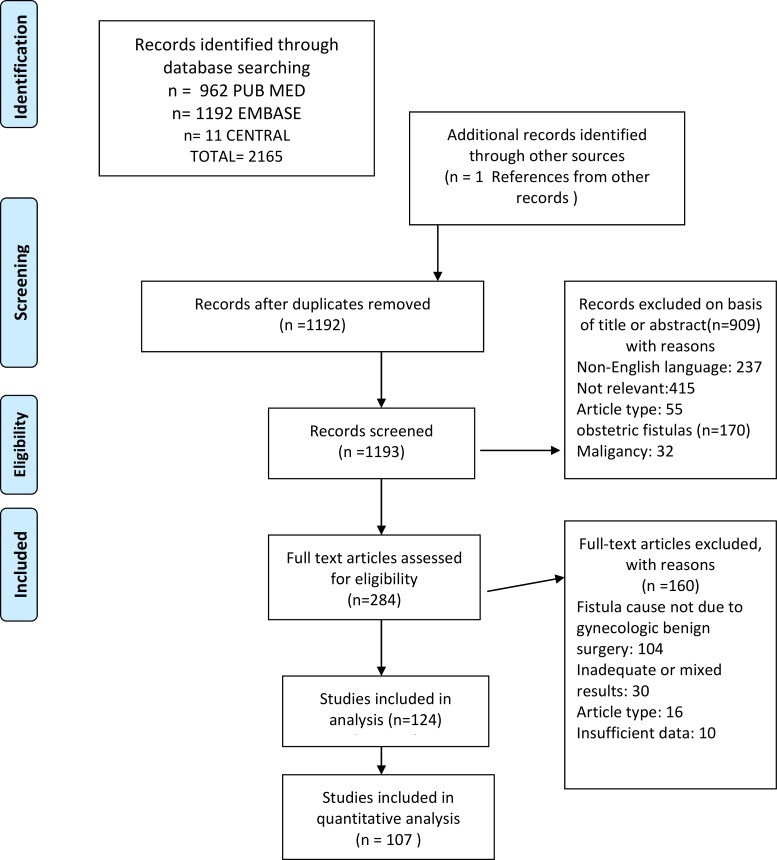
Methods: PubMed, Old Medline, Embase and Cochrane Central Register of Controlled Trials were used as data sources. This systematic review was modelled on the Preferred Reporting Items for Systematic Reviews and Meta-Analyses statement, including a registration number (CRD42012002097).
Results: We reviewed 282 full text articles to identify 124 studies for inclusion. In all, 1379/1430 (96.4%) patients were treated surgically. Overall, the transvaginal approach was performed in the majority of patients (39%), followed by a transabdominal/transvesical route (36%), a laparoscopic/robotic approach (15%) and a combined transabdominal-transvaginal approach in 3% of cases. Success rate of conservative treatment was 92.86% (95%CI: 79.54-99.89), 97.98% in surgical cases (95% CI: 96.13-99.29) and 91.63% (95% CI: 87.68-97.03) in patients with prolonged catheter drainage followed by surgery. 79/124 studies (63.7%) provided information for the length of follow-up, but showed a poor reporting standard regarding prognosis. Complications were studied only selectively. Due to the inconsistency of these data it was impossible to analyse them collectively.
Conclusions: Although the literature is imprecise and inconsistent, existing studies indicate that operation, mainly through a transvaginal approach, is the most commonly preferred treatment strategy in females with postsurgical VVF. Our data showed no clear odds-on favorite regarding disease management as well as surgical approach and current evidence on the surgical management of VVF does not allow any accurate estimation of success and complication rates. Standardisation of the terminology is required so that VVF can be managed with a proper surgical treatment algorithm based on characteristics of the fistula.
Conflict of interest statement
Figures
References
-
- Miller EA, Webster GD. Current management of vesicovaginal fistulae. Curr Opin Urol. 2001; 11: 417–421. - PubMed
-
- Bazi T. Spontaneous closure of vesicovaginal fistula after bladder drainage alone: review of the evidence. Int Urogynecol J pelvic Floor Dysfunct. 2007; 18(4): 475. - PubMed
-
- Arrow SS, Hamlin EC, Wall LL. Obstructed labour injury complex: Obstetric fistula formation and the multifaceted morbidity of maternal birth trauma in the developing world. Obstet Gynecol Surv. 1996; 51: 568–574. - PubMed
Publication types
MeSH terms
LinkOut - more resources
Full Text Sources
Other Literature Sources
