. 2017 Feb 22;12(2):e0171361.
doi: 10.1371/journal.pone.0171361. eCollection 2017.

Whole-genome duplication and molecular evolution in Cornus L. (Cornaceae) - Insights from transcriptome sequences

Affiliations

Whole-genome duplication and molecular evolution in Cornus L. (Cornaceae) - Insights from transcriptome sequences

Yan Yu et al. PLoS One. .

Abstract

The pattern and rate of genome evolution have profound consequences in organismal evolution. Whole-genome duplication (WGD), or polyploidy, has been recognized as an important evolutionary mechanism of plant diversification. However, in non-model plants the molecular signals of genome duplications have remained largely unexplored. High-throughput transcriptome data from next-generation sequencing have set the stage for novel investigations of genome evolution using new bioinformatic and methodological tools in a phylogenetic framework. Here we compare ten de novo-assembled transcriptomes representing the major lineages of the angiosperm genus Cornus (dogwood) and relevant outgroups using a customized pipeline for analyses. Using three distinct approaches, molecular dating of orthologous genes, analyses of the distribution of synonymous substitutions between paralogous genes, and examination of substitution rates through time, we detected a shared WGD event in the late Cretaceous across all taxa sampled. The inferred doubling event coincides temporally with the paleoclimatic changes associated with the initial divergence of the genus into three major lineages. Analyses also showed an acceleration of rates of molecular evolution after WGD. The highest rates of molecular evolution were observed in the transcriptome of the herbaceous lineage, C. canadensis, a species commonly found at higher latitudes, including the Arctic. Our study demonstrates the value of transcriptome data for understanding genome evolution in closely related species. The results suggest dramatic increase in sea surface temperature in the late Cretaceous may have contributed to the evolution and diversification of flowering plants.


Conflict of interest statement

Competing Interests: The authors have declared that no competing interests exist.

Figures

Fig 1
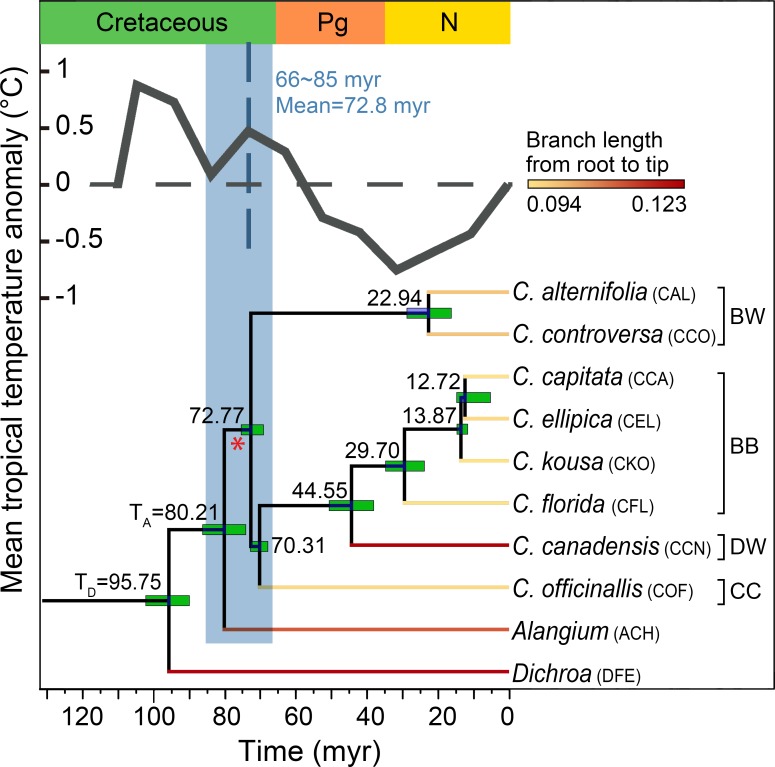
Fig 1. Phylogenetic reconstruction of the 10 study species using 51 single copy genes obtained from the transcriptome data.
Three letter acronyms are used to refer to each major lineage. The tree was dated with fossil calibration points. The blue bar represents the range of estimated times for the WGD events detected in the Cornus species analyzed in this study. The location of WDG with the highest likelihood score from the hypothesis testing analysis is marked with an asterisk. The sea surface temperatures inferred from the d18O data were placed above the tree [82]. Estimated branch length is scaled by color intensity.
Fig 2
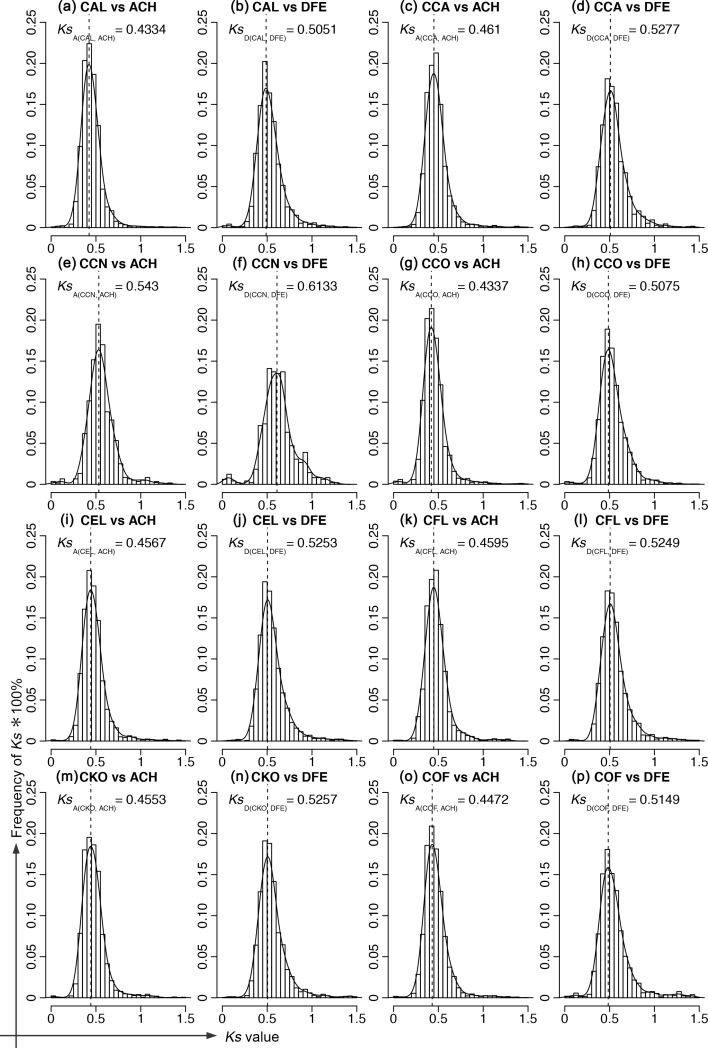
Fig 2. Distribution of synonymous substitutions Ks in orthologous pairs between species of Cornus and outgroups.
The x-axix is the value of Ks and the y-axix is frequency of Ks *100%. The black curve represents the kernel density estimate of the distributions, while the vertical black dashed lines represent its peak (used as the molecular clock CKs for dating paralogous Ks) as inferred from the density function.
Fig 3
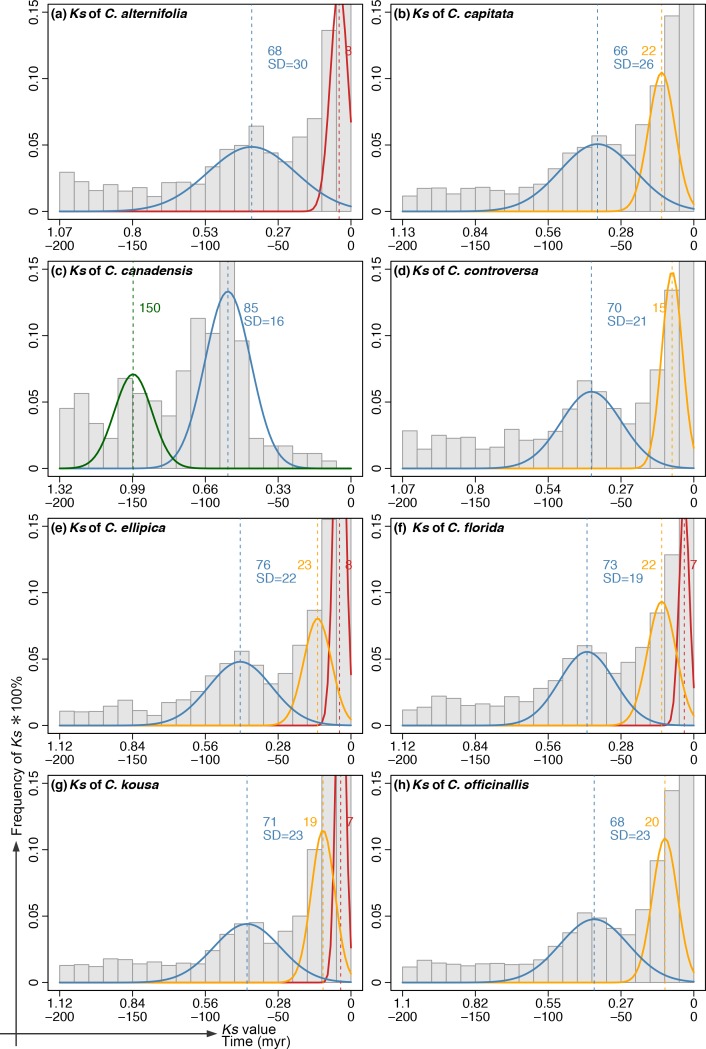
Fig 3
Frequency distribution of Ks values and corresponding ages of paralogous gene pairs in (a) C. alternifolia, (b) C. capitata, (c) C. canadensis, (d) C. controversa, (e) C. ellipica, (f) C. florida, (g) C. kousa, and (h) C. officinallis. Absolute ages were estimated using the Ks values with the molecular clock CKs calibrated for each species using outgroup references of Alangium and Dichlora (see Table 2). Normal distribution components of Ks were estimated using EMMIX (see Methods) and are superimposed on the histograms of the paralogous pair Ks plot (a-h). These components are hypothesized to be small-scale duplications (red and yellow curve), or whole genome duplications (green and blue yellow curve). The vertical green, blue, yellow and red dashed lines represent mean Ks values of the corresponding component (converted to absolute age). The estimated mean (and standard deviation) for each group was converted into absolute time using the clock of the corresponding species.
Fig 4
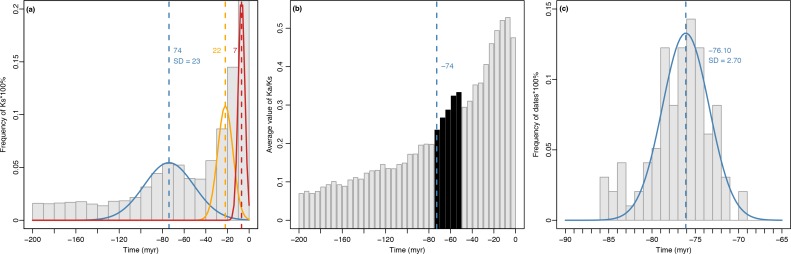
Fig 4. Frequency distributions of the ages and Ka/Ks values through time within a 200 million year window using combined data from all eight Cornus species and the frequency distributions of the dates of WGD in the Cornus ancestor inferred from gene tree method.
a. The frequency distributions of the ages of paralogous genes. The normal distribution components of ages estimated using EMMIX and colored according to those in Fig 3. The vertical dashed lines represent average absolute ages of corresponding components (or WGD). b. Ka/Ks values through time within a 200 million year window. The grey bars represent the average values of Ka/Ks in a increment of 5 myr. and evident increase of Ka/Ks values after the inferred WGD event (marked by the blue vertical line and black bars). c. The frequency distributions of the dates of gene duplications at the Cornus ancestral node (inferred as the WGD event) from 98 gene trees. The normal distribution components of dates estimated using EMMIX. The vertical blue dashed line represent average dates of component.

References

    1. Lynch M, Walsh B. The origins of genome architecture: Sinauer Associates Sunderland; 2007.
    1. Soltis PS, Soltis DE. Polyploidy and genome evolution: Springer; 2012.
    1. Wendel JF. Genome evolution in polyploids Plant molecular evolution: Springer; 2000. p. 225–49. - PubMed
    1. Wendel JF. The wondrous cycles of polyploidy in plants. American journal of botany. 2015;102(11):1753–6. 10.3732/ajb.1500320 - DOI - PubMed
    1. Stebbins C Jr. Variation and evolution in plants. Variation and evolution in plants. 1950.

LinkOut - more resources