. 2017 Apr:277:45-51.
doi: 10.1016/j.jmr.2017.02.009. Epub 2017 Feb 14.

Extruded dielectric sample tubes of complex cross section for EPR signal enhancement of aqueous samples

Affiliations

Extruded dielectric sample tubes of complex cross section for EPR signal enhancement of aqueous samples

Jason W Sidabras et al. J Magn Reson. 2017 Apr.

Abstract

This paper builds on the work of Mett and Hyde (2003) and Sidabras et al. (2005) where multiple flat aqueous sample cells placed perpendicular to electric fields in microwave cavities were used to reduce the RF losses and increase the EPR signal. In this work, we present three novel sample holders for loop-gap resonators (LGRs) and cylindrical cavity geometries. Two sample holders have been commissioned and built by polytetrafluoroethylene (PTFE) extrusion techniques: a 1mm O.D. capillary with a septum down the middle, named DoubleDee, and a 3.5mm O.D. star shaped sample holder, named AquaStar. Simulations and experimental results at X-band show that the EPR signal intensity increases by factors of 1.43 and 3.87 in the DoubleDee and AquaStar respectively, over the current TPX 0.9mm O.D. sample tube in a two-loop-one-gap LGR. Finally, combining the insight gained from the constructed sample holders and finite-element solutions, a third multi-lumen sample holder for a cylindrical TE011 cavity is optimized, named AquaSun, where simulations show an EPR signal intensity increase by a factor of 8.2 over a standard 1mm capillary.

Keywords: Aqueous samples; Cylindrical symmetry; Electron paramagnetic resonance; Loop-gap resonator; Multi-lumen sample holders.


Figures

Figure 1
Figure 1
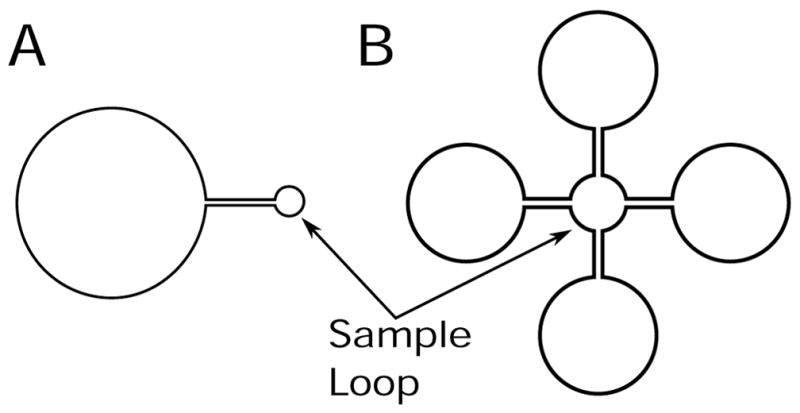
Two LGR geometries: (a) a two-loop–one-gap with a 1 mm sample loop and b) a five-loop–four-gap with a 5 mm sample loop.
Figure 2
Figure 2
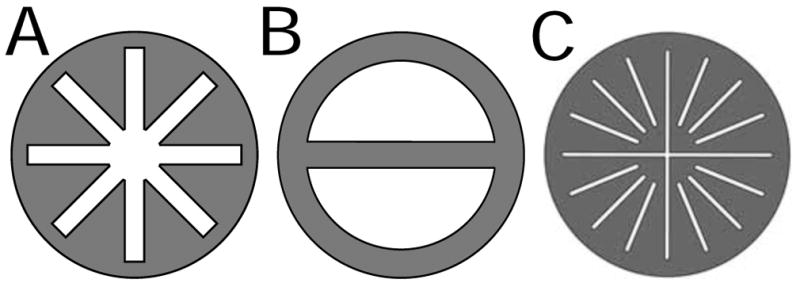
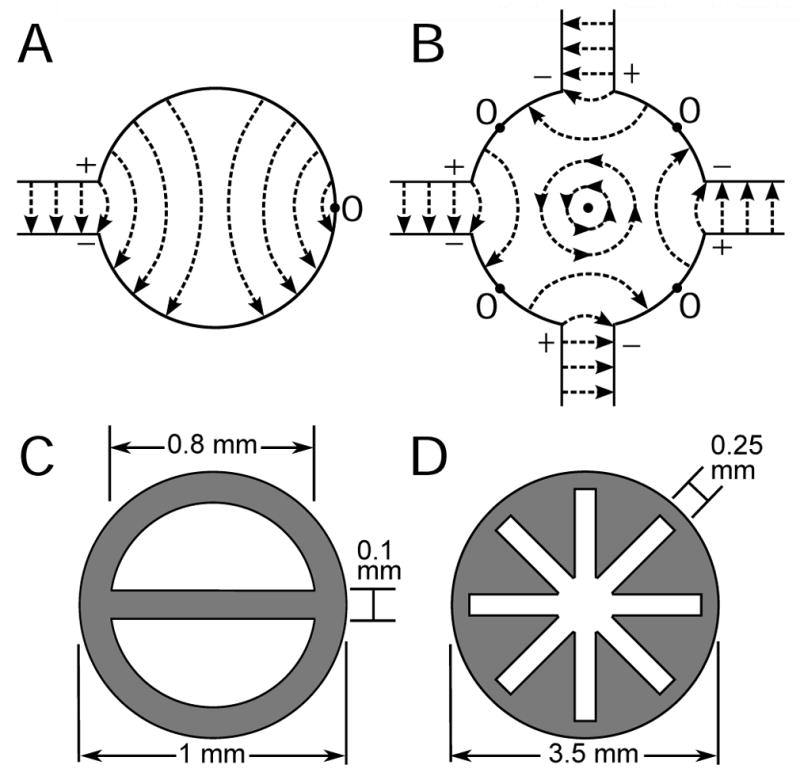
Three aqueous sample tube cross sections: (a) the AquaStar; (b) the DoubleDee; and (c) the AquaSun. Grey represents PTFE.
Figure 3
Figure 3
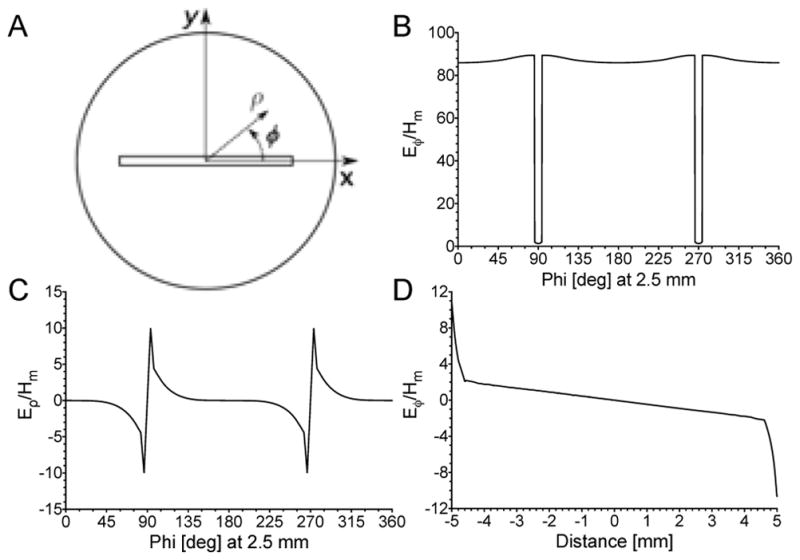
Cylindrical electric field components highlighting the three types of losses along a 2.5mm radius circle concentric within a TE011 cavity. A) Cross-section of a TE011 with a 8 × 0.2 mm flat-cell sample B) Electric field, Eϕ, showing the reduction of electric field in the sample from Type II losses, C) Electric field, Eρ, showing the tangential electric field null down the center of the sample cell, and D) Electric field, Eϕ, along the center of the sample showing the Type III complexity where the electric field increases towards the end of sample cell.
Figure 4
Figure 4
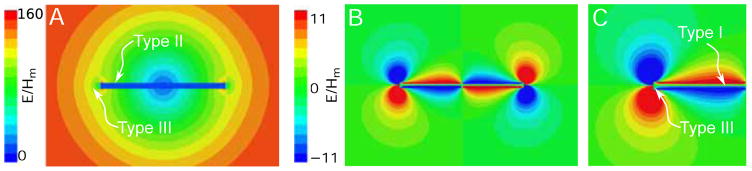
Electric field 2D plot showing the three types of losses established in Mett and Hyde [3] A) Plot of Eϕ showing Type II and Type III loss. B) Plot of Eρ showing the electric field tangential to the sample surface and C) a zoom of Eρ highlighting the Type I and Type III loss.
Figure 5
Figure 5
Illustration of the electric vector fields in the sample loop of A) a two-loop–one-gap 1.2 mm inner diameter and B) a five-loop–four-gap 5 mm inner diameter LGR. Shown are positions of zero electric field, marked as 0. Illustration of the two sample holder geometries with dimensions: C) the DoubleDee and D) the AquaStar.
Figure 6
Figure 6
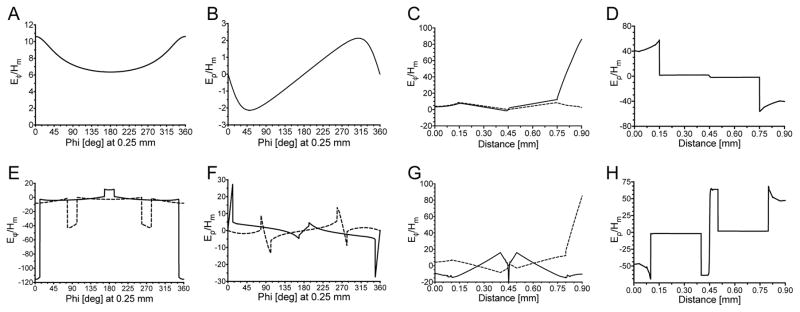
Electric field profiles comparing the TPX capillary (A–D) with the DoubleDee (E–H) in a 1 mm I.D. 2-loop–1-gap LGR. A) Eϕ and B) Eρ along a 0.25 mm radius circle concentric with the sample loop, showing an electric field peak at the LGR gap at 0°. C) Eϕ along the line parallel to the gap (solid) and perpendicular to the gap (dashed), D) Eρ perpendicular to the gap. E) Eϕ showing discontinuities of the electric field at the DoubleDee septum and F) Eρ showing tangential electric field null. Plots are for septum orientations perpendicular (solid) and parallel (dashed) to the electric field along a 0.5 mm concentric circle. G) Eϕ perpendicular to the gap for the septum orientation parallel to the gap (solid) and Eϕ parallel to the gap for the septum orientation perpendicular to the gap (dashed). H) Eρ perpendicular to the gap for the septum orientation parallel to the gap.
Figure 7
Figure 7
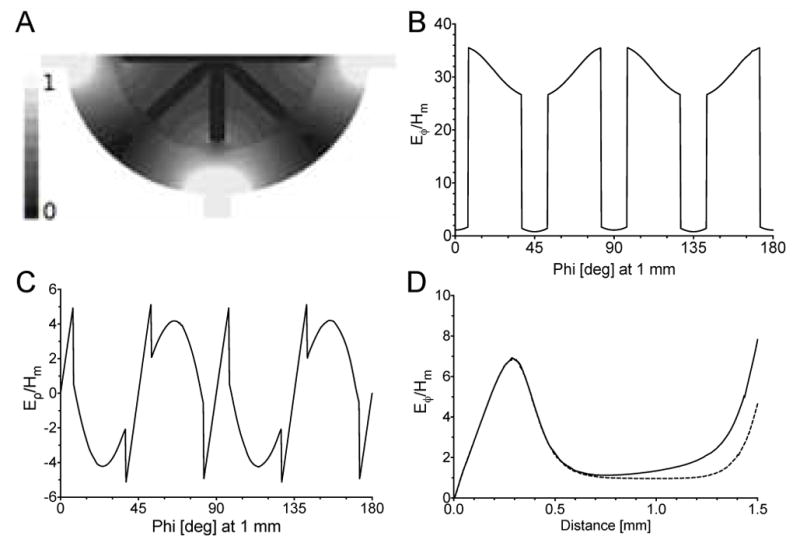
A) Electric field for the AquaStar geometry in the five-loop–four-gap LGR. B) Eϕ is plotted showing the Type II reduction in each sample cell and C) Eρ showing tangential electric field nulls in each sample cell at 45° increments. D) Eϕ along the center of the sample showing the Type III increase towards the end of sample cell for a cell parallel to the gap (solid) and parallel to the electric field null (dashed). Increase in electric field at 0.3 mm is formed from circulating tangential fields where the arms connect.
Figure 8
Figure 8
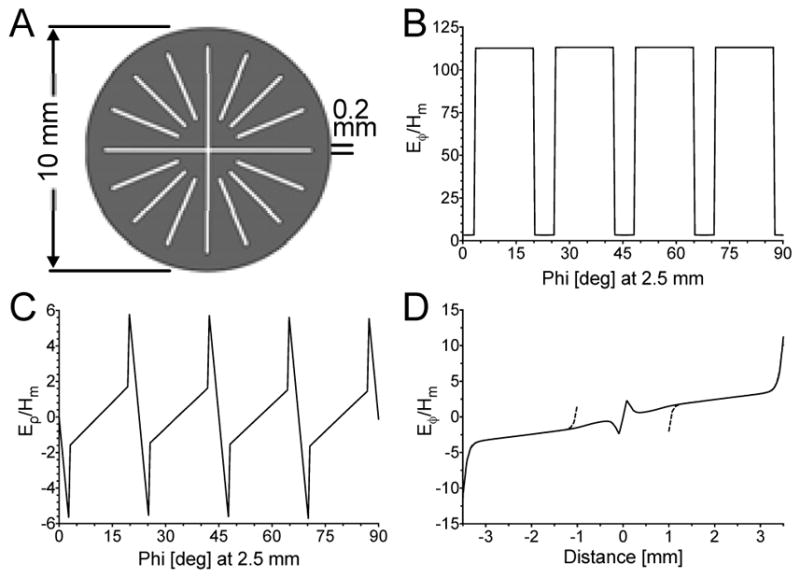
A) The proposed AquaSun sample tube designed for a cylindrical TE011 cavity, where each of the 12 azimuthal flat cells and two crossed flat cells are aligned with the perpendicular electric field in the azimuthal direction. Cylindrical electric field components are plotted: B) Eϕ showing the Type II reduction in each sample cell at a 2.5 mm radius; and C) Eρ showing tangential electric field nulls in each sample cell at 22.5° increments over half the circumference along the center of the flat cells. D) Eϕ along the center of the sample showing the Type III increase towards the end of the azimuthal sample cells (dashed) and through one of the crossed flat cells (solid). A small increase due to circulating electric fields occurs near the center.

References

    1. Hyde JS. A New Principle for Aqueous Sample Cells for EPR. Rev Sci Instr. 1972;43:629–631.
    1. Eaton SS, Eaton GR. Electron Paramagnetic Resonance Sample Cell for Lossy Samples. Anal Chem. 1977;49(8):1277–1278.
    1. Mett RR, Hyde JS. Aqueous Flat Cells Perpendicular to the Electric Field for Use in Electron Paramagnetic Resonance Spectroscopy. J of Magn Reson. 2003;165(1):137–152. - PubMed
    1. Sidabras JW, Mett RR, Hyde JS. Aqueous Flat-Cells Perpendicular to the Electric Field for Use in Electron Paramagnetic Resonance Spectroscopy, II: Design. J Magn Reson. 2005;172(2):333–341. - PubMed
    1. Hyde JS, Sidabras JW, Mett RR. Resonators for multifrequency epr of spin labels. In: Misra SK, editor. Multifrequency Electron Paramagnetic Resonance: Theory and Applications. Ch. 5.2. Wiley-VCH Verlag GmbH & Co. KGaA; Weinheim, Germany: 2011. pp. 244–269.

Publication types

LinkOut - more resources