


Epigenetic characteristics of the mitotic chromosome in 1D and 3D
- PMID: 28228067
- PMCID: PMC5456460
- DOI: 10.1080/10409238.2017.1287160
Epigenetic characteristics of the mitotic chromosome in 1D and 3D
Abstract
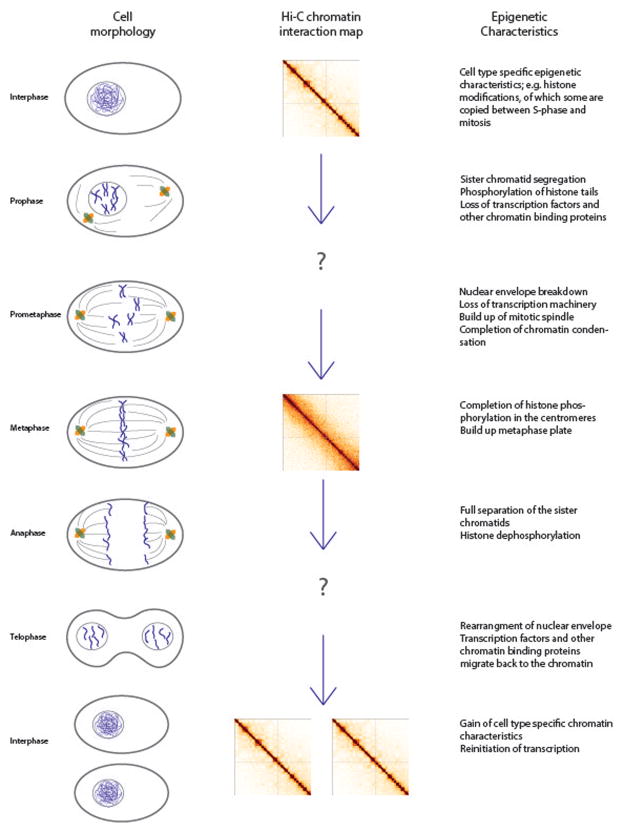
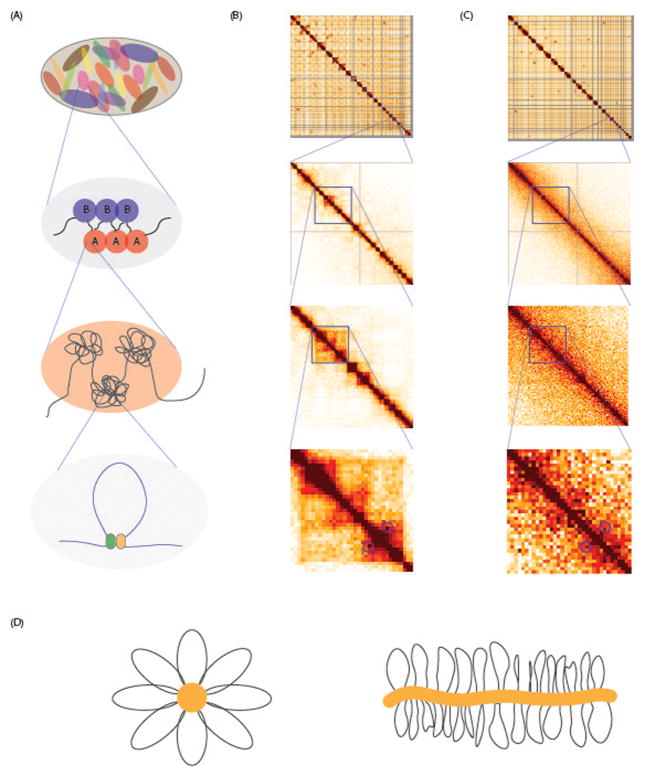
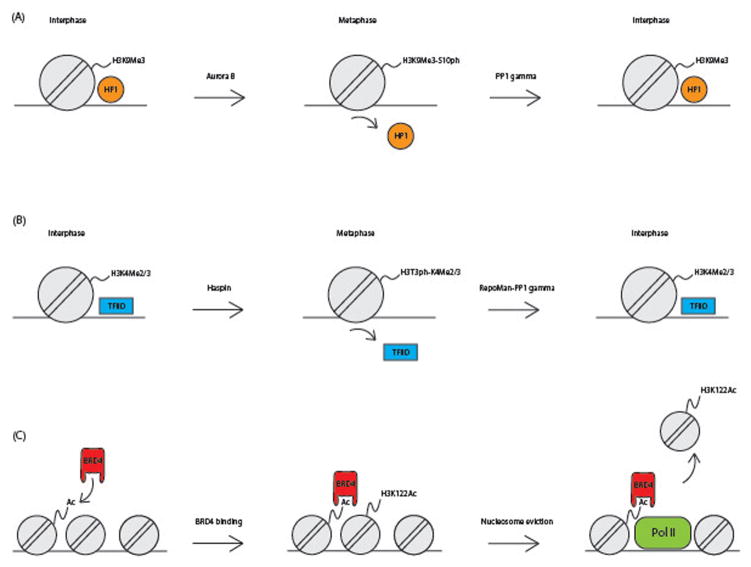
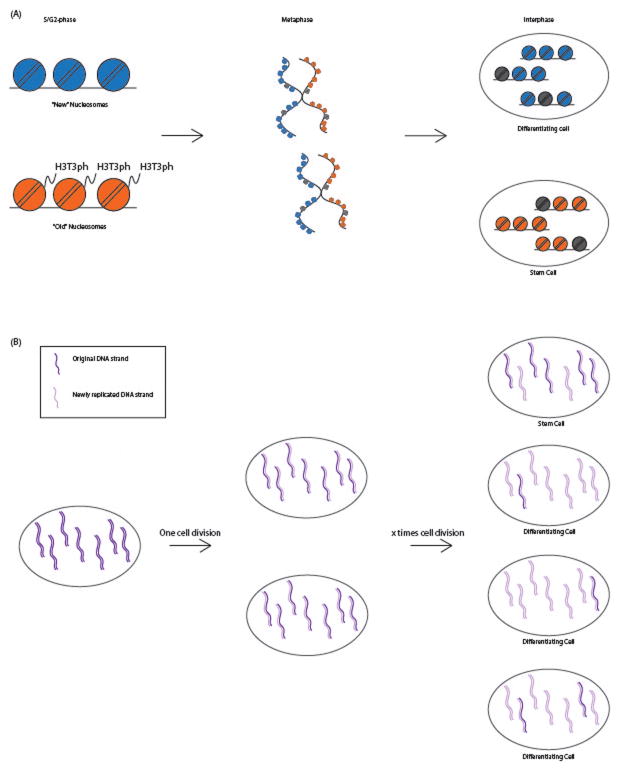
While chromatin characteristics in interphase are widely studied, characteristics of mitotic chromatin and their inheritance through mitosis are still poorly understood. During mitosis, chromatin undergoes dramatic changes: transcription stalls, chromatin-binding factors leave the chromatin, histone modifications change and chromatin becomes highly condensed. Many key insights into mitotic chromosome state and conformation have come from extensive microscopy studies over the last century. Over the last decade, the development of 3C-based techniques has enabled the study of higher order chromosome organization during mitosis in a genome-wide manner. During mitosis, chromosomes lose their cell type-specific and locus-dependent chromatin organization that characterizes interphase chromatin and fold into randomly positioned loop arrays. Upon exit of mitosis, cells are capable of quickly rearranging the chromosome conformation to form the cell type-specific interphase organization again. The information that enables this rearrangement after mitotic exit is thought to be encoded at least in part in mitotic bookmarks, e.g. histone modifications and variants, histone remodelers, chromatin factors, and non-coding RNA. Here we give an overview of the chromosomal organization and epigenetic characteristics of interphase and mitotic chromatin in vertebrates. Second, we describe different ways in which mitotic bookmarking enables epigenetic memory of the features of interphase chromatin through mitosis. And third, we explore the role of epigenetic modifications and mitotic bookmarking in cell differentiation.
Keywords: Chromatin organization; cell cycle; epigenetic memory; epigenetics; histone modification; mitosis; mitotic bookmarking.
Figures
References
-
- Ahmad K, Henikoff S. Centromeres are specialized replication domains in heterochromatin. Journal of Cell Biology. 2001;153(1):101–109. http://doi.org/10.1083/jcb.153.1.101. - DOI - PMC - PubMed
-
- Ahmad K, Henikoff S. The Histone Variant H3.3 Marks Active Chromatin by Replication-Independent Nucleosome Assembly ment are not clear. A study in Tetrahymena concluded that no protein difference between histone H3 variants was required for replacement histone deposition and Molecular. Cell. 2002;9:1191–1200. - PubMed
-
- Alabert C, Barth TK, Reveron-Gomez N, Sidoli S, Schmidt A, Jensen O, … Groth A. Two distinct modes for propagation of histone PTMs across the cell cycle. Genes and Development. 2015;29(6):585–590. http://doi.org/10.1101/gad.256354.114. - DOI - PMC - PubMed
-
- Alipour E, Marko JF. Self-organization of domain structures by DNA-loop-extruding enzymes. Nucleic Acids Research. 2012;40(22):11202–11212. http://doi.org/10.1093/nar/gks925. - DOI - PMC - PubMed
-
- Antonin W, Neumann H. Chromosome condensation and decondensation during mitosis. Current Opinion in Cell Biology. 2016;40:15–22. http://doi.org/10.1016/j.ceb.2016.01.013. - DOI - PubMed
Publication types
MeSH terms
Substances
Grants and funding
LinkOut - more resources
Full Text Sources
Other Literature Sources
