. 2017 May 1;312(5):R718-R726.
doi: 10.1152/ajpregu.00444.2016. Epub 2017 Feb 22.

Cough and expiration reflexes elicited by inhaled irritant gases are intensified in ovalbumin-sensitized mice

Affiliations

Cough and expiration reflexes elicited by inhaled irritant gases are intensified in ovalbumin-sensitized mice

Cheng Zhang et al. Am J Physiol Regul Integr Comp Physiol. .

Abstract

This study was designed to determine the effect of active sensitization with ovalbumin (Ova) on cough responses to inhaled irritant gases in mice. Conscious mice moved freely in a recording chamber, while the pressure change in the chamber and audio and video signals of the mouse movements were recorded simultaneously to measure the frequencies of cough reflex (CR) and expiration reflex (ER). To further verify the accuracy of cough analysis, the intrapleural pressure was also recorded by a telemetry sensor surgically implanted in the intrapleural space in a subgroup of mice. During the irritant gas inhalation challenge, sulfur dioxide (SO2; 200 and 400 ppm) or ammonia (NH3; 0.1% and 0.2%) was drawn into the chamber at a constant flow rate for 8 min. Ova sensitization and sham sensitization with vehicle (Veh) were performed over a 25-day period in separate groups of mice. Our results showed that 1) both SO2 and NH3 inhalation challenges increased CR and ER frequencies in a concentration-dependent manner before Ova sensitization; 2) the baseline CR frequency was significantly elevated after Ova sensitization, accompanied by pronounced airway inflammation; and 3) Ova sensitization also markedly augmented the responses of CR and ER to both SO2 and NH3 inhalation challenges; in sharp contrast, the cough responses did not change after sham sensitization in the Veh group. In conclusion, Ova sensitization caused distinct and lingering increases in baseline cough frequency, and also intensified both CR and ER responses to inhaled irritant gases, which probably resulted from an allergic inflammation-induced hypersensitivity of airway sensory nerves.

Keywords: airway; allergen cough; inflammation; inhaled irritants.


Figures

Fig. 1.
Fig. 1.
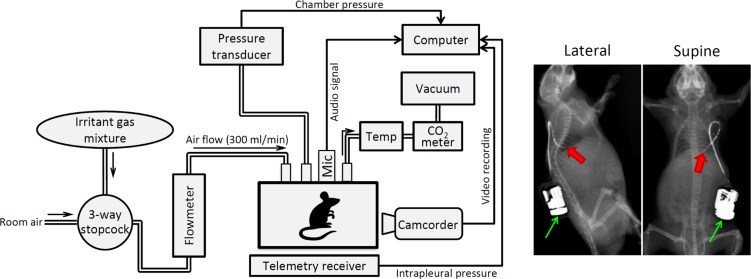
Left: schematic diagram of the experimental setup. Mic, microphone for recording audio signal; Temp, air temperature in the chamber measured by a thermometer. Right: X-ray pictures illustrating the positions of the telemetry sensor (red arrow) and transmitter (green arrow) implanted in the intrapleural space and under the lower back skin of a mouse, respectively. The telemetry catheter was painted with a radio opaque ink (Creative Materials, Ayer, MA) for identifying its position.
Fig. 2.
Fig. 2.
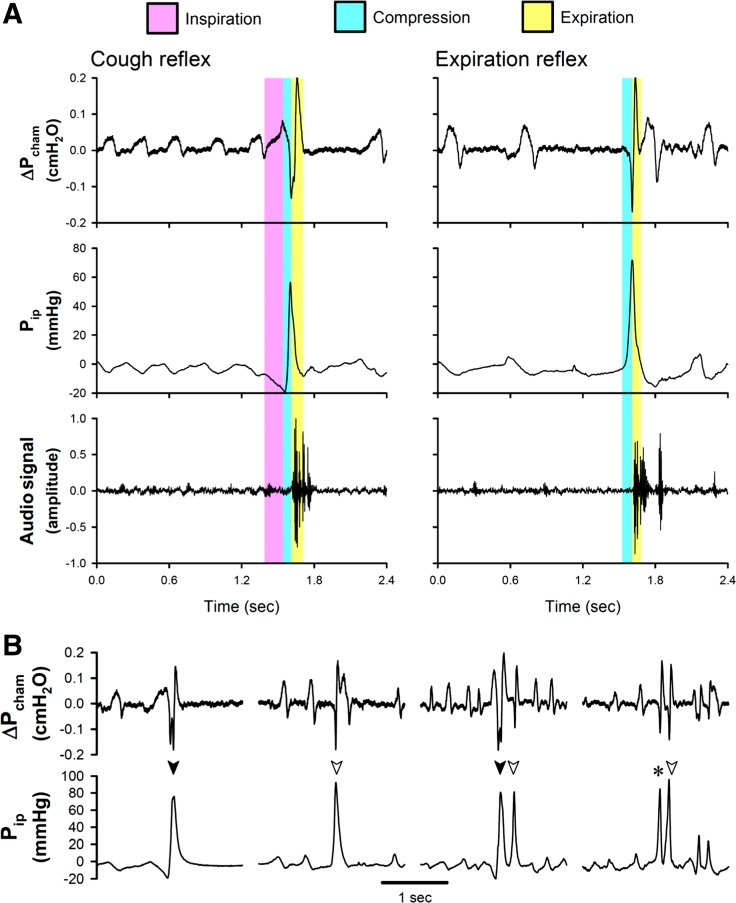
A: representative experimental records, illustrating the characteristic features of pressure changes and the audio signal generated by a single cough (cough reflex, CR; left) and a single expiration reflex (ER; right). B: additional experimental records (from left to right): a CR (solid arrowhead), an ER (open arrowhead), a cough epoch consisting of a combination of CR and ER, and a cough epoch of CR/ER and ER. CR/ER (asterisk) depicts the cough response that could not be distinguished between CR and ER. Pcham, pressure inside the chamber; Pip, intrapleural pressure recorded via the telemetry sensor in awake mice.
Fig. 3.
Fig. 3.
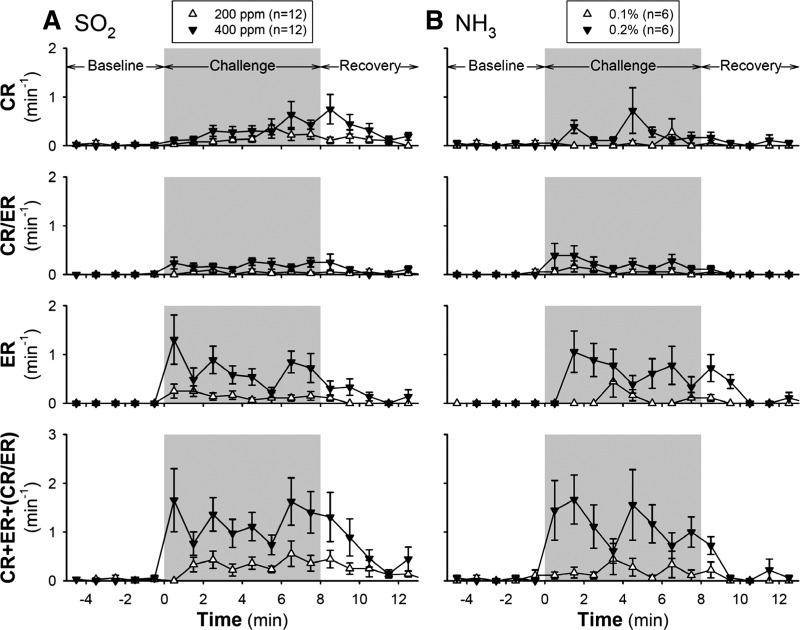
Changes in frequencies of CR and ER in response to inhalation challenges of SO2 (A) and NH3 (B) during control (before ovalbumin sensitization or vehicle treatment). CR/ER represented the response that could not be distinguished between CR and ER. Responses were recorded for 5 min before (baseline), 8 min during (gray shaded areas), and 5 min after the inhalation challenge (recovery). Responses to both low and high concentrations of each of the irritant gases (SO2: 200 ppm and 400 ppm; NH3: 0.1% and 0.2%) were tested, and at least 30 min elapsed between two consecutive challenges. Each test was repeated on three consecutive days in each mouse, and the data were averaged. Each data point represents the mean ± SE of all the animals tested.
Fig. 4.
Fig. 4.
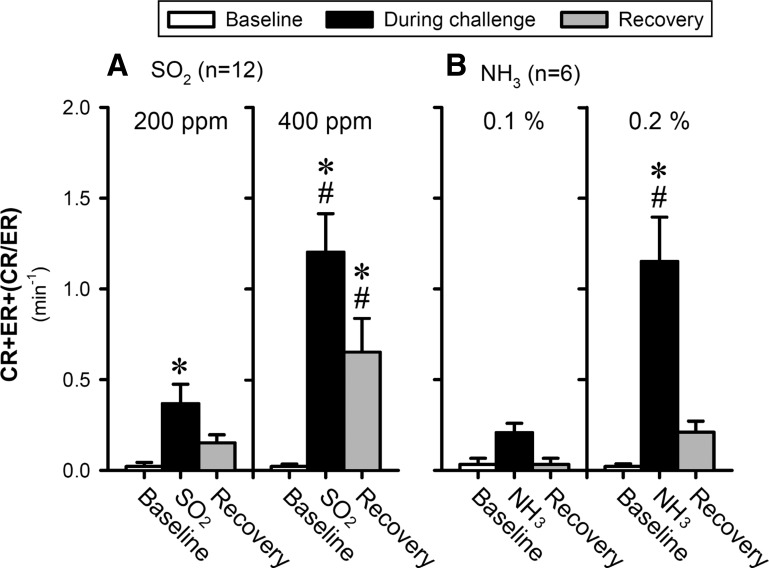
Group data of total cough responses (CR+ER+CR/ER) to inhalation challenges of SO2 (A) and NH3 (B) during control (before ovalbumin sensitization or vehicle treatment). Data (means ± SE) represent the group responses averaged over the 5-, 8- and 5-min durations of baseline, during challenge, and recovery, respectively; for details, see legend of Fig. 3. *Significantly (P < 0.05) different from the baseline data. #Significantly (P < 0.05) different from the responses to the low-concentration challenge.
Fig. 5.
Fig. 5.
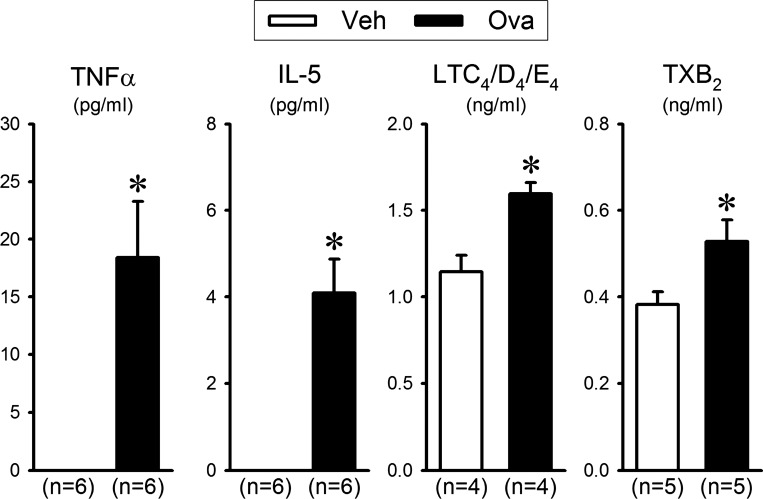
Effect of ovalbumin (Ova) sensitization on inflammatory mediators and cytokines in the bronchoalveolar lavage fluid (BALF) collected from the vehicle (Veh)-treated group (open bars) and Ova-sensitized group (solid bars). BALF was collected at 3–5 h after the last exposure to Ova or Veh aerosol. TNF-α, tumor necrosis factor-α; IL-5, interleukins 5; LTC4/D4/E4, leukotrienes C4/D4/E4; TXB2, thromboxane B2. Each data point represents the mean ± SE (n = the number of mice studied). Data were analyzed by the Studentʼs t-test. *Significantly different from the Veh group (P < 0.05). Concentrations of TNF-α and IL-5 were not detectable in the Veh group.
Fig. 6.
Fig. 6.
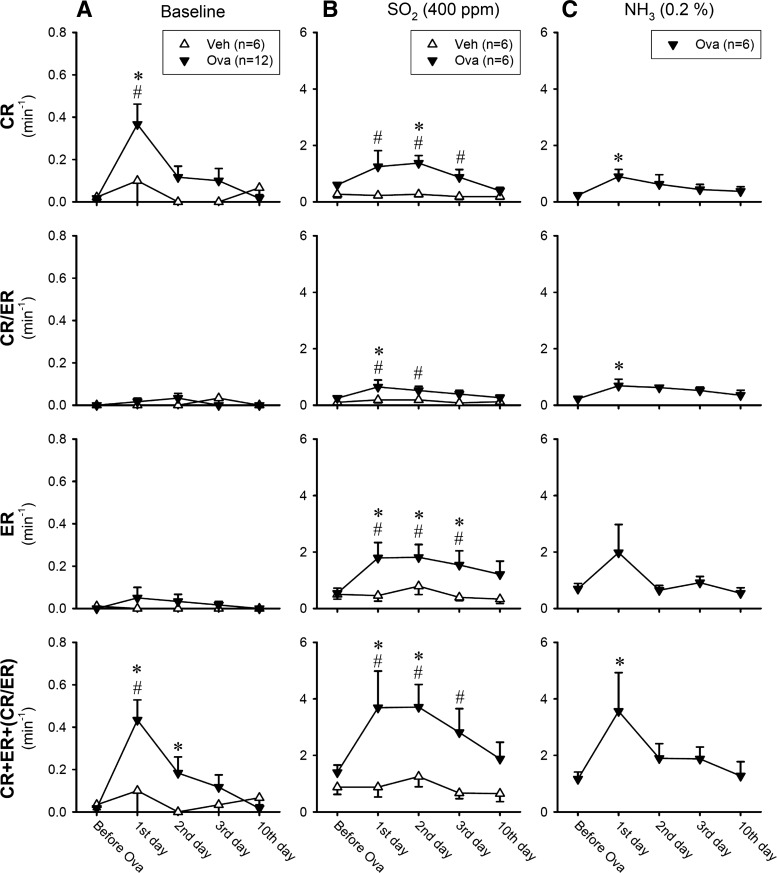
Effects of Ova sensitization and Veh treatment on the frequencies of cough reflex (CR) and expiration reflex (ER) in response to inhalation challenges of SO2 and NH3 at different time points after the treatment. CR/ER represented the response that could not be distinguished between CR and ER. A: baseline cough frequency averaged over the 5-min duration immediately before the irritant gas inhalation challenge. B and C: cough responses to SO2 (400 ppm) and NH3 (0.2%) inhalation challenges, respectively, averaged over the 8-min duration. In A, n = 12 in the Ova-sensitized group and n = 6 in the Veh-treated group; this difference is due to the fact that the response to NH3 was not tested in the Veh group (C). Each data point represents the mean ± SE. *Significantly (P < 0.05) different from the data obtained before Ova sensitization or Veh treatment. #Significantly (P < 0.05) different from the corresponding data point in the Veh group.
Fig. 7.
Fig. 7.
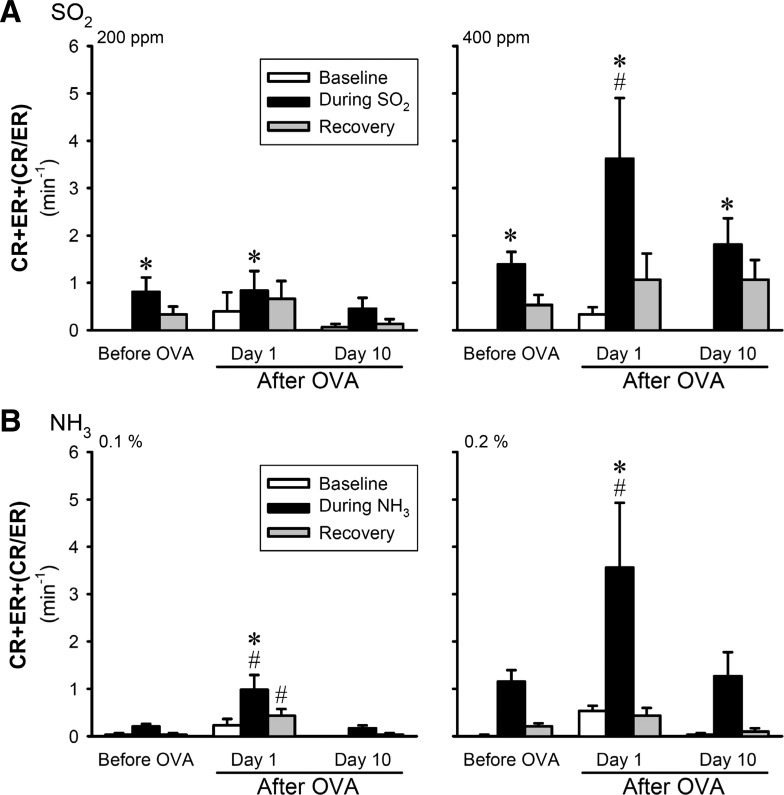
Potentiating effects of Ova sensitization on the total cough responses (CR+ER+CR/ER) to inhalation challenges of both low and high concentrations of SO2 (A) and NH3 (B) in awake mice. Data (means ± SE) represent the group responses averaged over the 5-, 8-, and 5-min durations of baseline, during challenge and recovery, respectively. *Significantly (P < 0.05) different from the baseline data (open bars). #Significantly (P < 0.05) different from the corresponding data obtained before Ova sensitization.

References

    1. Belvisi MG, Bolser DC. Summary: animal models for cough. Pulm Pharmacol Ther 15: 249–250, 2002. doi: 10.1006/pupt.2002.0349. - DOI - PubMed
    1. Busse WW, Lemanske RF Jr. Asthma. N Engl J Med 344: 350–362, 2001. doi: 10.1056/NEJM200102013440507. - DOI - PubMed
    1. Canning BJ, Mazzone SB, Meeker SN, Mori N, Reynolds SM, Undem BJ. Identification of the tracheal and laryngeal afferent neurones mediating cough in anaesthetized guinea-pigs. J Physiol 557: 543–558, 2004. doi: 10.1113/jphysiol.2003.057885. - DOI - PMC - PubMed
    1. Canning BJ, Mori N, Mazzone SB. Vagal afferent nerves regulating the cough reflex. Respir Physiol Neurobiol 152: 223–242, 2006. doi: 10.1016/j.resp.2006.03.001. - DOI - PubMed
    1. Caterina MJ, Schumacher MA, Tominaga M, Rosen TA, Levine JD, Julius D. The capsaicin receptor: a heat-activated ion channel in the pain pathway. Nature 389: 816–824, 1997. doi: 10.1038/39807. - DOI - PubMed

Publication types

MeSH terms