


Low FT3: a possible marker of frailty in the elderly
- PMID: 28228654
- PMCID: PMC5312686
- DOI: 10.2147/CIA.S125934
Low FT3: a possible marker of frailty in the elderly
Abstract
Introduction: Frailty is associated with a functional decline of multiple physiological systems, of which they may be a cause or consequence. The objective of the study was to evaluate the prevalence of thyroid hormone modifications in elderly frail subjects and its relationship with frailty.
Study population and methods: An observational study was carried out at the University Hospital "Tor Vergata" in Rome among ambulatory and hospitalized patients. The study population consisted of 112 elderly subjects: 62 were hospitalized following hip fracture and 50 control subjects were outpatients. Participating patients received a multidimensional geriatric evaluation. The Survey of Health, Ageing and Retirement in Europe Frailty Instrument (SHARE-FI) was used to assess the degree of frailty. Thyroid stimulating hormone (TSH), free triiodothyronine (FT3), and free thyroxine (FT4) were measured to evaluate thyroid status.
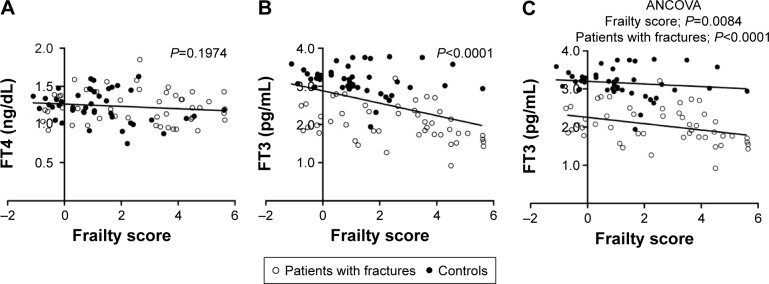
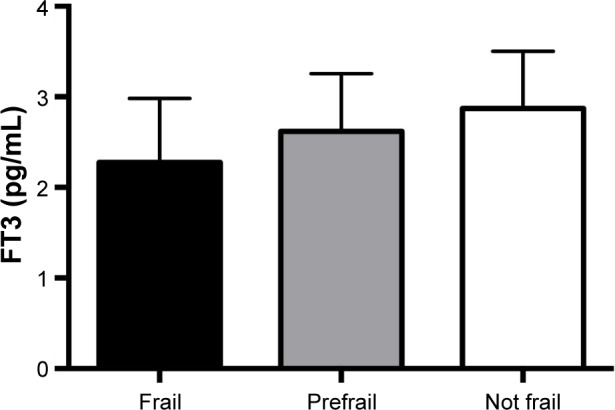
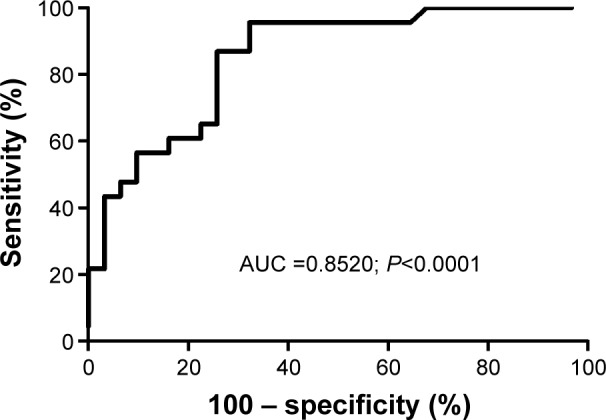
Results: FT3, but not FT4, was significantly correlated with Frailty score, both in patients with hip fracture and in patients from the control group. In the entire study population, FT3 under normal limits is effective in discriminating frail/prefrail subjects from nonfrail subjects.
Discussion: The reduction in serum concentrations of FT3 is a clear manifestation of stress associated with fractures. Numerous preexisting factors, such as the fracture patients' nutritional status, sarcopenia, disability and comorbidities, which characterize the condition of frailty and influence its pathogenesis, are strongly correlated with FT3 values, suggesting the existence of latent nonthyroidal illness syndrome (NTIS).
Conclusion: We conclude that measuring FT3 can be a useful laboratory parameter in clinical assessment, which can play an important role in identifying vulnerable elderly subjects and in quantifying the condition of frailty.
Keywords: FT3; NTIS; aging; frailty; hip fracture.
Conflict of interest statement
Disclosure The authors report no conflicts of interest in this work.
Figures
References
-
- ISTAT [homepage on the Internet] Previsioni della popolazione. [Population Projection] [Accessed December 1, 2016]. Available from: www.demo.istat.it.
-
- Fried LP, Tangen CN, Walston J, et al. Frailty in older adults: evidence for a phenotype. J Gerontol A Biol Sci Med Sci. 2001;56(3):M146–M156. - PubMed
-
- Hogan DB, MacKnight C, Bergman H. Models, definitions, and criteria of frailty. Aging Clin Exp Res. 2003;15(3 suppl):1–29. - PubMed
-
- Rockwood K, Andrew M, Mitnitski A. A comparison of two approaches to measuring frailty in elderly people. J Gerontol A Bio Sci Med Sci. 2007;62(7):738–743. - PubMed
Publication types
MeSH terms
Substances
LinkOut - more resources
Full Text Sources
Other Literature Sources
Medical
