Review
. 2017 Feb 8:8:65.
doi: 10.3389/fimmu.2017.00065. eCollection 2017.

Proofreading of Peptide-MHC Complexes through Dynamic Multivalent Interactions

Affiliations
Review

Proofreading of Peptide-MHC Complexes through Dynamic Multivalent Interactions

Christoph Thomas et al. Front Immunol. .

Abstract

The adaptive immune system is able to detect and destroy cells that are malignantly transformed or infected by intracellular pathogens. Specific immune responses against these cells are elicited by antigenic peptides that are presented on major histocompatibility complex class I (MHC I) molecules and recognized by cytotoxic T lymphocytes at the cell surface. Since these MHC I-presented peptides are generated in the cytosol by proteasomal protein degradation, they can be metaphorically described as a window providing immune cells with insights into the state of the cellular proteome. A crucial element of MHC I antigen presentation is the peptide-loading complex (PLC), a multisubunit machinery, which contains as key constituents the transporter associated with antigen processing (TAP) and the MHC I-specific chaperone tapasin (Tsn). While TAP recognizes and shuttles the cytosolic antigenic peptides into the endoplasmic reticulum (ER), Tsn samples peptides in the ER for their ability to form stable complexes with MHC I, a process called peptide proofreading or peptide editing. Through its selection of peptides that improve MHC I stability, Tsn contributes to the hierarchy of immunodominant peptide epitopes. Despite the fact that it concerns a key event in adaptive immunity, insights into the catalytic mechanism of peptide proofreading carried out by Tsn have only lately been gained via biochemical, biophysical, and structural studies. Furthermore, a Tsn homolog called TAP-binding protein-related (TAPBPR) has only recently been demonstrated to function as a second MHC I-specific chaperone and peptide proofreader. Although TAPBPR is PLC-independent and has a distinct allomorph specificity, it is likely to share a common catalytic mechanism with Tsn. This review focuses on the current knowledge of the multivalent protein-protein interactions and the concomitant dynamic molecular processes underlying peptide-proofreading catalysis. We do not only derive a model that highlights the common mechanistic principles shared by the MHC I editors Tsn and TAPBPR, and the MHC II editor HLA-DM, but also illustrate the distinct quality control strategies employed by these chaperones to sample epitopes. Unraveling the mechanistic underpinnings of catalyzed peptide proofreading will be crucial for a thorough understanding of many aspects of immune recognition, from infection control and tumor immunity to autoimmune diseases and transplant rejection.

Keywords: MHC; adaptive immunity; antigen presentation; molecular tug-of-war; peptide editing; peptide-loading complex; quality control; tapasin.


Figures

Figure 1
Figure 1
Molecular environment of tapasin (Tsn) within the peptide-loading complex (PLC). Structural organization of the PLC. The individual components of the PLC are shown according to their domain organization. Tsn, covalently linked to the oxidoreductase ERp57 through a disulfide bridge (yellow line), interacts via its transmembrane region with the heterodimeric ATP-binding cassette transporter TAP1/2, which shuttles antigenic peptides across the endoplasmic reticulum (ER) membrane in an ATP-dependent manner. The monoglucosylated (G) N-glycan of the MHC I is shown as white branched lines. This multivalent interaction network localizes recruited calreticulin-associated MHC I molecules directly at the peptide source, facilitating selection of high-affinity epitopes.
Figure 2
Figure 2
Model of the tapasin (Tsn)–major histocompatibility complex class I (MHC I) interaction. Cartoon representation of the predicted Tsn–MHC I complex, based on multi-microsecond all-atom MD simulations, for which the crystal structures of the lumenal portions of Tsn and HLA-B*44:02 were used as starting models (40, 55). There are two distinct interfaces, one between the N-terminal (distal) domain of Tsn and the α2-1-helix region of the MHC I heavy chain (MHC I hc) (A), the other between the membrane-proximal domain of Tsn and the α3 domain of the MHC I hc (B). Residues predicted to be part of the interfaces are shown as sticks in the close-up views. β2m, β2-microglobulin.
Figure 3
Figure 3
Proposed model of tapasin (Tsn)-catalyzed peptide proofreading. According to the model of Tsn-catalyzed peptide proofreading, Tsn scans the quality of major histocompatibility complex class I (MHC I)-bound peptides with regard to their affinity by sensing and acting on the α2-1 helix, a structural element close to the C-terminal anchor region of the peptide (F pocket). Intrinsic flexibility of the α2-1 helix is depicted by cartoon-blur semicircles. Peptide dissociation in the absence of Tsn can result in partial unfolding of the MHC molecule. Upon being confronted with a suboptimally loaded MHC I molecule (step 1), Tsn presumably stabilizes an open conformation of the binding groove by interacting with the α2-1 helix, inducing peptide dissociation and stabilizing the resulting empty MHC (step 2). Only high-affinity peptides can subsequently compete with Tsn over the α2-1 helix to tighten the binding groove again (step 3). This lowers the Tsn–MHC affinity and eventually triggers Tsn dissociation (step 4). As a result, the peptide repertoire presented on MHC I at the cell surface is enriched with high-affinity peptide epitopes capable of triggering an immune response (step 5). The quintessence of the MHC I peptide-proofreading mechanism might be considered as a tug-of-war between Tsn and the peptide over the α2-1 helix and the opening/closing of the binding groove.
Figure 4
Figure 4
Energy level diagram of the peptide exchange reaction. Energy level diagram of the un-catalyzed and catalyzed peptide exchange reaction (energy levels are qualitative and not drawn to scale). In its function as a peptide exchange catalyst, tapasin stabilizes the high-energy intermediate of the empty MHC I molecule. Stabilizing this high-energy intermediate lowers the energy barrier (ΔΔG) of the exchange reaction and hence increases the rate of peptide exchange toward the thermodynamically most favored high-affinity peptide.
Figure 5
Figure 5
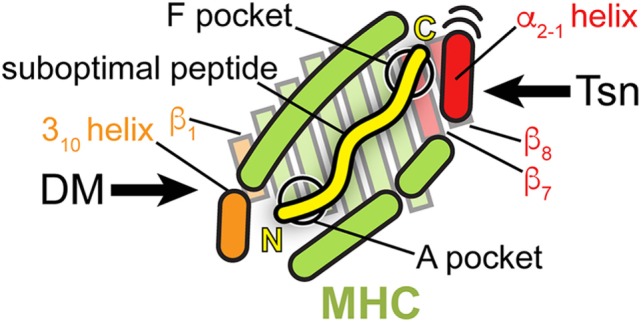
Peptide proofreading by tapasin (Tsn) and DM—a structural comparison. A top view of the MHC peptide-binding groove is shown schematically, highlighting structural elements, which the two peptide editors interact with during catalysis (orange: DM; red: Tsn). Bound peptide is indicated by a yellow line (N, N-terminus; C, C-terminus). Please note that the cartoon, including the length of the peptide, is a simplified depiction combining features of class I and class II MHC. Structural elements of MHC interacting with DM are close to the N-terminus of the peptide; those elements, which Tsn acts on, are in the vicinity of the F pocket of MHC I at the C-terminus of the peptide.

References

    1. Rock KL, Reits E, Neefjes J. Present yourself! By MHC class I and MHC class II molecules. Trends Immunol (2016) 37(11):724–37.10.1016/j.it.2016.08.010 - DOI - PMC - PubMed
    1. Eggensperger S, Tampé R. The transporter associated with antigen processing: a key player in adaptive immunity. Biol Chem (2015) 396:1059–72.10.1515/hsz-2014-0320 - DOI - PubMed
    1. Blum JS, Wearsch PA, Cresswell P. Pathways of antigen processing. Annu Rev Immunol (2013) 31:443–73.10.1146/annurev-immunol-032712-095910 - DOI - PMC - PubMed
    1. Mayerhofer PU, Tampé R. Antigen translocation machineries in adaptive immunity and viral immune evasion. J Mol Biol (2015) 427:1102–18.10.1016/j.jmb.2014.09.006 - DOI - PubMed
    1. Williams AP, Peh CA, Purcell AW, McCluskey J, Elliott T. Optimization of the MHC class I peptide cargo is dependent on tapasin. Immunity (2002) 16:509–20.10.1016/S1074-7613(02)00304-7 - DOI - PubMed