


"Tennis leg": gastrocnemius injury is a far more common cause than plantaris rupture
- PMID: 28228893
- PMCID: PMC5310238
- DOI: 10.1016/j.radcr.2016.10.012
"Tennis leg": gastrocnemius injury is a far more common cause than plantaris rupture
Abstract
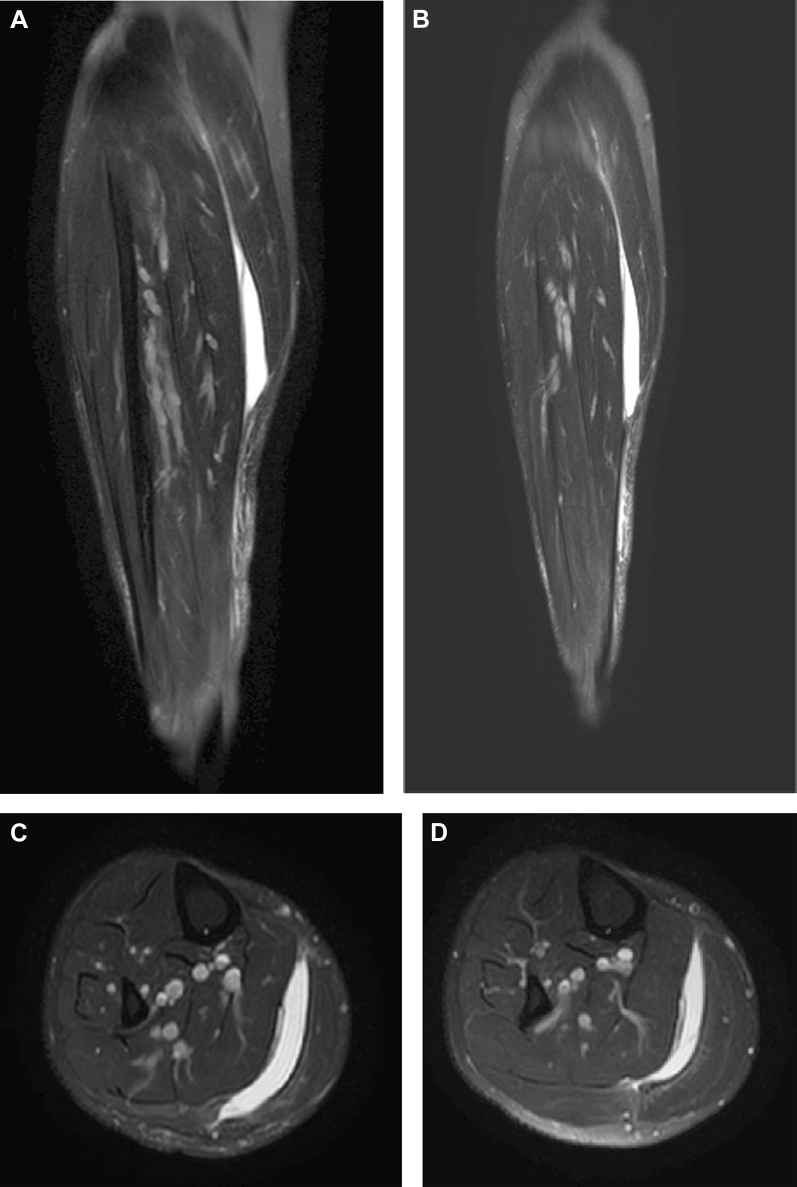
We report a typical case of "tennis leg", in which the main finding was a fluid collection between the medial head of the gastrocnemius and soleus muscles. Since the first clinical description of this entity in 1883, the injury has been attributed to rupture of the plantaris tendon. However, recent studies of this condition with sonography and magnetic resonance imaging have shown that most of these cases are actually due to injury to the gastrocnemius and/or soleus muscles, and up to 10% are due to deep venous thrombosis masquerading as muscle injury. The plantaris muscle and tendon are only rarely involved in this injury.
Keywords: Deep vein thrombosis; Gastrocnemius; Plantaris tendon; Tennis leg.
Figures
References
-
- Delgado G.J., Chung C.B., Lektrakul N., Azocar P., Botte M.J., Coria D. Tennis leg: clinical US study of 141 patients and anatomic investigation of four cadavers with MR imaging and US. Radiology. 2002;224:112–119. - PubMed
-
- Powell R.W. Lawn tennis leg. Lancet. 1883;122(3123):44.
-
- Helms C.A., Fritz R.C., Garvin G.J. Plantaris muscle injury: evaluation with MR imaging. Radiology. 1995;195:201–203. - PubMed
-
- Pacheco R.A., Stock H. Tennis leg: mechanism of injury and radiographic presentation. Conn Med. 2013;77:427–430. - PubMed
Publication types
LinkOut - more resources
Full Text Sources
Other Literature Sources
