


Examining the relationship between infectious diseases and flooding in Europe: A systematic literature review and summary of possible public health interventions
- PMID: 28228994
- PMCID: PMC5314884
- DOI: 10.4161/dish.25216
Examining the relationship between infectious diseases and flooding in Europe: A systematic literature review and summary of possible public health interventions
Abstract
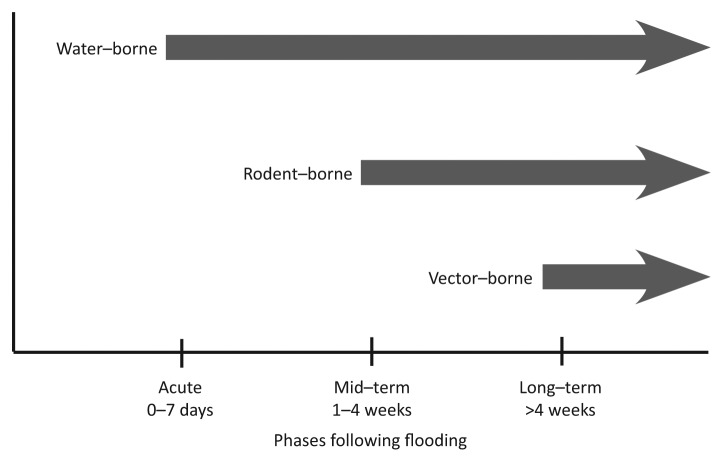
Introduction Many infectious diseases are sensitive to climatic changes; specifically, flooding. This systematic literature review aimed to strengthen the quality and completeness of evidence on infectious diseases following flooding, relevant to Europe. Methods A systematic literature review from 2004-2012 was performed. Focused searches of the following databases were conducted: Medline, Scopus, PubMed, Cochrane Library, and Evidence Aid. Personal communications with key informants were also reviewed. Results Thirty-eight studies met the inclusion criteria. Evidence suggested that water-borne, rodent-borne, and vector-borne diseases have been associated with flooding in Europe, although at a lower incidence than developing countries. Conclusion Disease surveillance and early warning systems, coupled with effective prevention and response capabilities, can reduce current and future vulnerability to infectious diseases following flooding.
Keywords: climate change; flooding; infectious diseases; natural disaster; rodent-borne; vector-borne; water-borne.
Figures
References
-
- Few R. Flood hazards, vulnerability, and risk reduction. In: [Few R and Matthies F, eds] Flood hazards and health: Responding to present and future risks. Tyndall Centre for Climate Change Research. 2006. Earthscan.
-
- Adikari Y, Yoshitani J. Global trends in water-related disasters: An insight for policy-makers. The United Nations world water assessment program. International center for water hazard and risk management. 2009. Available from: http://unesdoc.unesco.org/images/0018/001817/181793e.pdf [Accessed on 6/6/12].
-
- Keim ME. . Building human resilience: the role of public health preparedness and response as an adaptation to climate change. Am J Prev Med 2008; 35:508 - 16; http://dx.doi.org/ 10.1016/j.amepre.2008.08.022; PMID: 18929977 - DOI - PubMed
-
- Jakubicka T, Vos F, Phalkey R, Marx M. Health impacts of floods in Europe: data gaps and needs from a spatial perspective. A MICRODIS REPORT. CRED. 2010. Available from: http://www.preventionweb.net/files/19820_healthimpactsoffloodsineurope1.pdf [Accessed on 7/6/12].
-
- Barredo JI. . Major flood disasters in Europe: 1950–2005. Nat Hazards 2007; 42:125 - 48; http://dx.doi.org/ 10.1007/s11069-006-9065-2 - DOI
Publication types
LinkOut - more resources
Full Text Sources
Other Literature Sources
Miscellaneous
