


Detection and molecular characterization of the mosquito-borne filarial nematode Setaria tundra in Danish roe deer (Capreolus capreolus)
- PMID: 28229043
- PMCID: PMC5312512
- DOI: 10.1016/j.ijppaw.2017.01.002
Detection and molecular characterization of the mosquito-borne filarial nematode Setaria tundra in Danish roe deer (Capreolus capreolus)
Abstract
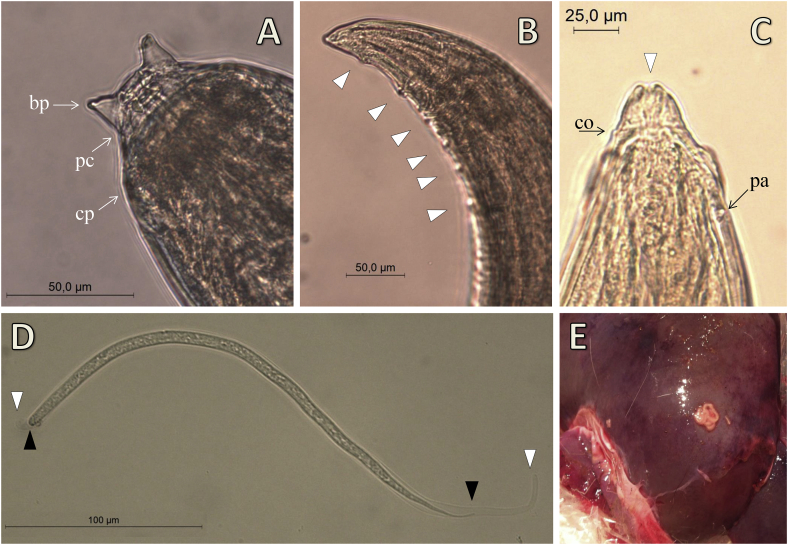
Setaria tundra is a mosquito-borne filarial nematode of cervids in Europe. It has recently been associated with an emerging epidemic disease causing severe morbidity and mortality in reindeer and moose in Finland. Here, we present the first report of S. tundra in six roe deer (Capreolus capreolus) collected between October 2010 and March 2014 in Denmark. The deer originated from various localities across the country: the eastern part of the Jutland peninsular and four locations on the island Zealand. With the exception of one deer, with parasites residing in a transparent cyst just under the liver capsule, worms (ranging from 2 to >20/deer) were found free in the peritoneal cavity. The worms were identified as S. tundra by morphological examination and/or molecular typing of the mitochondrial 12S rRNA and cox1 genes, which showed 99.1-99.8% identity to previously published S. tundra isolates from Europe. Roe deer are generally considered as asymptomatic carriers and their numbers in Denmark have increased significantly in recent decades. In light of climatic changes which result in warmer, more humid weather in Scandinavia greater numbers of mosquitoes and, especially, improved conditions for development of parasite larvae in the mosquito vectors are expected, which may lead to increasing prevalence of S. tundra. Monitoring of this vector-borne parasite may thus be needed in order to enhance the knowledge of factors promoting its expansion and prevalence as well as predicting disease outbreaks.
Keywords: Filarial nematode; Meat hygiene; Peritoneal cavity; Roe deer; Setaria tundra; Vector borne.
Figures



References
-
- Alasaad S., Pascucci I., Jowers M.J., Soriguer R.C., Zhu X.-Q., Rossi L. Phylogenetic study of Setaria cervi based on mitochondrial cox1 gene sequences. Parasitol. Res. 2012;110:281–285. - PubMed
-
- Anderson R.C. The superfamily Filarioidea. In: Anderson R.C., editor. Nematode Parasites of Vertebrates; Their Development and Transmission (2nd Ed) CABI Publishing; New York: 2000. pp. 467–529.
-
- Andrews J.R., Hörning B., Wandeler A. Endoparasites of roe deer (Capreolus capreolus L.) from Switzerland with special reference to hosts from the Emmental region of Canton Berne. Rev. Suisse. Zool. 1974;81:13–24. - PubMed
-
- Angelone-Alasaad S., Jowers M.J., Panadero R., Pérez-Creo A., Pajares G., Díez-Baños P., Soriguer R.C., Morrondo P. First report of Setaria tundra in roe deer (Capreolus capreolus) from the Iberian Peninsula inferred from molecular data: epidemiological implications. Parasit. Vectors. 2016;9(1):521. - PMC - PubMed
-
- Asferg T. Aarhus University, Institut for Bioscience; 2012. Hunting Yield for Hunting Season 2011/12, Memo from DCE - National Centre for Environment and Energy. (in Danish) Published on 15. October/2012.
LinkOut - more resources
Full Text Sources
Other Literature Sources
Miscellaneous
