


Internalizing and Externalizing Problem Behavior: a Test of a Latent Variable Interaction Predicting a Two-Part Growth Model of Adolescent Substance Use
- PMID: 28229368
- PMCID: PMC5568518
- DOI: 10.1007/s10802-017-0277-6
Internalizing and Externalizing Problem Behavior: a Test of a Latent Variable Interaction Predicting a Two-Part Growth Model of Adolescent Substance Use
Abstract
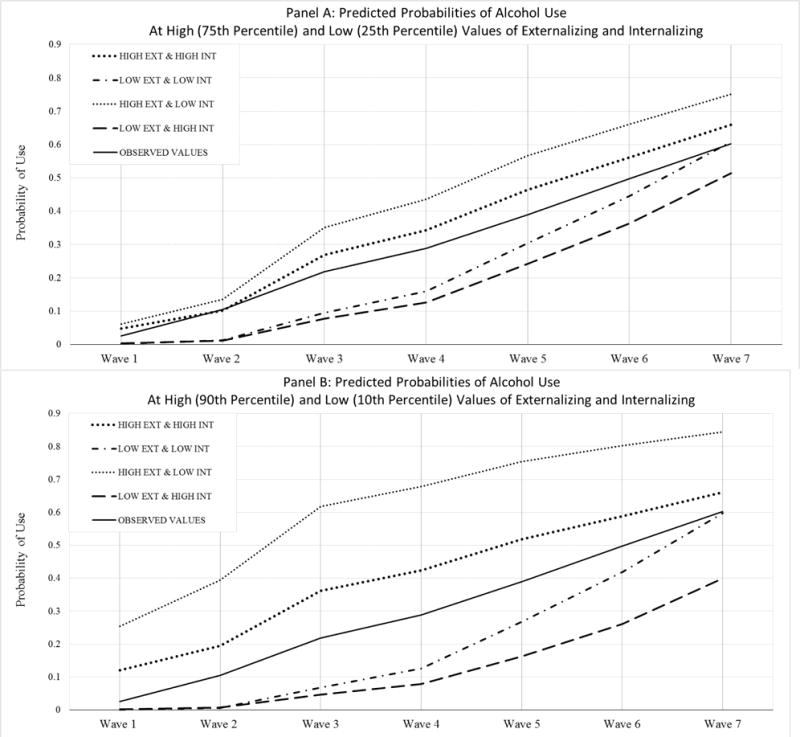
Externalizing symptoms robustly predict adolescent substance use (SU); however, findings regarding internalizing symptoms have been mixed, suggesting that there may be important moderators of the relationship between internalizing problems and SU. The present study used a longitudinal community sample (N = 387, 55% female, 83% White) to test whether externalizing symptoms moderated the relationship between internalizing symptoms and trajectories of alcohol and marijuana use from early (age 11-12 years old) to late (age 18-19 years old) adolescence. Two-part latent growth models were used to distinguish trajectories of probability of use from trajectories of amount of use among users. Results suggested that externalizing symptoms moderated the association between internalizing symptoms and probability of alcohol, but not marijuana use. The highest probability of alcohol use was observed at high levels of externalizing symptoms and low levels of internalizing symptoms. A negative protective effect of internalizing symptoms on probability of alcohol use was strongest in early adolescence for youth high on externalizing symptoms. Although moderation was not supported for amount of use among users, both domains of symptomology were associated with amount of alcohol and marijuana use as first-order effects. High levels of externalizing symptoms and low levels of internalizing symptoms were associated with high levels of amount of use among users. These findings suggest that developmental models of substance use that incorporate internalizing symptomology should consider the context of externalizing problems and distinguish probability and amount of use.
Keywords: Externalizing problems; Internalizing problems; Substance use; Trajectories.
Conflict of interest statement
Conflict of Interest: The authors declare that they have no conflict of interest.
Figures
References
-
- Achenbach TM, Rescorla LA. Youth Self-Report for Ages 11–18. Burlington, VT: ASEBA; 2001.
-
- Bollen KA, Curran PJ. Latent curve models: A structural equation perspective. Vol. 467. Hoboken, NJ: John Wiley & Sons; 2006.
-
- Borsari B, Carey KB. Injunctive and descriptive norms in college drinking: A review of the research. Journal of Substance Abuse. 2003;13:391–424. - PubMed
-
- Brown EC, Catalano RF, Fleming CB, Haggerty KP, Abbott RD. Adolescent substance use outcomes in the Raising Healthy Children project: A two-part latent growth curve analysis. Journal of Consulting and Clinical Psychology. 2005;73:699–710. - PubMed
Publication types
MeSH terms
Grants and funding
LinkOut - more resources
Full Text Sources
Other Literature Sources
Medical
