


Hair cortisol and adiposity in a population-based sample of 2,527 men and women aged 54 to 87 years
- PMID: 28229550
- PMCID: PMC5324577
- DOI: 10.1002/oby.21733
Hair cortisol and adiposity in a population-based sample of 2,527 men and women aged 54 to 87 years
Abstract
Objective: Chronic cortisol exposure is hypothesized to contribute to obesity. This study examined associations between hair cortisol concentrations, a novel indicator of long-term cortisol exposure, and adiposity in a large population-based sample.
Methods: Data were from 2,527 men and women aged 54 and older (98% white British) participating in the English Longitudinal Study of Ageing. Hair cortisol concentrations were determined from the scalp-nearest 2 cm hair segment, and height, weight, and waist circumference were objectively measured. Covariates included age, sex, socioeconomic status, smoking status, diabetes, and arthritis.
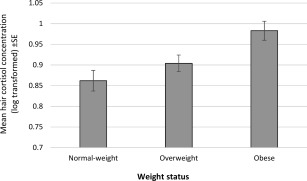
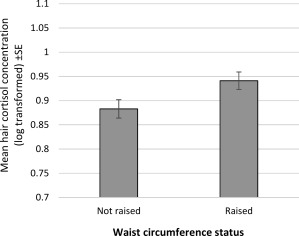
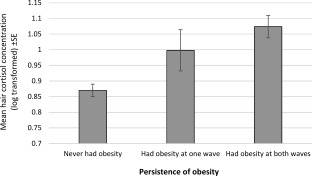
Results: In cross-sectional analyses, hair cortisol concentrations were positively correlated with weight (r = 0.102, P < 0.001), BMI (r = 0.101, P < 0.001), and waist circumference (r = 0.082, P = 0.001) and were significantly elevated in participants with obesity (BMI ≥30 kg/m2 ) (F = 6.58, P = 0.001) and raised waist circumference (≥102 cm in men, ≥88 cm in women) (F = 4.87, P = 0.027). Hair cortisol levels were also positively associated with the persistence of obesity (F = 12.70, P < 0.001), evaluated in retrospect over 4 years.
Conclusions: Chronic exposure to elevated cortisol concentrations, assessed in hair, is associated with markers of adiposity and with the persistence of obesity over time.
© 2017 The Authors. Obesity published by Wiley Periodicals, Inc. on behalf of The Obesity Society (TOS).
Figures
Comment in
-
Obesity and cortisol: New perspectives on an old theme.Obesity (Silver Spring). 2017 Mar;25(3):500-501. doi: 10.1002/oby.21774. Obesity (Silver Spring). 2017. PMID: 28229549 No abstract available.
References
-
- World Health Organization . Global Health Risks: Mortality and Burden of Disease Attributable to Selected Major Risks. Geneva: World Health Organization; 2009.
-
- Grundy SM, Cleeman JI, Daniels SR, et al. Diagnosis and management of the metabolic syndrome. An American Heart Association/National Heart, Lung, and Blood Institute scientific statement. Circulation 2005;112:2735‐2752. - PubMed
-
- Anagnostis P, Athyros VG, Tziomalos K, Karagiannis A, Mikhailidis DP. The pathogenetic role of cortisol in the metabolic syndrome: a hypothesis. J Clin Endocrinol Metab 2009;94:2692‐2701. - PubMed
-
- Marieb EN, Hoehn K. Human Anatomy & Physiology. San Francisco, CA: Pearson Education; 2007.
-
- Björntorp P. Hormonal control of regional fat distribution. Hum Reprod 1997;12(suppl 1):21‐25. - PubMed
MeSH terms
Substances
Grants and funding
LinkOut - more resources
Full Text Sources
Other Literature Sources
Medical
