


Assessment of Chicken Carcass Microbiome Responses During Processing in the Presence of Commercial Antimicrobials Using a Next Generation Sequencing Approach
- PMID: 28230180
- PMCID: PMC5322484
- DOI: 10.1038/srep43354
Assessment of Chicken Carcass Microbiome Responses During Processing in the Presence of Commercial Antimicrobials Using a Next Generation Sequencing Approach
Abstract
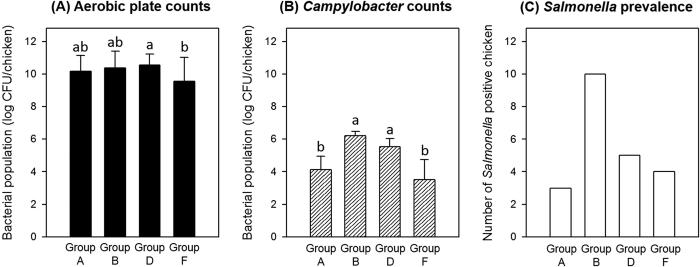
The purpose of this study was to 1) identify microbial compositional changes on chicken carcasses during processing, 2) determine the antimicrobial efficacy of peracetic acid (PAA) and Amplon (blend of sulfuric acid and sodium sulfate) at a poultry processing pilot plant scale, and 3) compare microbial communities between chicken carcass rinsates and recovered bacteria from media. Birds were collected from each processing step and rinsates were applied to estimate aerobic plate count (APC) and Campylobacter as well as Salmonella prevalence. Microbiome sequencing was utilized to identify microbial population changes over processing and antimicrobial treatments. Only the PAA treatment exhibited significant reduction of APC at the post chilling step while both Amplon and PAA yielded detectable Campylobacter reductions at all steps. Based on microbiome sequencing, Firmicutes were the predominant bacterial group at the phyla level with over 50% frequency in all steps while the relative abundance of Proteobacteria decreased as processing progressed. Overall microbiota between rinsate and APC plate microbial populations revealed generally similar patterns at the phyla level but they were different at the genus level. Both antimicrobials appeared to be effective on reducing problematic bacteria and microbiome can be utilized to identify optimal indicator microorganisms for enhancing product quality.
Conflict of interest statement
The authors declare no competing financial interests.
Figures



References
-
- Bauermeister L., Bowers J., Townsend J. & McKee S. The microbial and quality properties of poultry carcasses treated with peracetic acid as an antimicrobial treatment. Poult. Sci. 87, 2390–2398 (2008). - PubMed
-
- Sahin O., Morishita T. Y. & Zhang Q. Campylobacter colonization in poultry: Sources of infection and modes of transmission. Anim. Health Res. Rev. 3, 95–105 (2002). - PubMed
-
- Kramer J. M., Frost J. A., Bolton F. J. & Wareing D. R. Campylobacter contamination of raw meat and poultry at retail sale: Identification of multiple types and comparison with isolates from human infection. J. Food Prot. 63, 1654–1659 (2000). - PubMed
-
- USDA Food Safety and Inspection Service. Food Safety and Inspection Service strategic plan: FY 2011–2016 http://www.fsis.usda.gov/wps/wcm/connect/65602d92-d017-4edc-8536-5ed6aaa... (2011). Date of access: 01/12/2016.
Publication types
MeSH terms
Substances
LinkOut - more resources
Full Text Sources
Other Literature Sources
