. 2015 Jun 15;4(2):240-253.
doi: 10.3390/foods4020240.

Emergence of Seaweed and Seaweed-Containing Foods in the UK: Focus on Labeling, Iodine Content, Toxicity and Nutrition

Affiliations

Emergence of Seaweed and Seaweed-Containing Foods in the UK: Focus on Labeling, Iodine Content, Toxicity and Nutrition

Maria Bouga et al. Foods. .

Abstract

Seaweed (edible algae) is not a staple food in the Western diet, despite occasional use as a traditional ingredient in coastal areas. High nutritional value, combined with the expansion of the health-food industry, has led to a resurgence of seaweed in the British diet. While seaweed could be useful in tackling dietary iodine insufficiency, consumption of some species and sources of seaweed has also been associated with risks, such as toxicity from high iodine levels, or accumulation of arsenic, heavy metals and contaminants. The current retail level of seaweed and edible algae in the UK market, either as whole foods or ingredients, was evaluated with particular focus on labelling and iodine content. Seaweed-containing products (n = 224) were identified. Only 22 products (10%) stated information regarding iodine content and another 40 (18%) provided information sufficient to estimate the iodine content. For these products, the median iodine content was 110 μg/g (IQR 21-503) and 585 μg per estimated serving (IQR 105-2520). While calculations for iodine exposure per serving relied on assumptions, 26 products could potentially lead to an iodine intake above the (European) tolerable adult upper level of 600 μg/day. In the context of the data presented, there is scope to improve product labelling (species, source, processing, content).

Keywords: availability; consumer; edible algae; functional ingredient; iodine, market; labelling; retail landscape; seaweed.


Conflict of interest statement

The authors declare no conflict of interest.

Figures
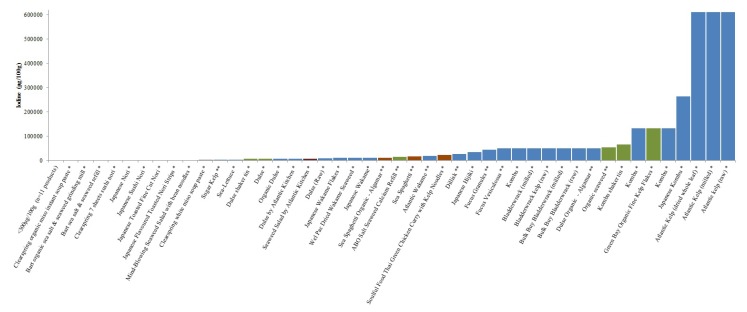
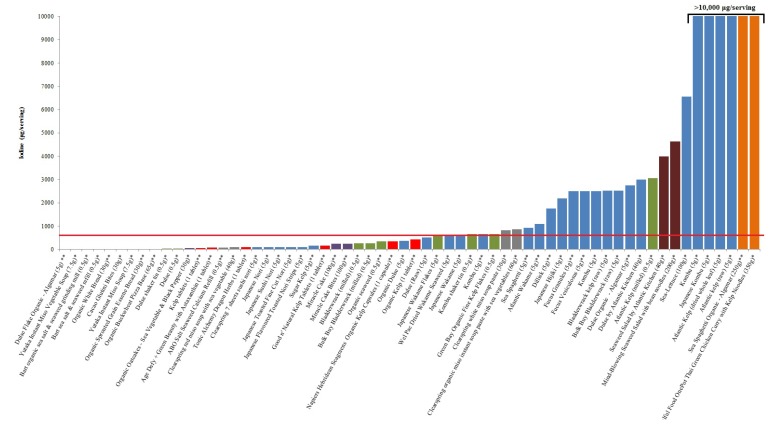
Figure 1
Figure 1
(A) Iodine content (μg/100 g) of identified seaweed products with known iodine concentration; (B) Iodine content (μg/serving) of identified seaweed products with known iodine concentration. Bar colour indicates the product categories: seaweed; salad; condiments; soup; noodles and pasta; supplements; bread and confectionary. Red line indicates the European tolerable upper level for iodine (600 μg/day) [37]. Products with one asterix (*) have estimated iodine content and with two asterix (**) are products for which iodine content was provided. Estimated serving size is indicated in bracket4. Discussion
Figure 1
Figure 1
(A) Iodine content (μg/100 g) of identified seaweed products with known iodine concentration; (B) Iodine content (μg/serving) of identified seaweed products with known iodine concentration. Bar colour indicates the product categories: seaweed; salad; condiments; soup; noodles and pasta; supplements; bread and confectionary. Red line indicates the European tolerable upper level for iodine (600 μg/day) [37]. Products with one asterix (*) have estimated iodine content and with two asterix (**) are products for which iodine content was provided. Estimated serving size is indicated in bracket4. Discussion

References

    1. Kenicer G., Bridgewater S., Milliken W. The ebb and flow of scottish seaweed use. Bot. J. Scotl. 2000;52:119–148. doi: 10.1080/13594860009441750. - DOI
    1. Brandon E.F., Janssen P.J., de Wit-Bos L. Arsenic: Bioaccessibility from seaweed and rice, dietary exposure calculations and risk assessment. Food Addit. Contam. Part A Chem. Anal. Control Expo. Risk Assess. 2014;31:1993–2003. doi: 10.1080/19440049.2014.974687. - DOI - PubMed
    1. Brown E.M., Allsopp P.J., Magee P.J., Gill C.I.R., Nitecki S., Strain C.R., McSorley E.M. Seaweed and human health. Nutr. Rev. 2014;72:205–216. doi: 10.1111/nure.12091. - DOI - PubMed
    1. Brownlee I., Fairclough A., Hall A., Paxman J. Dietary seaweed and human health. Culin. Arts Sci. VII. 2011:82–88. doi: 10.1111/nure.12091. - DOI
    1. Teas J., Pino S., Critchley A., Braverman L.E. Variability of iodine content in common commercially available edible seaweeds. Thyroid. 2004;14:836–841. doi: 10.1089/thy.2004.14.836. - DOI - PubMed

LinkOut - more resources