. 2017 Feb 23;13(2):e1006546.
doi: 10.1371/journal.pgen.1006546. eCollection 2017 Feb.

Rapid evolution of distinct Helicobacter pylori subpopulations in the Americas

Affiliations

Rapid evolution of distinct Helicobacter pylori subpopulations in the Americas

Kaisa Thorell et al. PLoS Genet. .

Erratum in

Abstract

For the last 500 years, the Americas have been a melting pot both for genetically diverse humans and for the pathogenic and commensal organisms associated with them. One such organism is the stomach-dwelling bacterium Helicobacter pylori, which is highly prevalent in Latin America where it is a major current public health challenge because of its strong association with gastric cancer. By analyzing the genome sequence of H. pylori isolated in North, Central and South America, we found evidence for admixture between H. pylori of European and African origin throughout the Americas, without substantial input from pre-Columbian (hspAmerind) bacteria. In the US, strains of African and European origin have remained genetically distinct, while in Colombia and Nicaragua, bottlenecks and rampant genetic exchange amongst isolates have led to the formation of national gene pools. We found three outer membrane proteins with atypical levels of Asian ancestry in American strains, as well as alleles that were nearly fixed specifically in South American isolates, suggesting a role for the ethnic makeup of hosts in the colonization of incoming strains. Our results show that new H. pylori subpopulations can rapidly arise, spread and adapt during times of demographic flux, and suggest that differences in transmission ecology between high and low prevalence areas may substantially affect the composition of bacterial populations.


Conflict of interest statement

The authors have declared that no competing interests exist.

Figures
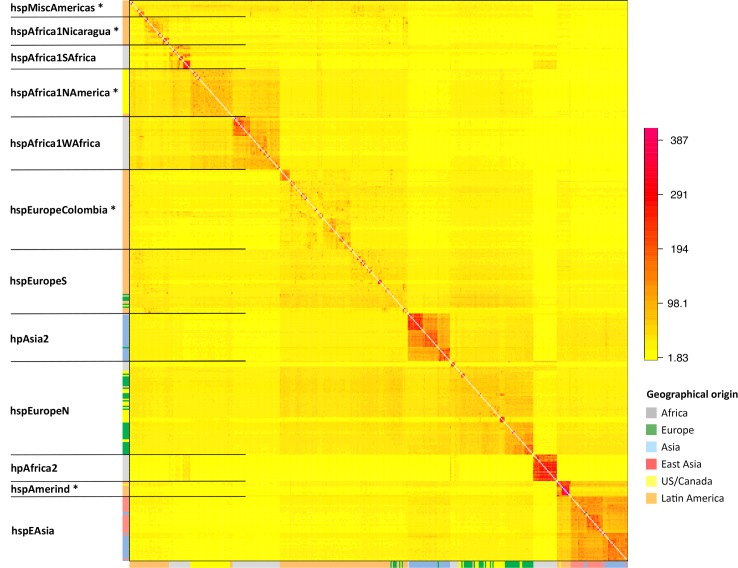
Fig 1
Fig 1. Population structure of global H. pylori strains.
The colour of each cell of the matrix indicates the expected number of DNA chunks imported from a donor genome (column) to a recipient genome (row). The boundaries between named populations are marked with lines, with New World populations marked with an asterisk. The colour bar on the left indicates the geographical locations where the strains were sampled.
Fig 2
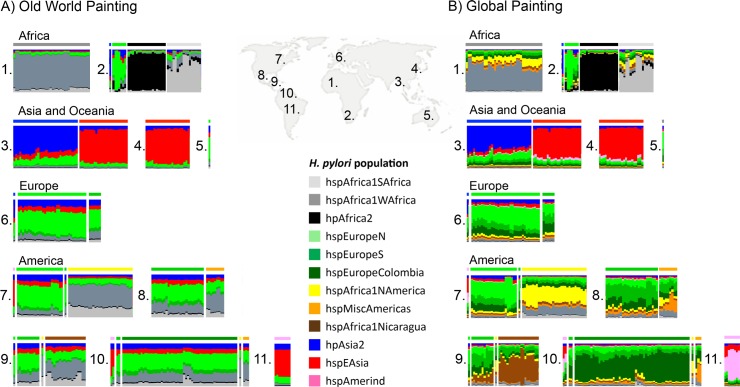
Fig 2. Ancestry of H. pylori inferred by chromosome painting.
Each vertical bar represents one isolate, which are ordered by geographical origin (1–11). 1: West Africa, 2: South Africa, 3: Central Asia, 4: East Asia, 5: Australia, 6: Europe, 7: US and Canada, 8: Mexico, 9: Central America, 10: Colombia, 11: Peruvian Amazon. The colour composition of each bar indicates each of the subpopulations’ contribution to the core genome of that isolate. A) Old world painting where only isolates from Old world areas (1–6 on map) have been used as donors in the chromosome painting. B) Global painting in which all populations have been used as donors.
Fig 3
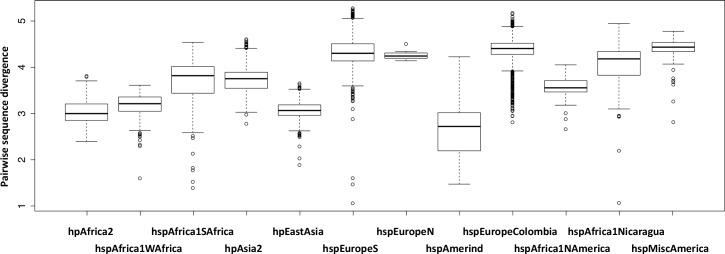
Fig 3. Pairwise sequence divergence within populations.
For the two hspEurope populations only the Old World isolates are included.
Fig 4
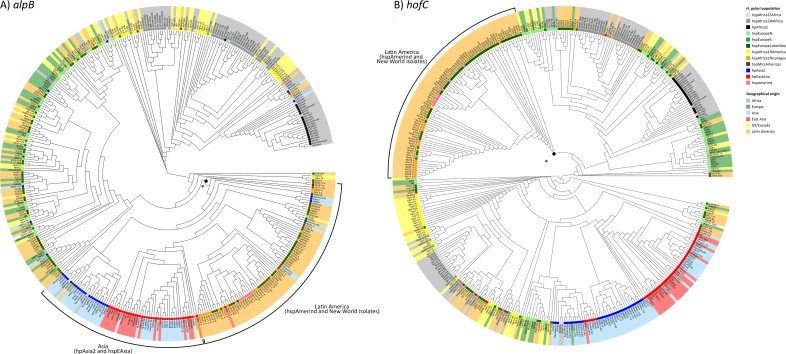
Fig 4. Maximum likelihood phylogenetic trees of alpB and hofC genes.
Leaves are shaded according to geographical origin and the H. pylori population assignment according to the FineSTRUCTURE analysis is marked at the base of each leaf. A) AlpB. A black dot with an asterisk marks the branch for which the joint Latin American and Asian clade segregate from the others. B) HofC. The black dot with an asterisk marks the branch at which the South American clade segregates from the others.
Fig 5
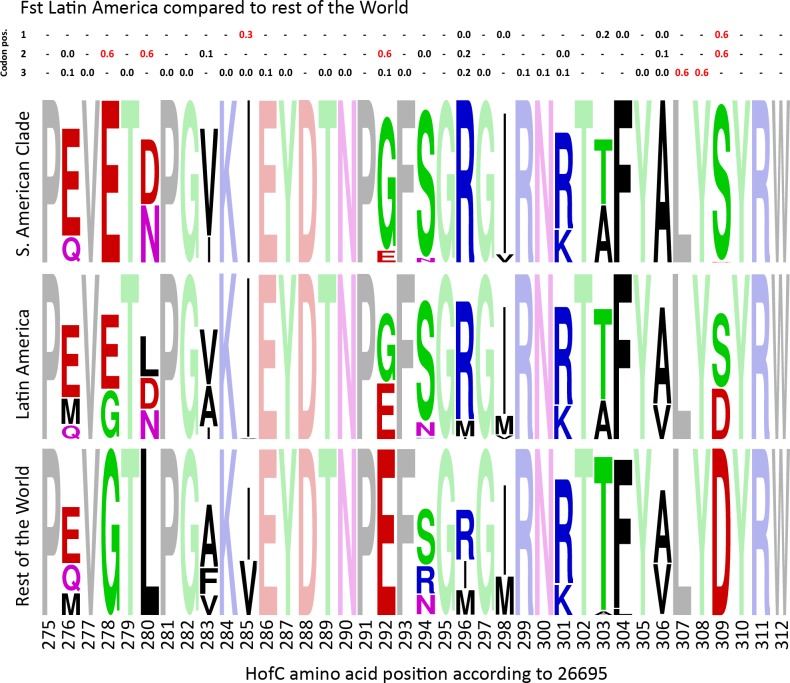
Fig 5. Fst values and WebLogo representations for amino acids 275–312 of HofC.
The upper rows are Fst values for the triplets of nucleotides in each codon, calculated for isolates originating from Latin America compared to isolates from the rest of the world. WebLogo representations of the region are showed for i) the South American clade in Fig 4B, ii) All isolates from Latin America (for which the Fst was calculated), and iii) Isolates from the rest of the world. Shaded residues are synonymous in all three populations.
Fig 6
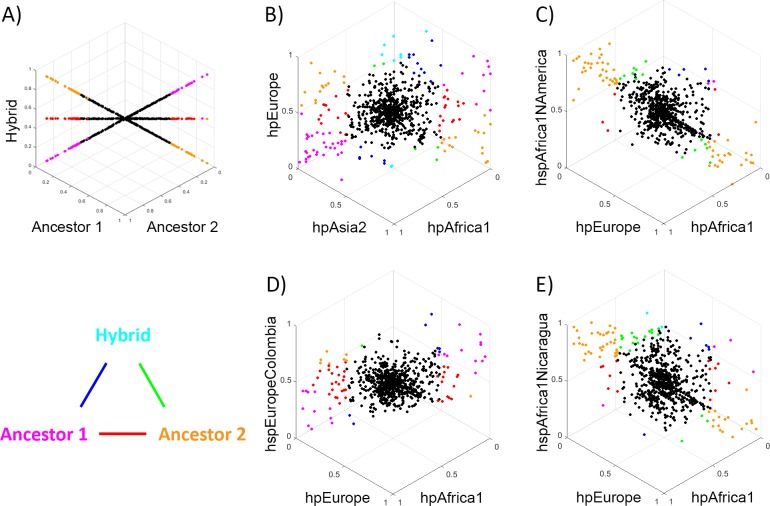
Fig 6. Comparison of accessory gene frequency in a hybrid population with the frequencies in its putative ancestors.
Each dot shows the frequencies of an accessory gene in three populations, with the graphs orientated such that genes with identical frequencies in all three appear at the centre of the plot. Genes with large frequency differences between populations are labelled in colours, according to the triangular legend. Colours shown on the vertices indicate genes that differ substantially between one population and the other two (according to the criteria that X is considered substantially bigger than Y if X–Y > = 0.5, X > = 0.5 and Y < 0.1, or X > 0.9 and Y < = 0.5), while colours on the edges indicate genes where the two populations on the vertices differ substantially in frequency, with the third population having an intermediate frequency. A) Plot showing results obtained if the frequency of genes in the hybrid population is either identical to Ancestor 1 (line ending in magenta), to Ancestor 2 (line ending in orange) or a 50–50 hybrid (line ending in red). B) Comparison between Old world populations hpEurope, hpAsia2 and hpAfrica1, C) Comparison of hspEuropeColombia to hpEurope and hpAfrica, D) Comparison of hspAfrica1Nicaragua to hpEurope and hpAfrica, E) Comparison of hspAfrica1NAmerica to hpEurope and hpAfrica.

References

    1. Bianchine PJ, Russo TA (1992) The Role of Epidemic Infectious-Diseases in the Discovery of America. Allergy Proceedings 13: 225–232. - PubMed
    1. Suerbaum S, Josenhans C (2007) Helicobacter pylori evolution and phenotypic diversification in a changing host. Nat Rev Microbiol 5: 441–452. 10.1038/nrmicro1658 - DOI - PubMed
    1. Kodaman N, Pazos A, Schneider BG, Piazuelo MB, Mera R, et al. (2014) Human and Helicobacter pylori coevolution shapes the risk of gastric disease. Proc Natl Acad Sci U S A 111: 1455–1460. 10.1073/pnas.1318093111 - DOI - PMC - PubMed
    1. Montano V, Didelot X, Foll M, Linz B, Reinhardt R, et al. (2015) Worldwide Population Structure, Long-Term Demography, and Local Adaptation of Helicobacter pylori. Genetics 200: 947–963. 10.1534/genetics.115.176404 - DOI - PMC - PubMed
    1. Maixner F, Krause-Kyora B, Turaev D, Herbig A, Hoopmann MR, et al. (2016) The 5300-year-old Helicobacter pylori genome of the Iceman. Science 351: 162–165. 10.1126/science.aad2545 - DOI - PMC - PubMed

Substances