


Dismantling the "Red Wall" of Colloidal Perovskites: Highly Luminescent Formamidinium and Formamidinium-Cesium Lead Iodide Nanocrystals
- PMID: 28231432
- PMCID: PMC5800405
- DOI: 10.1021/acsnano.7b00116
Dismantling the "Red Wall" of Colloidal Perovskites: Highly Luminescent Formamidinium and Formamidinium-Cesium Lead Iodide Nanocrystals
Abstract
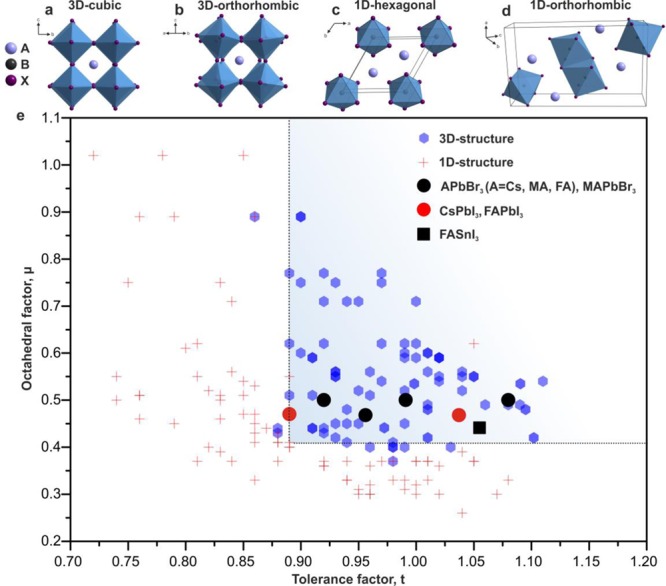
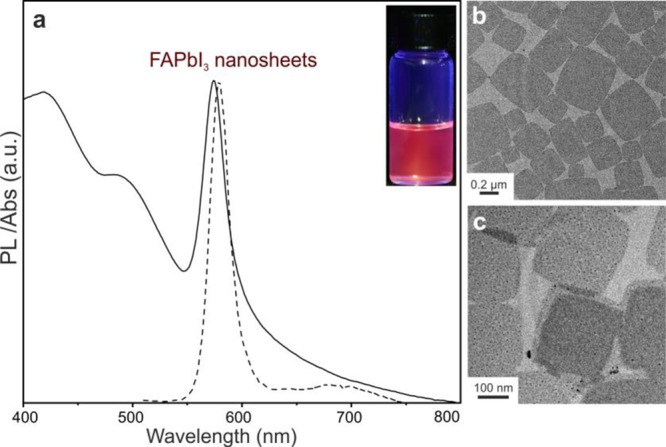
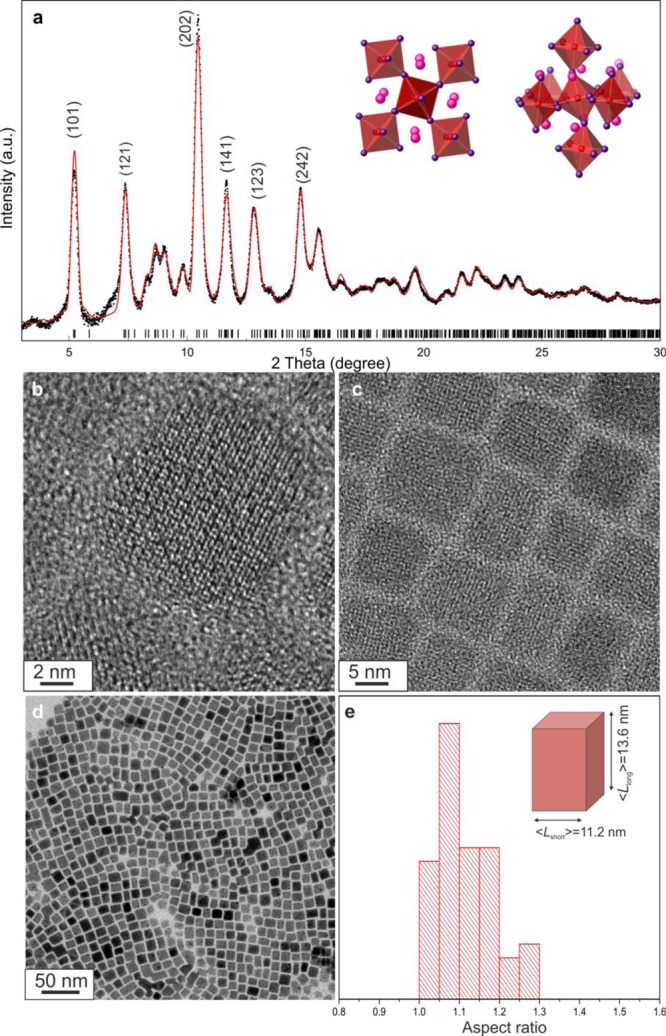
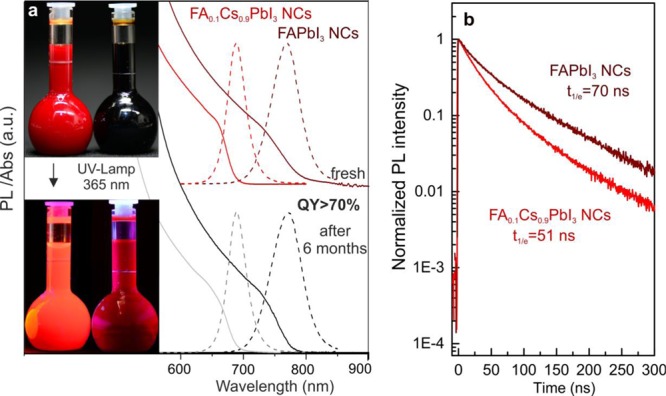
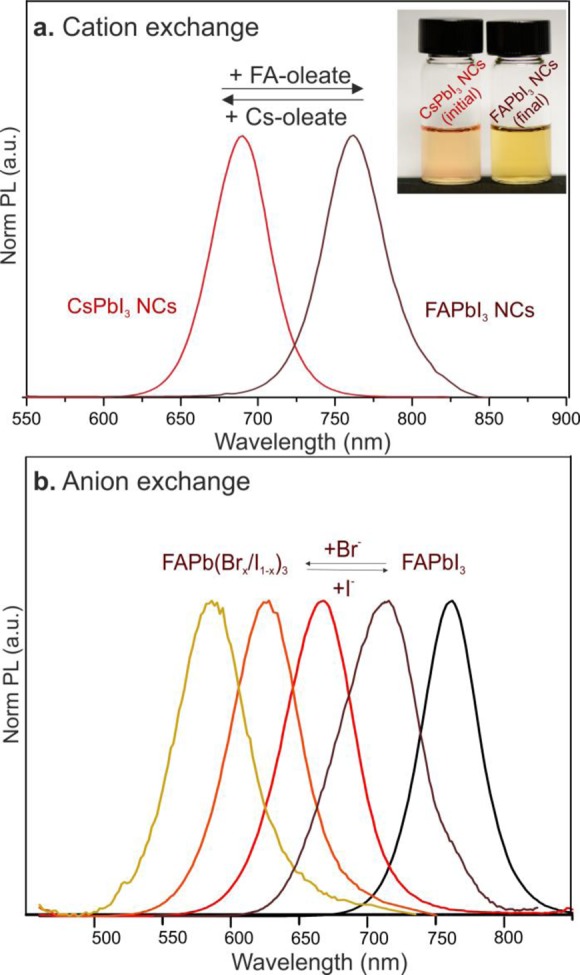
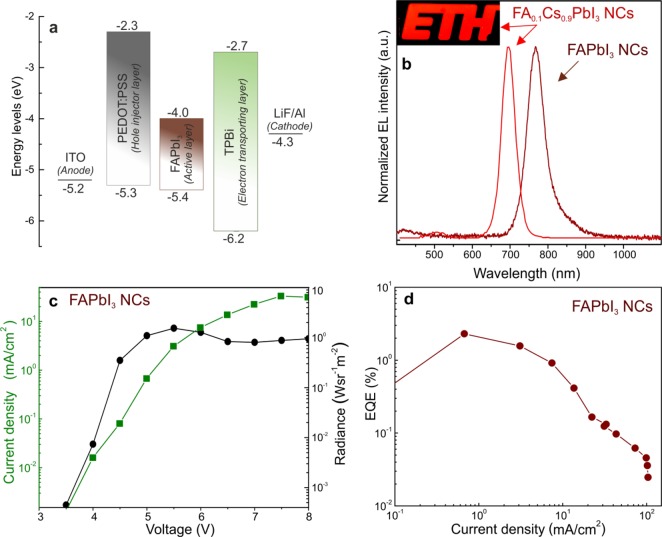
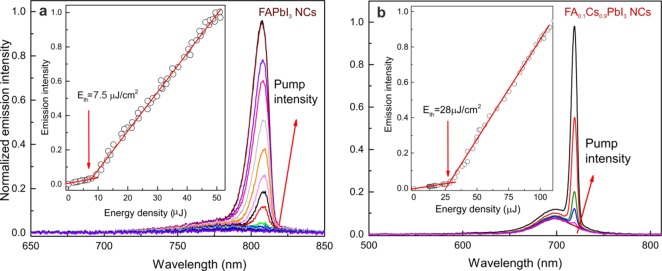
Colloidal nanocrystals (NCs) of APbX3-type lead halide perovskites [A = Cs+, CH3NH3+ (methylammonium or MA+) or CH(NH2)2+ (formamidinium or FA+); X = Cl-, Br-, I-] have recently emerged as highly versatile photonic sources for applications ranging from simple photoluminescence down-conversion (e.g., for display backlighting) to light-emitting diodes. From the perspective of spectral coverage, a formidable challenge facing the use of these materials is how to obtain stable emissions in the red and infrared spectral regions covered by the iodide-based compositions. So far, red-emissive CsPbI3 NCs have been shown to suffer from a delayed phase transformation into a nonluminescent, wide-band-gap 1D polymorph, and MAPbI3 exhibits very limited chemical durability. In this work, we report a facile colloidal synthesis method for obtaining FAPbI3 and FA-doped CsPbI3 NCs that are uniform in size (10-15 nm) and nearly cubic in shape and exhibit drastically higher robustness than their MA- or Cs-only cousins with similar sizes and morphologies. Detailed structural analysis indicated that the FAPbI3 NCs had a cubic crystal structure, while the FA0.1Cs0.9PbI3 NCs had a 3D orthorhombic structure that was isostructural to the structure of CsPbBr3 NCs. Bright photoluminescence (PL) with high quantum yield (QY > 70%) spanning red (690 nm, FA0.1Cs0.9PbI3 NCs) and near-infrared (near-IR, ca. 780 nm, FAPbI3 NCs) regions was sustained for several months or more in both the colloidal state and in films. The peak PL wavelengths can be fine-tuned by using postsynthetic cation- and anion-exchange reactions. Amplified spontaneous emissions with low thresholds of 28 and 7.5 μJ cm-2 were obtained from the films deposited from FA0.1Cs0.9PbI3 and FAPbI3 NCs, respectively. Furthermore, light-emitting diodes with a high external quantum efficiency of 2.3% were obtained by using FAPbI3 NCs.
Keywords: cesium; formamidinium; infrared; lead halides; nanocrystals; perovskites; photoluminescence.
Conflict of interest statement
The authors declare no competing financial interest.
Figures

References
-
- Kim H.-S.; Lee C.-R.; Im J.-H.; Lee K.-B.; Moehl T.; Marchioro A.; Moon S.-J.; Humphry-Baker R.; Yum J.-H.; Moser J. E.; Grätzel M.; Park N.-G. Lead Iodide Perovskite Sensitized All-Solid-State Submicron Thin Film Mesoscopic Solar Cell with Efficiency Exceeding 9%. Sci. Rep. 2012, 2, 591. 10.1038/srep00591. - DOI - PMC - PubMed
-
- Research Cell Efficiency Records. http://www.Nrel.Gov/Ncpv/Images/Efficiency_Chart.Jpg (accessed May 2016).
-
- Saliba M.; Matsui T.; Domanski K.; Seo J.-Y.; Ummadisingu A.; Zakeeruddin S. M.; Correa-Baena J.-P.; Tress W. R.; Abate A.; Hagfeldt A.; Grätzel M. Incorporation of Rubidium Cations into Perovskite Solar Cells Improves Photovoltaic Performance. Science 2016, 354, 206–209. 10.1126/science.aah5557. - DOI - PubMed
-
- Brivio F.; Frost J. M.; Skelton J. M.; Jackson A. J.; Weber O. J.; Weller M. T.; Goñi A. R.; Leguy A. M. A.; Barnes P. R. F.; Walsh A. Lattice Dynamics and Vibrational Spectra of the Orthorhombic, Tetragonal, and Cubic Phases of Methylammonium Lead Iodide. Phys. Rev. B: Condens. Matter Mater. Phys. 2015, 92, 144308. 10.1103/PhysRevB.92.144308. - DOI
Publication types
Grants and funding
LinkOut - more resources
Full Text Sources
Other Literature Sources
Miscellaneous
