


Ethylene production with engineered Synechocystis sp PCC 6803 strains
- PMID: 28231787
- PMCID: PMC5324202
- DOI: 10.1186/s12934-017-0645-5
Ethylene production with engineered Synechocystis sp PCC 6803 strains
Abstract
Background: Metabolic engineering and synthetic biology of cyanobacteria offer a promising sustainable alternative approach for fossil-based ethylene production, by using sunlight via oxygenic photosynthesis, to convert carbon dioxide directly into ethylene. Towards this, both well-studied cyanobacteria, i.e., Synechocystis sp PCC 6803 and Synechococcus elongatus PCC 7942, have been engineered to produce ethylene by introducing the ethylene-forming enzyme (Efe) from Pseudomonas syringae pv. phaseolicola PK2 (the Kudzu strain), which catalyzes the conversion of the ubiquitous tricarboxylic acid cycle intermediate 2-oxoglutarate into ethylene.
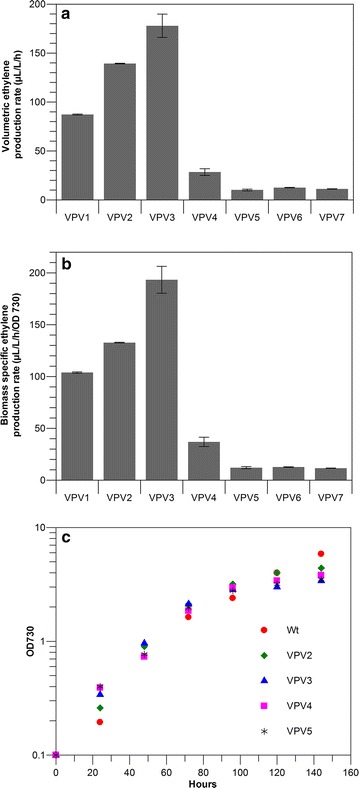
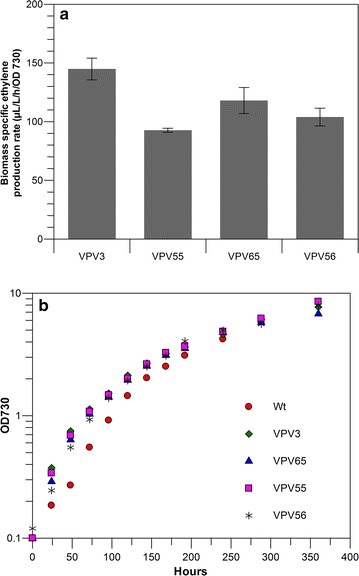
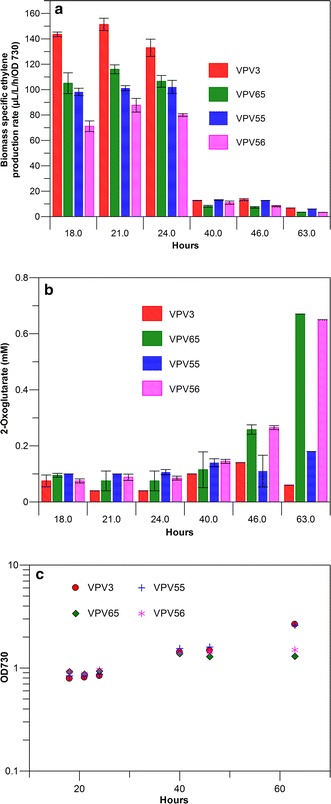
Results: This study focuses on Synechocystis sp PCC 6803 and shows stable ethylene production through the integration of a codon-optimized version of the efe gene under control of the Ptrc promoter and the core Shine-Dalgarno sequence (5'-AGGAGG-3') as the ribosome-binding site (RBS), at the slr0168 neutral site. We have increased ethylene production twofold by RBS screening and further investigated improving ethylene production from a single gene copy of efe, using multiple tandem promoters and by putting our best construct on an RSF1010-based broad-host-self-replicating plasmid, which has a higher copy number than the genome. Moreover, to raise the intracellular amounts of the key Efe substrate, 2-oxoglutarate, from which ethylene is formed, we constructed a glycogen-synthesis knockout mutant (ΔglgC) and introduced the ethylene biosynthetic pathway in it. Under nitrogen limiting conditions, the glycogen knockout strain has increased intracellular 2-oxoglutarate levels; however, surprisingly, ethylene production was lower in this strain than in the wild-type background.
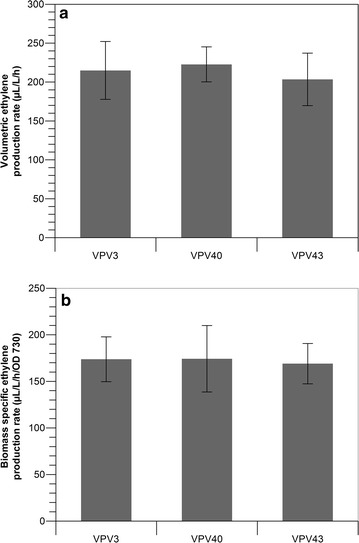
Conclusion: Making use of different RBS sequences, production of ethylene ranging over a 20-fold difference has been achieved. However, a further increase of production through multiple tandem promoters and a broad-host plasmid was not achieved speculating that the transcription strength and the gene copy number are not the limiting factors in our system.
Keywords: Arginine; Cyanobacteria; Ethylene; Glycogen; Oxoglutarate; Sustainable; Synechocystis.
Figures
References
-
- Carrieri D, Paddock T, Maness PC, Seibert M, Yu J. Photo-catalytic conversion of carbon dioxide to organic acids by a recombinant cyanobacterium incapable of glycogen storage. Energy Environ Sci. 2012;5:9457–9461. doi: 10.1039/c2ee23181f. - DOI
MeSH terms
Substances
LinkOut - more resources
Full Text Sources
Other Literature Sources
Molecular Biology Databases
