


Special pro-resolving mediator (SPM) actions in regulating gastro-intestinal inflammation and gut mucosal immune responses
- PMID: 28232096
- PMCID: PMC5797700
- DOI: 10.1016/j.mam.2017.02.002
Special pro-resolving mediator (SPM) actions in regulating gastro-intestinal inflammation and gut mucosal immune responses
Abstract
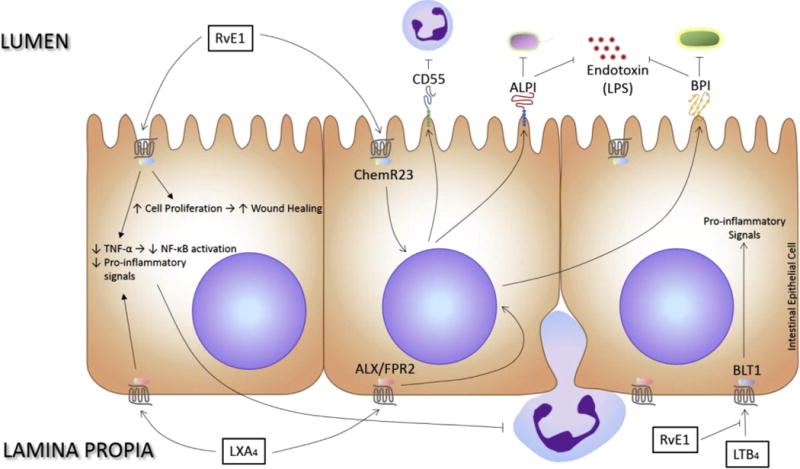
Surfaces covered by epithelial cells, termed mucosal surfaces, serve special functions as selectively permeable barriers that partition the host and the outside world. Given its close association to microbial antigens, the intestinal mucosa has evolved creative mechanisms to maintain homeostasis, to prevent excessive inflammatory responses, and to promote rapid and full inflammatory resolution. In recent years, an active role for the epithelium has been attributed to the local generation of specialized pro-resolving mediators (SPMs) in the maintenance of immunological homeostasis. In this brief review, we highlight evidence that the epithelium actively contributes to coordination and resolution of inflammation, principally through the generation of SPMs. These autacoids are derived from omega-6 and omega-3 polyunsaturated fatty acids. Acting through widely expressed G-protein coupled receptors, SPMs are implicated in the resolution of acute inflammation that manifests specific, epithelial-directed actions focused on mucosal-homeostasis, including regulation of leukocyte trafficking, the generation of antimicrobial peptides, the dampening of endotoxin signaling, and the attenuation of mucosal cytokine responses.
Copyright © 2017. Published by Elsevier Ltd.
Figures
References
-
- Abraham C, Cho JH. Inflammatory bowel disease. N Engl J Med. 2009;361:2066–2078. http://dx.doi.org/10.1056/NEJMra0804647. - DOI - PMC - PubMed
-
- Aliberti J, Hieny S, Reis e Sousa C, Serhan CN, Sher A. Lipoxin-mediated inhibition of IL-12 production by DCs: a mechanism for regulation of microbial immunity. Nat Immunol. 2002;3:76–82. http://dx.doi.org/10.1038/ni745. - DOI - PubMed
-
- Allison MC, Poulter LW. Changes in phenotypically distinct mucosal macrophage populations may be a prerequisite for the development of inflammatory bowel disease. Clin Exp Immunol. 1991;85:504–509. http://dx.doi.org/10.1111/j.1365-2249.1991.tb05757.x. - DOI - PMC - PubMed
-
- Arita M, Bianchini F, Aliberti J, Sher A, Chiang N, Hong S, Yang R, Petasis NA, Serhan CN. Stereochemical assignment, antiinflammatory properties, and receptor for the omega-3 lipid mediator resolvin E1. J Exp Med. 2005;201:713–722. http://dx.doi.org/10.1084/jem.20042031. - DOI - PMC - PubMed
-
- Aʇiş ER, Savaş B, Melli M. Impact of colonic mucosal lipoxin A4 synthesis capacity on healing in rats with dextran sodium sulfate-induced colitis. Prostagl Other Lipid Mediat. 2015;121:63–69. http://dx.doi.org/10.1016/j.prostaglandins.2015.04.001. - DOI - PubMed
Publication types
MeSH terms
Substances
Grants and funding
LinkOut - more resources
Full Text Sources
Other Literature Sources
Medical
