


Internet-based cognitive-behavioural writing therapy for reducing post-traumatic stress after intensive care for sepsis in patients and their spouses (REPAIR): study protocol for a randomised-controlled trial
- PMID: 28232467
- PMCID: PMC5337733
- DOI: 10.1136/bmjopen-2016-014363
Internet-based cognitive-behavioural writing therapy for reducing post-traumatic stress after intensive care for sepsis in patients and their spouses (REPAIR): study protocol for a randomised-controlled trial
Abstract
Introduction: As a consequence of sepsis and intensive care, considerable proportions of patients but also of their spouses develop a post-traumatic stress disorder (PTSD). However, only a very small number receive psychotherapeutic treatment. Internet-based cognitive-behavioural writing therapy (IB-CBWT) has proven to be an effective treatment option for PTSD. It seems to fit the specific needs of this cohort and to overcome treatment barriers. Aim of the REPAIR trial is to examine the efficacy, safety and applicability of IB-CBWT for PTSD in patients and their spouses after intensive care for sepsis.
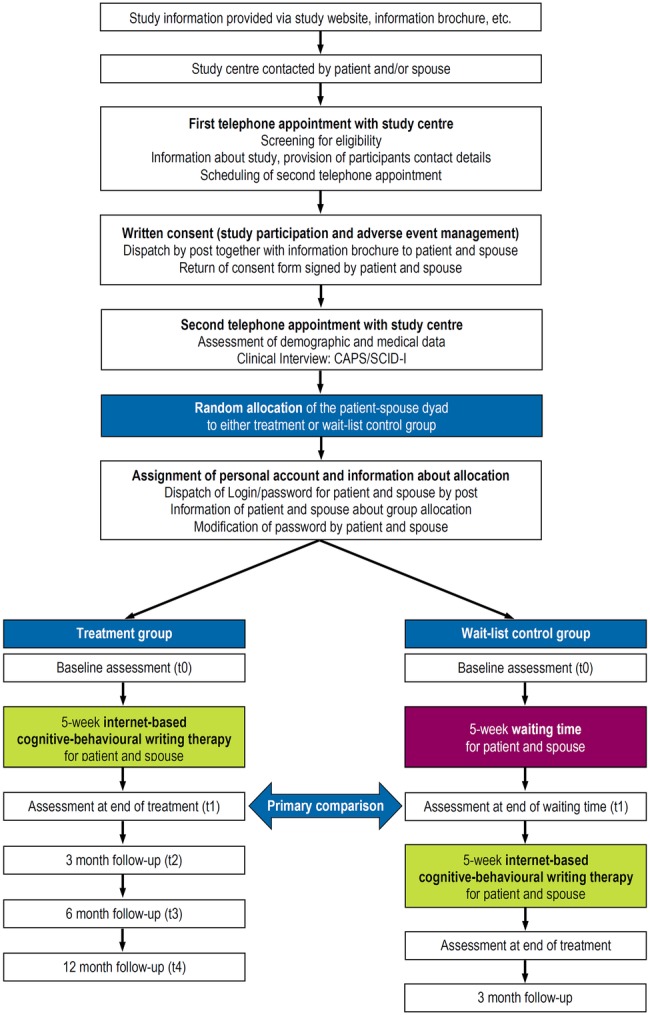
Methods and analysis: Participants will be assigned randomly either to a treatment or a wait-list (WL) control group. The treatment group receives IB-CBWT for PTSD, actively involving the partners of the participants. IB-CBWT will be guided by a therapist and comprises two written assignments per week over a 5 week period. After completing the assignments, the participants obtain individual responses from the therapist. Participants of the WL control group will receive treatment after a waiting period of 5 weeks. The primary outcome is PTSD symptom severity in self-rated PTSD Checklist for Diagnostic and Statistical Manual Fifth Edition at the end of treatment and waiting time, respectively. Secondary outcomes are remission of PTSD, depression, anxiety, and somatisation measured by the Brief Symptom Inventory-18, marital satisfaction measured by the Relationship Assessment Scale, health-related quality of life measured by the EQ-5D-5L, and the feasibility of IB-CBWT for this cohort (ie, dropout rate). Statistical analysis will be performed according to the intent-to-treat principle.
Ethics and dissemination: The study is conducted according to the principles of Good Clinical Practice and has been approved by the ethics committee of the Friedrich-Schiller University Jena, Germany. Results will be disseminated at scientific conferences, published in peer-reviewed journals, and provided to consumers of healthcare.
Trial registration number: Pre-results, DRKS00010676.
Keywords: Cognitive behavior therapy; Internet; Posttraumatic stress disorder; Randomized controlled trial; Sepsis.
Published by the BMJ Publishing Group Limited. For permission to use (where not already granted under a licence) please go to http://www.bmj.com/company/products-services/rights-and-licensing/.
Conflict of interest statement
Figures
References
-
- American Psychiatric Association. Diagnostic and Statistical Manual of Mental Disorders (DSM-5®). 5th edn Washington DC: American Psychiatric Association, 2013.
Publication types
MeSH terms
Associated data
LinkOut - more resources
Full Text Sources
Other Literature Sources
Medical
Research Materials
