. 2017 Feb 23;8(1):3.
doi: 10.1038/s41467-016-0014-9.

GIGANTEA is a co-chaperone which facilitates maturation of ZEITLUPE in the Arabidopsis circadian clock

Affiliations

GIGANTEA is a co-chaperone which facilitates maturation of ZEITLUPE in the Arabidopsis circadian clock

Joon-Yung Cha et al. Nat Commun. .

Abstract

Circadian clock systems help establish the correct daily phasing of the behavioral, developmental, and molecular events needed for the proper coordination of physiology and metabolism. The circadian oscillator comprises transcription-translation feedback loops but also requires post-translational processes that regulate clock protein homeostasis. GIGANTEA is a unique plant protein involved in the maintenance and control of numerous facets of plant physiology and development. Through an unknown mechanism GIGANTEA stabilizes the F-box protein ZEITLUPE, a key regulator of the circadian clock. Here, we show that GIGANTEA has general protein chaperone activity and can act to specifically facilitate ZEITLUPE maturation into an active form in vitro and in planta. GIGANTEA forms a ternary complex with HSP90 and ZEITLUPE and its co-chaperone action synergistically enhances HSP90/HSP70 maturation of ZEITLUPE in vitro. These results identify a molecular mechanism for GIGANTEA activity that can explain its wide-ranging role in plant biology.The plant-specific GIGANTEA protein regulates the circadian clock by stabilizing the F-box protein ZEITLUPE via an unknown mechanism. Here Cha et al. show that GIGANTEA has intrinsic chaperone activity and can facilitate ZEITLUPE maturation by acting synergistically with HSP90.


Figures
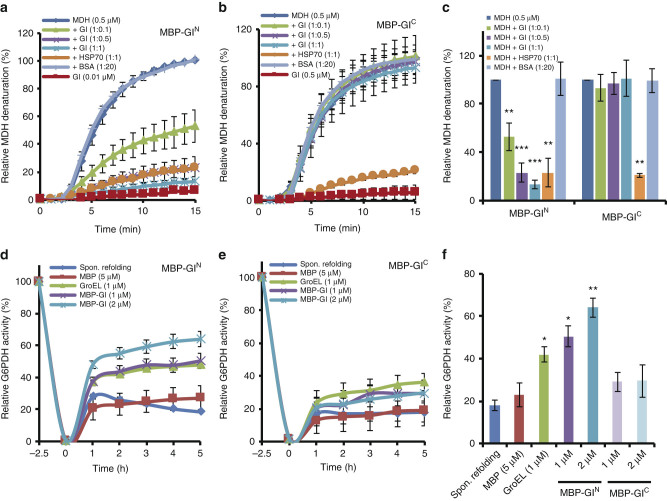
Fig. 1
Fig. 1
GI N exhibits general molecular chaperone activity in vitro. a MBP-GIN decreases heat-mediated MDH aggregation with increasing stoichiometric parity. b MBP-GIC has no effect on heat-mediated MDH aggregation. Both GI polypeptides were tested using MDH (0.5 μM) as a model substrate under thermal denaturing conditions (45 °C) in various molar ratios. HSP70 and BSA used as positive and negative controls, respectively. c The mean MDH denaturation state at the treatment endpoint of a and b relative to thermal-denaturation of MDH alone. The holdase assay (ac) measures the aggregation of the model substrate MDH (0.5 μM), by measuring the turbidity (light scattering) at 340 nm under thermal denaturing conditions for 15 min at 45 °C. The turbidity of MDH alone at 15 min was set to 100%, and that from each treatment expressed relative to it. d MBP-GIN refolds chemically denatured G6PDH. e MBP-GIC cannot refold chemically denatured G6PDH. f The mean G6PDH activity at the treatment endpoint of d and e relative to the activity of undenatured G6PDH. The foldase assay determines G6PDH activity by measuring absorbance at 340 nm (Abs340) from NADPH formation. G6PDH was denatured in 4 M guanidine-HCl for 2.5 h (−2.5 h), and the relative G6PDH activity (compared to native G6PDH activity, set to 100%) was monitored in the absence (Spon. Refolding, spontaneous refolding) or presence of MBP, GroEL, and MBP-GIN or MBP-GIC for 5 h in renaturation buffer. GroEL and MBP were used as a positive and negative control, respectively. *P < 0.05; **P < 0.01; ***P < 0.001; two-tailed Student’s t-test. Data are means ± s.e. (n = 3)
Fig. 2
Fig. 2
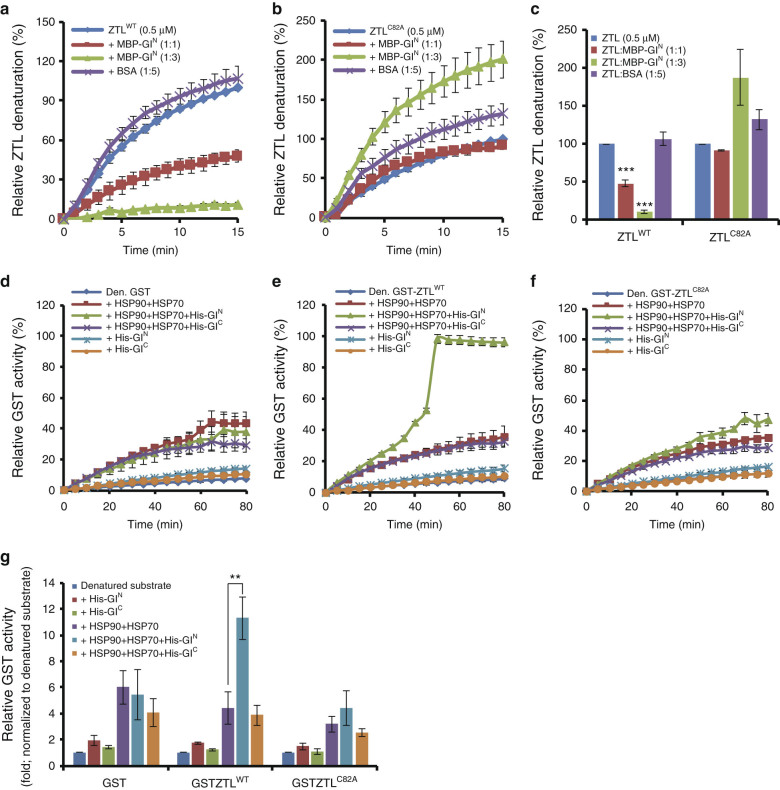
ZTL is a specific client of GI N chaperone activity in vitro. a MBP-GIN decreases heat-mediated ZTLWT aggregation with increasing levels of MBP-GIN. b MBP-GIN has no effect or increases heat-mediated aggregation of the ZTLC82A allele. c The mean denaturation state at the treatment endpoint of a and b relative to thermal-denaturation of ZTLWT or ZTLC82A alone. BSA used as a non-specific protein control. Holdase activity of MBP-GIN was measured as the change in turbidity at 340 nm (aggregation of ZTLWT or ZTLC82A (0.5 μM)) under thermal denaturing conditions (45 °C) for 15 min. The value of ZTLWT or ZTLC82A alone at 15 min was set to 100%, and turbidity at 340 nm from each treatment expressed relative to it. BSA used as a non-specific protein control. df GI acts synergistically with HSP90 and HSP70 to reactivate denatured GST-ZTL. d GST, e GST-ZTLWT, and f GST-ZTLC82A were heat-denatured at 45 °C and immediately mixed with His-GIN (0.05 μM) or His-GIC (0.05 μM) in the absence or presence of HSP90 (0.1 μM) and HSP70 (0.5 μM). Enzyme activity of undenatured GST, GST-ZTLWT, and GST-ZTLC82A was set to 100% for d, e and f, respectively. g Mean GST activity at the treatment endpoint of df was normalized to the spontaneously refolding value of denatured GST or GST-fusions set to 1. The foldase assay determined GST activity by measuring the formation of a GS-DNB conjugate (GST reaction product) as determined by absorbance at 340 nm (Abs340). **P < 0.01; ***P < 0.001; two-tailed Student’s t-test. Data are means ± s.e. (n = 3)
Fig. 3
Fig. 3
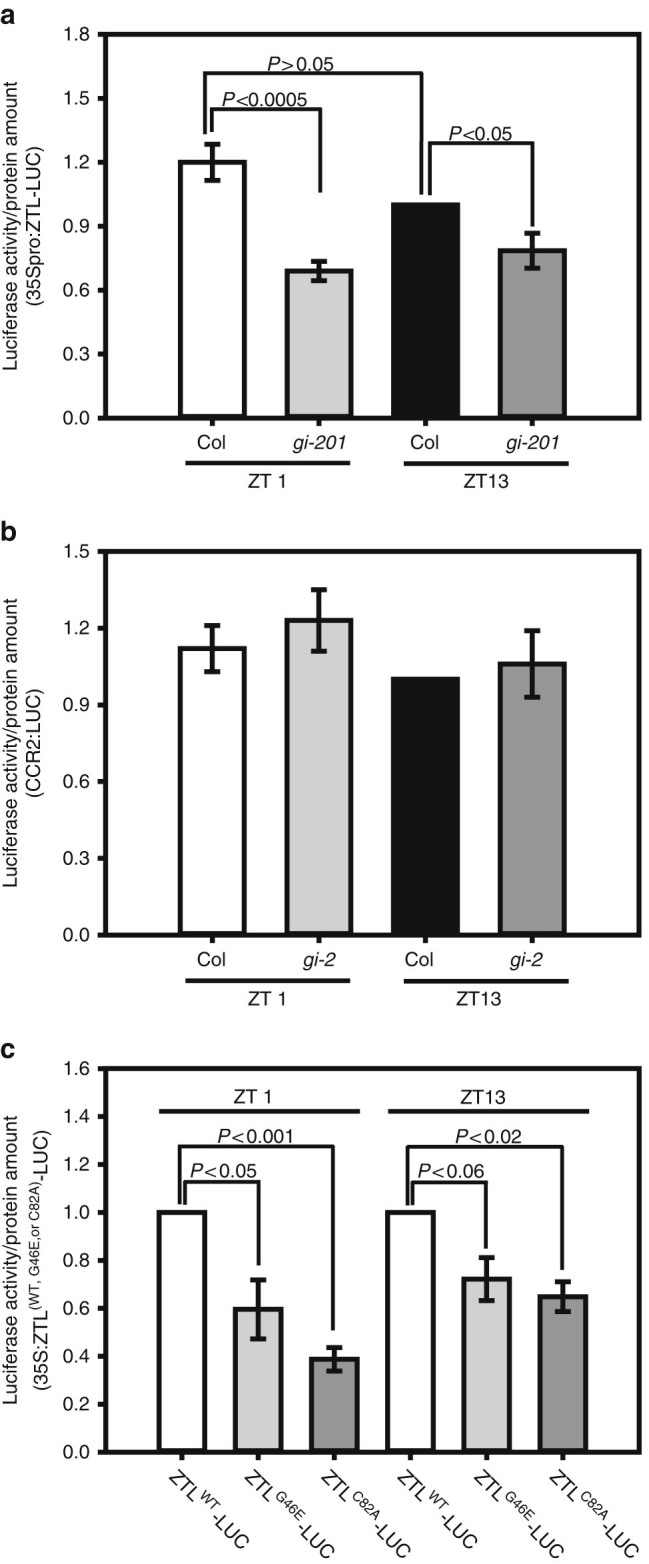
GI is required in vivo for complete ZTL activity. a Relative-specific activity of ZTL-LUC at ZT1 and ZT13 in the Col and gi-201 background. b Relative-specific activity of LUC from the CCR2:LUC transgene in the Col and gi-2 backgrounds. c Relative-specific activity of ZTLWT-, ZTLG46E-, and ZTLC82A-LUC at ZT1 and ZT13 in the Col background. ac Specific activity was determined by the ratio of luminescence (enzyme activity) to LUC protein levels derived from ZTLWT-, ZTLG46E-, ZTLC82A-LUC or LUC protein alone. See “Methods” for details. Data are means ± s.e. of eight (a) or four (b, c) independent samples
Fig. 4
Fig. 4
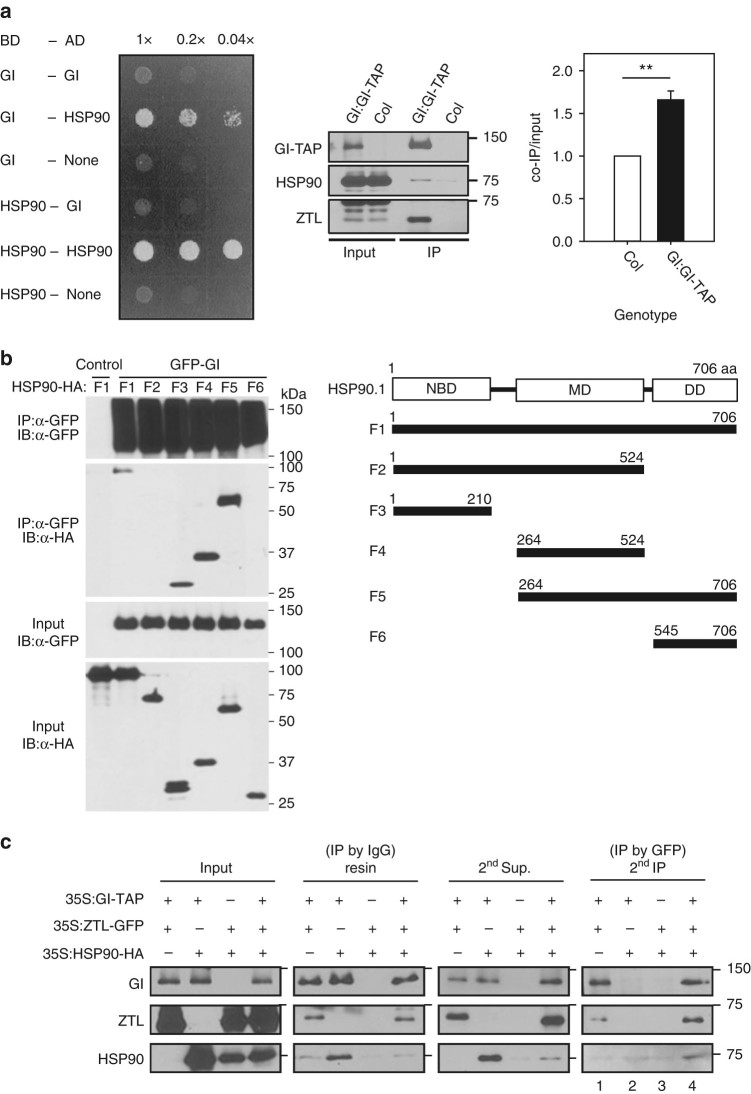
GI complex formation with ZTL and HSP90 in vivo. a GI and HSP90 interact directly in yeast (left panel) and in planta (right panel). Full-length GI and HSP90 protein interaction via yeast two-hybrid was determined by growth on leucine deficient media. Transgenic Arabidopsis expressing GI:GI-TAP immunoprecipitates with endogenous HSP90 and ZTL (right panels). Untransformed Col controlled for non-specific HSP90 interaction. Quantification of HSP90 in GI-TAP immunoprecipitations (IPs) (far right panel; mean ± s.e.m.; **P < 0.01) (n = 4). b HSP90 deletion interactions with GI. Agrobacteria harboring GI-GFP or HSP90 and its respective deletions tagged with 3 × HA were co-infiltrated into N. benthamiana leaves. Anti-GFP (IP) were followed by detection of co-immunoprecipitated HSP90-HA and respective deletions. Representative of three trials with similar results. Right panel: HSP90 domain structure and respective deletion scheme. IP immunoprecipitating antibody, IB immunoblot antibody, NBD nucleotide-binding domain, MD middle domain, DD dimerization domain. c GI, ZTL, and HSP90 form a tripartite protein complex in planta. Sequential co-immunopreciptations used GI-TAP in the primary IP followed by IP of ZTL-GFP (anti-GFP ab) from the protease-released supernatant (2nd Sup.). The final detection of HSP90-HA (anti HA ab) in lane 4 indicates HSP90-HA associated with ZTL-GFP from the first IP. N. benthamiana leaves were triply co-infiltrated with 35S:GI-TAP/35S:HSP90-HA/35S:ZTL-GFP simultaneously or in all pairwise combinations. Representative of three independent trials
Fig. 5
Fig. 5
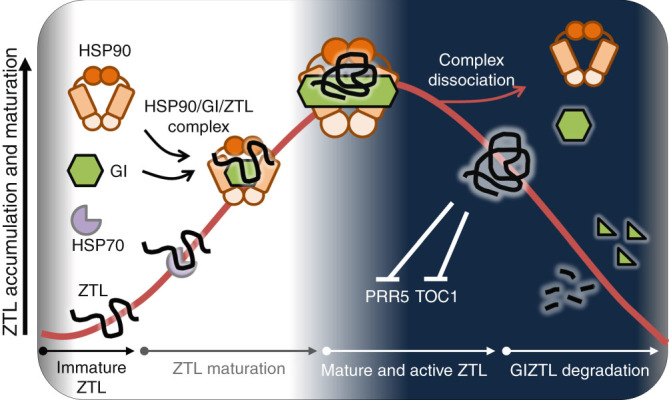
Post-transcriptional oscillation of ZTL is regulated by GI and HSP90. Nascent ZTL may be first captured by HSP70 in an early complex, and then transferred to a second complex comprising HSP90 and the co-chaperone GI. Order of ZTL interaction with GI and HSP90 is unknown. GI oligomerization and ZTL interaction is enhanced in the light, which may increase the binding capacity with ZTL and HSP90. Matured/active ZTL dissociates from the complex, to form SCFZTL which ubiquitylates PRR5 and TOC1. During the dark period ZTL is degraded together with GI

Comment in

References

    1. Hsu PY, Harmer SL. Wheels within wheels: the plant circadian system. Trends Plant. Sci. 2014;19:240. doi: 10.1016/j.tplants.2013.11.007. - DOI - PMC - PubMed
    1. Tataroglu O, Emery P. The molecular ticks of the Drosophila circadian clock. Curr. Opin. Insect. Sci. 2015;7:51. doi: 10.1016/j.cois.2015.01.002. - DOI - PMC - PubMed
    1. Seo PJ, Mas P. Multiple layers of posttranslational regulation refine circadian clock activity in Arabidopsis. Plant. Cell. 2014;26:79. doi: 10.1105/tpc.113.119842. - DOI - PMC - PubMed
    1. Crane BR, Young MW. Interactive features of proteins composing eukaryotic circadian clocks. Annu. Rev. Biochem. 2014;83:191. doi: 10.1146/annurev-biochem-060713-035644. - DOI - PubMed
    1. Mas P, Kim WY, Somers DE, Kay SA. Targeted degradation of TOC1 by ZTL modulates circadian function in Arabidopsis thaliana. Nature. 2003;426:567. doi: 10.1038/nature02163. - DOI - PubMed

Publication types

MeSH terms