


Pyricularia graminis-tritici, a new Pyricularia species causing wheat blast
- PMID: 28232765
- PMCID: PMC5315288
- DOI: 10.3767/003158516X692149
Pyricularia graminis-tritici, a new Pyricularia species causing wheat blast
Abstract
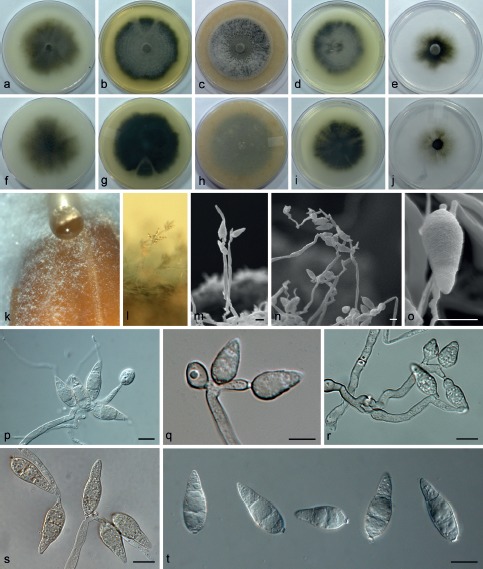
Pyricularia oryzae is a species complex that causes blast disease on more than 50 species of poaceous plants. Pyricularia oryzae has a worldwide distribution as a rice pathogen and in the last 30 years emerged as an important wheat pathogen in southern Brazil. We conducted phylogenetic analyses using 10 housekeeping loci for 128 isolates of P. oryzae sampled from sympatric populations of wheat, rice, and grasses growing in or near wheat fields. Phylogenetic analyses grouped the isolates into three major clades. Clade 1 comprised isolates associated only with rice and corresponds to the previously described rice blast pathogen P. oryzae pathotype Oryza (PoO). Clade 2 comprised isolates associated almost exclusively with wheat and corresponds to the previously described wheat blast pathogen P. oryzae pathotype Triticum (PoT). Clade 3 contained isolates obtained from wheat as well as other Poaceae hosts. We found that Clade 3 is distinct from P. oryzae and represents a new species, Pyricularia graminis-tritici (Pgt). No morphological differences were observed among these species, but a distinctive pathogenicity spectrum was observed. Pgt and PoT were pathogenic and highly aggressive on Triticum aestivum (wheat), Hordeum vulgare (barley), Urochloa brizantha (signal grass), and Avena sativa (oats). PoO was highly virulent on the original rice host (Oryza sativa), and also on wheat, barley, and oats, but not on signal grass. We conclude that blast disease on wheat and its associated Poaceae hosts in Brazil is caused by multiple Pyricularia species. Pyricularia graminis-tritici was recently found causing wheat blast in Bangladesh. This indicates that P. graminis-tritici represents a serious threat to wheat cultivation globally.
Keywords: Triticum aestivum; cryptic species; host adaptation; phylogenetics; systematics.
Figures


References
-
- Anjos JRND, Silva DBD, Charchar MJD, et al. 1996. Ocurrence of blast fungus (Pyricularia grisea) on wheat and rye in the savanna region of Central Brazil. Pesquisa Agropecuária Brasileira 31: 79–82.
-
- Bozzola JJ, Russell LD. 1999. Electron microscopy: principles and techniques for biologists: 670. Boston, Jones & Bartlett Publishers.
-
- Callaway E. 2016. Devastating wheat fungus appears in Asia for first time. Nature 532: 421–422. - PubMed
-
- Carbone I, Kohn LM. 1999. A method for designing primer sets for speciation studies in filamentous ascomycetes. Mycologia 91: 553–556.
-
- Castroagudín VL, Ceresini PC, Oliveira SC, et al. 2015. Resistance to QoI fungicides is widespread in Brazilian populations of the wheat blast pathogen Magnaporthe oryzae. Phytopathology 104: 284–294. - PubMed
LinkOut - more resources
Full Text Sources
Other Literature Sources
Research Materials