


EFFECTS OF A PROFESSIONAL DEVELOPMENT PROGRAM ON BEHAVIORAL ENGAGEMENT OF STUDENTS IN MIDDLE AND HIGH SCHOOL
- PMID: 28232767
- PMCID: PMC5319794
- DOI: 10.1002/pits.21741
EFFECTS OF A PROFESSIONAL DEVELOPMENT PROGRAM ON BEHAVIORAL ENGAGEMENT OF STUDENTS IN MIDDLE AND HIGH SCHOOL
Abstract
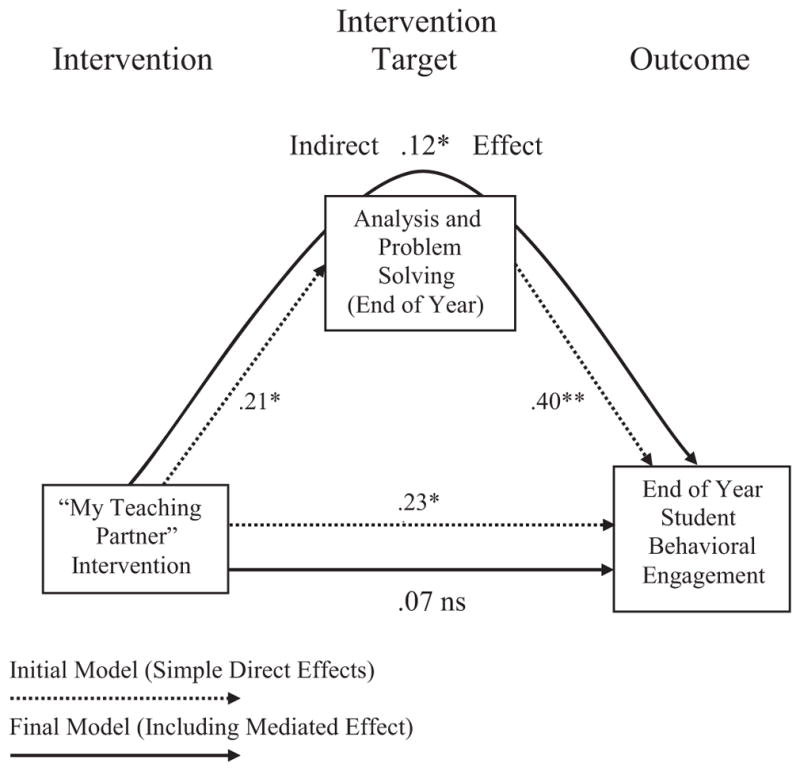
Student behavioral engagement is a key condition supporting academic achievement, yet student disengagement in middle and high schools is all too common. The current study used a randomized controlled design to test the efficacy of the My Teaching Partner-Secondary program to increase behavioral engagement. The program offers teachers personalized coaching and systematic feedback on teachers' interactions with students, based on systematic observation of videorecordings of teacher-student interactions in the classroom. The study found that intervention teachers had significantly higher increases, albeit to a modest degree, in student behavioral engagement in their classrooms after 1 year of involvement with the program compared to the teachers in the control group (explaining 4% of variance). In exploratory analyses, two dimensions of teachers' interactions with students-their focus on analysis and problem solving during instruction and their use of diverse instructional learning formats-acted as mediators of increased student engagement. The findings offer implications for new directions in teacher professional development and for understanding the classroom as a setting for adolescent development.
Figures

References
-
- Aiken LS, West SG. Multiple regression: testing and interpreting interactions. Thousand Oaks, CA: Sage Publications; 1991.
-
- Alexander KL, Entwisle DR, Horsey CS. From first grade forward: Early foundations of high school dropout. Society of Education. 1997;70:87–107. doi: 10.2307/2673158. - DOI
-
- Allen JP, Marsh P, McFarland C, McElhaney KB, Land DJ, Jodl KM, et al. Attachment and autonomy as predictors of the development of social skills and delinquency during midadolescence. Journal of Consulting & Clinical Psychology. 2002;70(1):56–66. doi: 10.1037//0022-006X.70.1.56. - DOI - PMC - PubMed
Grants and funding
LinkOut - more resources
Full Text Sources
Other Literature Sources