


Consumer underestimation of sodium in fast food restaurant meals: Results from a cross-sectional observational study
- PMID: 28235618
- PMCID: PMC6347977
- DOI: 10.1016/j.appet.2017.02.028
Consumer underestimation of sodium in fast food restaurant meals: Results from a cross-sectional observational study
Abstract
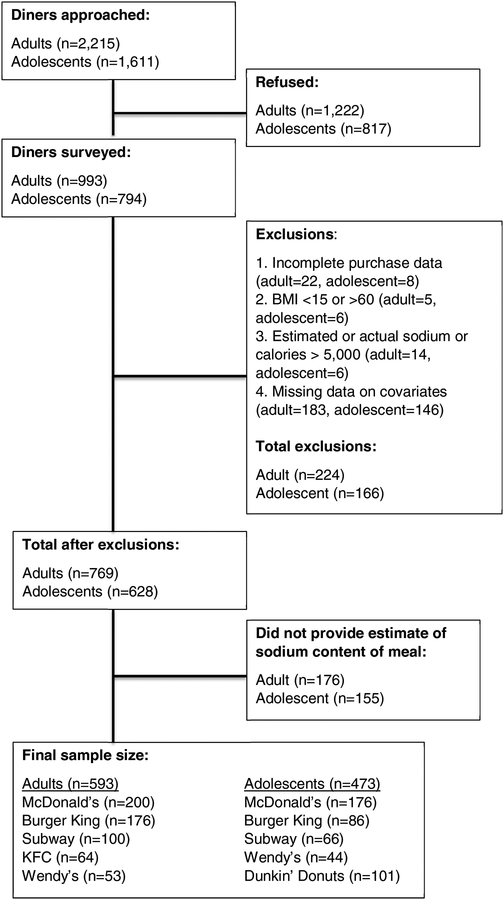
Restaurants are key venues for reducing sodium intake in the U.S. but little is known about consumer perceptions of sodium in restaurant foods. This study quantifies the difference between estimated and actual sodium content of restaurant meals and examines predictors of underestimation in adult and adolescent diners at fast food restaurants. In 2013 and 2014, meal receipts and questionnaires were collected from adults and adolescents dining at six restaurant chains in four New England cities. The sample included 993 adults surveyed during 229 dinnertime visits to 44 restaurants and 794 adolescents surveyed during 298 visits to 49 restaurants after school or at lunchtime. Diners were asked to estimate the amount of sodium (mg) in the meal they had just purchased. Sodium estimates were compared with actual sodium in the meal, calculated by matching all items that the respondent purchased for personal consumption to sodium information on chain restaurant websites. Mean (SD) actual sodium (mg) content of meals was 1292 (970) for adults and 1128 (891) for adolescents. One-quarter of diners (176 (23%) adults, 155 (25%) adolescents) were unable or unwilling to provide estimates of the sodium content of their meals. Of those who provided estimates, 90% of adults and 88% of adolescents underestimated sodium in their meals, with adults underestimating sodium by a mean (SD) of 1013 mg (1,055) and adolescents underestimating by 876 mg (1,021). Respondents underestimated sodium content more for meals with greater sodium content. Education about sodium at point-of-purchase, such as provision of sodium information on restaurant menu boards, may help correct consumer underestimation, particularly for meals of high sodium content.
Keywords: Knowledge; Nutrition labeling; Nutrition policy; Restaurants; Sodium.
Copyright © 2017 Elsevier Ltd. All rights reserved.
Conflict of interest statement
Conflict of interest statement: Authors have no conflicts of interest to declare.
Figures
References
Publication types
MeSH terms
Substances
Grants and funding
LinkOut - more resources
Full Text Sources
Other Literature Sources
Medical
