


Misalignment between physicians and patient satisfaction with psoriatic arthritis disease control
- PMID: 28238086
- PMCID: PMC5554474
- DOI: 10.1007/s10067-017-3578-9
Misalignment between physicians and patient satisfaction with psoriatic arthritis disease control
Abstract
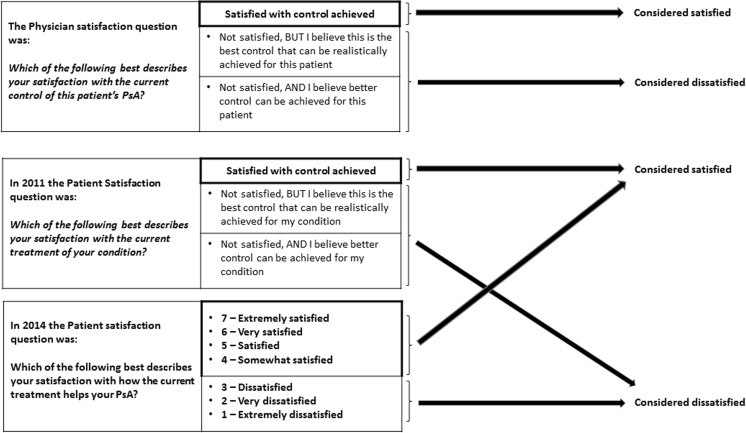
The main objective of the present study is to evaluate the misalignment between psoriatic arthritis (PsA) patient- and physician-reported satisfaction with PsA control. Data came from the Adelphi Rheumatology Disease Specific Programme, a retrospective, cross-sectional survey of US-based rheumatologists and patients. Physicians provided satisfaction and clinical characteristics on tender joint count, swollen joint count, and percent body surface area (BSA) affected by psoriasis. Patients provided data on satisfaction, the Work Productivity Activity Impairment and Health Assessment Questionnaire-Disability Index (HAQ-DI) questionnaires. Based on their satisfaction response, patient-physician pairs were classified into aligned (both satisfied or dissatisfied) or misaligned (rated satisfaction differently) groups. Multivariate analysis evaluated association of characteristics with misalignment. Among 305 paired patient-physician records analyzed, 23.6% were misaligned and 76.4% were aligned. The misaligned group had shorter disease duration (mean years, 5.2 vs. 6.4), used fewer biologic disease-modifying antirheumatic drugs (49.3 vs. 62.9%), had more swollen (mean, 3.7 vs. 1.9, P = 0.0002) and tender joints (mean, 5.6 vs. 2.9, P < 0.0001), greater proportion of patients with comorbidities (72.2 vs. 63.1%), and >3% BSA affected by psoriatic skin lesions (64.2 vs. 55.1%). Misaligned patients reported greater work impairment (mean, 38.7 vs. 21.4, P = 0.0004), daily activities (mean, 38.7 vs. 22.3, P < 0.0001), and higher disease burden (mean HAQ-DI; 0.56 vs. 0.37, P = 0.0001). Multivariate analysis found the number of swollen joints (P = 0.02) and HAQ-DI score (P = 0.03) was significantly associated with misalignment among all patients; however, not in the subgroup of employed patients. Patient-physician misalignment is associated with increased disease activity and disability among patients with PsA.
Keywords: Disease activity; Misalignment; Patient-physician survey; Psoriatic arthritis; Swollen joint count; Tender joint count.
Conflict of interest statement
Funding for this study was provided by Novartis Pharmaceuticals Corporation. DE Furst works at the Department of Rheumatology (Emeritus), University of California, Los Angeles Medical Center, is the Director of Research at Arthritis Associates of Southern California (AASC), an Adjunct Professor at University of Washington, Seattle, Washington, and a Researcher at University of Florence, Florence, Italy. JB Palmer and VH Herrera are employees of Novartis Pharmaceuticals Corporation. E Sullivan, J Pike, and J Piercy are employees of Adelphi Real World, Adelphi Mill, Cheshire, UK. M Tran was a post-doctoral Health Economics and Outcomes Research Fellow from Scott & White Health Plan and the University of Texas at Austin, providing services to Novartis Pharmaceuticals Corporation.
Figures
References
-
- American Academy of Dermatology Work, G. Menter A, Korman NJ, Elmets CA, Feldman SR, et al. Guidelines of care for the management of psoriasis and psoriatic arthritis: section 6. Guidelines of care for the treatment of psoriasis and psoriatic arthritis: case-based presentations and evidence-based conclusions. J Am Acad Dermatol. 2011;65:137–174. doi: 10.1016/j.jaad.2010.11.055. - DOI - PubMed
-
- Lewin, SA, Skea, ZC, Entwistle, V, Zwarenstein, M, Dick, J (2001) Interventions for providers to promote a patient-centred approach in clinical consultations. Cochrane Database Syst Rev (4):CD003267. doi:10.1002/14651858.CD003267 - PubMed
MeSH terms
Substances
LinkOut - more resources
Full Text Sources
Other Literature Sources
Medical
Research Materials
Miscellaneous
