


The Weighting is the Hardest Part: On the Behavior of the Likelihood Ratio Test and the Score Test Under a Data-Driven Weighting Scheme in Sequenced Samples
- PMID: 28238293
- PMCID: PMC5357183
- DOI: 10.1017/thg.2017.7
The Weighting is the Hardest Part: On the Behavior of the Likelihood Ratio Test and the Score Test Under a Data-Driven Weighting Scheme in Sequenced Samples
Abstract
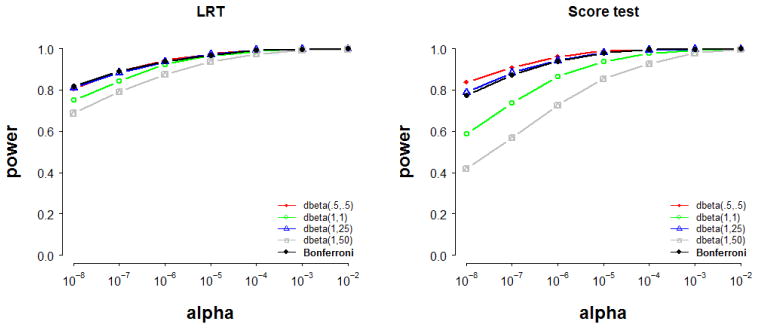
Sequence-based association studies are at a critical inflexion point with the increasing availability of exome-sequencing data. A popular test of association is the sequence kernel association test (SKAT). Weights are embedded within SKAT to reflect the hypothesized contribution of the variants to the trait variance. Because the true weights are generally unknown, and so are subject to misspecification, we examined the efficiency of a data-driven weighting scheme. We propose the use of a set of theoretically defensible weighting schemes, of which, we assume, the one that gives the largest test statistic is likely to capture best the allele frequency-functional effect relationship. We show that the use of alternative weights obviates the need to impose arbitrary frequency thresholds. As both the score test and the likelihood ratio test (LRT) may be used in this context, and may differ in power, we characterize the behavior of both tests. The two tests have equal power, if the weights in the set included weights resembling the correct ones. However, if the weights are badly specified, the LRT shows superior power (due to its robustness to misspecification). With this data-driven weighting procedure the LRT detected significant signal in genes located in regions already confirmed as associated with schizophrenia - the PRRC2A (p = 1.020e-06) and the VARS2 (p = 2.383e-06) - in the Swedish schizophrenia case-control cohort of 11,040 individuals with exome-sequencing data. The score test is currently preferred for its computational efficiency and power. Indeed, assuming correct specification, in some circumstances, the score test is the most powerful test. However, LRT has the advantageous properties of being generally more robust and more powerful under weight misspecification. This is an important result given that, arguably, misspecified models are likely to be the rule rather than the exception in weighting-based approaches.
Keywords: MAF thresholding; SKAT; power; robustness; schizophrenia; variable weighting.
Figures
References
-
- Genovese Giulio, Fromer Menachem, Stahl Eli A, Ruderfer Douglas M, Chambert Kimberly, Landén Mikael, Moran Jennifer L, Purcell Shaun M, Sklar Pamela, Sullivan Patrick F, et al. Nature Neuroscience. Nature Research; 2016. Increased burden of ultra-rare protein-altering variants among 4,877 individuals with schizophrenia. - PMC - PubMed
-
- Aberg Karolina A, Liu Youfang, Bukszár Jozsef, McClay Joseph L, Khachane Amit N, Andreassen Ole A, Blackwood Douglas, Corvin Aiden, Djurovic Srdjan, Gurling Hugh, et al. JAMA psychiatry. American Medical Association; 2013. A comprehensive family-based replication study of schizophrenia genes; pp. 573–581. - PMC - PubMed
MeSH terms
Substances
Grants and funding
LinkOut - more resources
Full Text Sources
Other Literature Sources
Research Materials
Miscellaneous
