


Linear Regression with a Randomly Censored Covariate: Application to an Alzheimer's Study
- PMID: 28239197
- PMCID: PMC5319605
- DOI: 10.1111/rssc.12164
Linear Regression with a Randomly Censored Covariate: Application to an Alzheimer's Study
Abstract
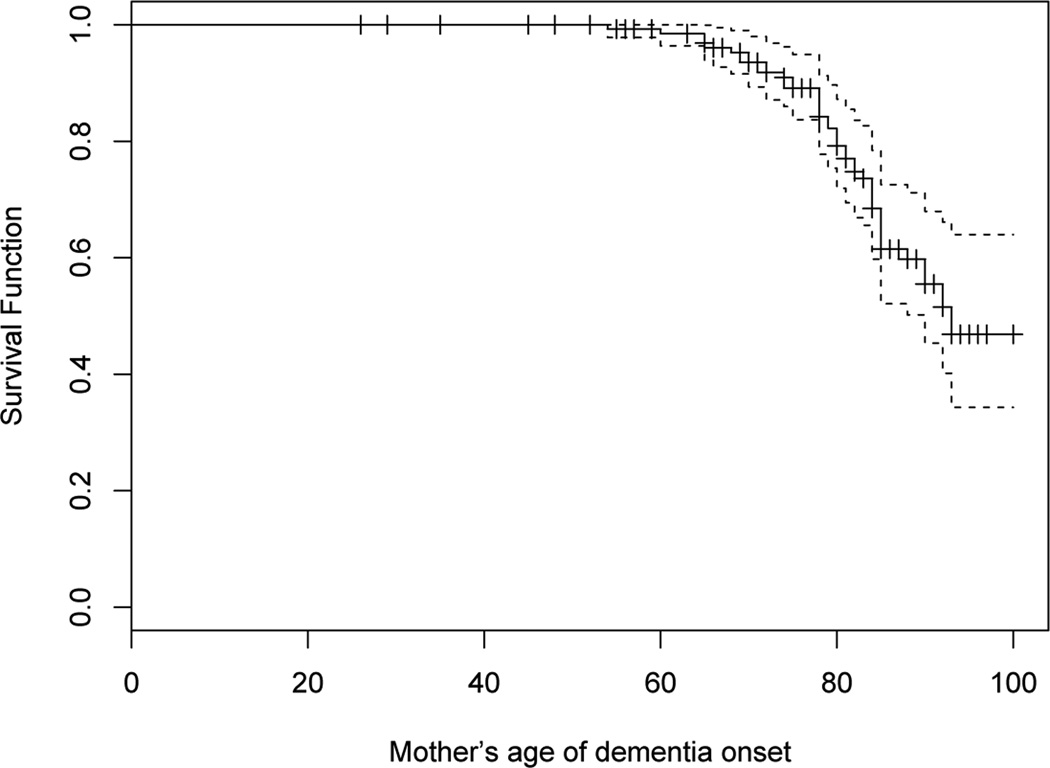
The association between maternal age of onset of dementia and amyloid deposition (measured by in vivo positron emission tomography (PET) imaging) in cognitively normal older offspring is of interest. In a regression model for amyloid, special methods are required due to the random right censoring of the covariate of maternal age of onset of dementia. Prior literature has proposed methods to address the problem of censoring due to assay limit of detection, but not random censoring. We propose imputation methods and a survival regression method that do not require parametric assumptions about the distribution of the censored covariate. Existing imputation methods address missing covariates, but not right censored covariates. In simulation studies, we compare these methods to the simple, but inefficient complete case analysis, and to thresholding approaches. We apply the methods to the Alzheimer's study.
Figures
References
-
- Austin P, Brunner L. Type I error inflation in the presence of a ceiling effect. Proc. Natl. Acad. Sci. U.S. A. 2003;57:97–104.
-
- Austin P, Hoch J. Estimating linear regression models in the presence of a censored independent variable. Statistical Methodology. 2004;23:411–429. - PubMed
-
- Breslow N. Discussion of the paper “regression models and life-tables” by D.R. Cox. Journal of the Royal Statistical Society: Series B. 1972;34:216–217.
-
- Clayton D. A model for association in bivariate life tables and its application in epidemiological studies of familial tendency in chronic disease incidence. Biometrika. 1978;65:141–151.
Publication types
Grants and funding
LinkOut - more resources
Full Text Sources
Other Literature Sources