. 2017 Jan 9;9(1):17-29.
doi: 10.1002/cctc.201600996. Epub 2016 Nov 17.

Future Challenges in Heterogeneous Catalysis: Understanding Catalysts under Dynamic Reaction Conditions

Affiliations

Future Challenges in Heterogeneous Catalysis: Understanding Catalysts under Dynamic Reaction Conditions

Kai F Kalz et al. ChemCatChem. .

Abstract

In the future, (electro-)chemical catalysts will have to be more tolerant towards a varying supply of energy and raw materials. This is mainly due to the fluctuating nature of renewable energies. For example, power-to-chemical processes require a shift from steady-state operation towards operation under dynamic reaction conditions. This brings along a number of demands for the design of both catalysts and reactors, because it is well-known that the structure of catalysts is very dynamic. However, in-depth studies of catalysts and catalytic reactors under such transient conditions have only started recently. This requires studies and advances in the fields of 1) operando spectroscopy including time-resolved methods, 2) theory with predictive quality, 3) kinetic modelling, 4) design of catalysts by appropriate preparation concepts, and 5) novel/modular reactor designs. An intensive exchange between these scientific disciplines will enable a substantial gain of fundamental knowledge which is urgently required. This concept article highlights recent developments, challenges, and future directions for understanding catalysts under dynamic reaction conditions.

Keywords: electrocatalysis; energy storage; heterogeneous catalysis; molecular modelling; operando spectroscopy.


Figures
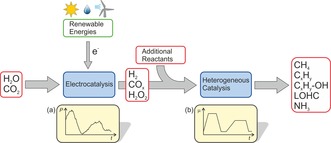
Figure 1
Figure 1
Schematic future scenario for power‐to‐chemicals processes demonstrating the importance of the development of more tolerant catalysts and processes a) time‐dependent power production by wind energy in 48 h (source: Fraunhofer ISE, KW 9, 2015), b) smoothed profile of hydrogen by intermediate storage.
Figure 2
Figure 2
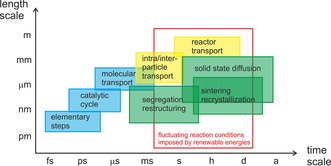
Typical time and length scales relevant for dynamic processes in catalysis. Blue: molecular processes at the active site; green: processes involving solid state catalysts, yellow: transport processes of reactants and products. The time frame important for dynamic operation addressed in the present concept article (indicated with a red box) includes microscopic and macroscopic length scales.
Figure 3
Figure 3
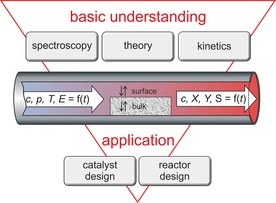
For understanding catalysts under dynamic reaction conditions different scientific disciplines such as (operando) spectroscopy, theory and kinetic modelling have to work hand in hand in order to provide a basic understanding of the relevant processes at the catalyst surface and the bulk. In a second step, this knowledge can then be implemented into the design of novel materials and reactor concepts. Fluctuations of the incoming variables concentration (c), pressure (p), temperature (T) and eventually electric potential (E) influence the local state of the catalyst and thereby lead to variations of the product stream composition in the form of concentration (c), conversion (X), yield (Y) and selectivity (S) of a specific product.
Figure 4
Figure 4
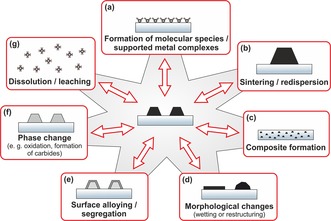
Examples for structural changes of supported metal nanoparticles resulting from changes of the environmental conditions (e.g. temperature, composition of the surrounding medium etc.).
Figure 5
Figure 5
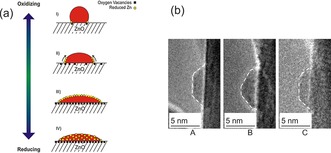
a) Dynamic model for the change of Cu‐particles in Cu/ZnO catalysts during the change of the reduction potential during methanol synthesis. Reprinted with permission from Ref. 13, Copyright 2000, Elsevier; b) TEM images showing the reversible shape change of a Cu nanocrystal. The same Cu nanocrystal is imaged at 220 °C under A) H2 at 1.5 mbar, B) H2/H2O (3:1) at a total pressure of 1.5 mbar, and C) H2 at 1.5 mbar. Reprinted with permission from Ref. 46, Copyright 2002, AAAS.
Figure 6
Figure 6
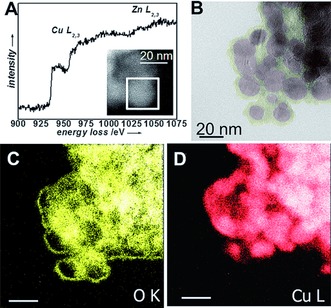
Analysis of the overgrowth of ZnO on Cu‐particles. A) STEM‐EELS‐spectrum of Cu/ZnO/Al2O3 of the Cu L2,3 and Zn L2,3 edge of one single Cu nanoparticle. The inset denotes the corresponding HAADF‐STEM image and the ROI from where the spectrum was collected. B) TEM image of the region where the EFTEM maps of C) and D) were recorded. C) and D) show oxygen K edge and copper L edge EFTEM maps of Cu/ZnO/Al2O3, respectively. The scale bars in C) and D) are 20 nm. Reprinted with permission from Ref. 47, Copyright 2015, Wiley‐VCH Verlag.
Figure 7
Figure 7
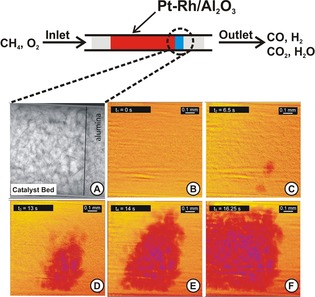
Spatio–temporal evolution of reduced Pt species during ignition of the catalytic partial oxidation of methane over 5 %Pt‐5 %Rh/Al2O3 (end of the evolution measured at 11 586 eV close to the Pt L3‐edge): A) X‐ray absorption image recorded below the ignition temperature; B–F) Images recorded as a function of time. A reddish color indicates lower absorption and thus the formation of a reduced Pt‐containing species. Adapted with permission from Ref. 78, Copyright 2009, American Chemical Society, and Ref. 79 with permission from the Royal Society of Chemistry.
Figure 8
Figure 8
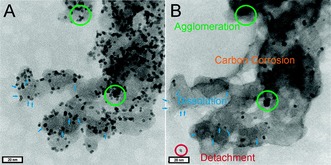
IL‐TEM images after 0 (A) and after 3600 (B) degradation cycles of a Pt/C fuel cell catalyst. Green circles indicate agglomeration, the red circle shows a detached platinum particle, blue arrows point at platinum particles that decrease in size due to dissolution; additionally, massive changes in the support structure are observed (denoted “carbon corrosion”). Reprinted with permission from Ref. 16, Copyright 2012, American Chemical Society.
Figure 9
Figure 9
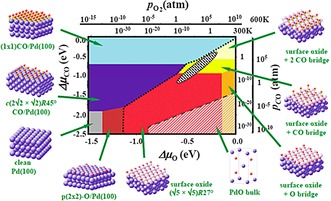
Surface phase diagram for a Pd(1 0 0) model catalyst in “constrained” thermodynamic equilibrium with an environment consisting of O2 and CO. Phases involving the pristine metal termination are above the dotted line, phases involving the surface oxide are below the dotted line, while bulk‐like PdO is stable at operation conditions below the dashed line. The dependence on the chemical potentials of O2 and CO in the gas phase is translated into pressure scales at 300 and 600 K. The black hatched ellipse marks gas‐phase conditions representative of technological CO oxidation catalysis, i.e., partial pressures of 1 atm and temperatures between 300 and 600 K. Adapted from Ref. 102; available under the terms of the Creative Commons Attribution 3.0 License, Copyright 2007.
Figure 10
Figure 10
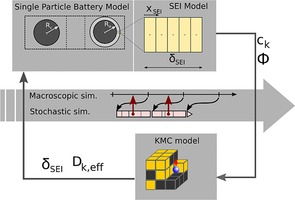
Multiscale model for a degrading Li ion battery: The macroscopic model contains a full battery cell model with mass and charge balances in electrolyte, electrode and degradation layer, whereas the kMC model contains the degradation kinetics with detailed sorption, reaction, surface diffusion processes and Li intercalation. The exchange of states and constants in each time step between the deterministic and stochastic model requires step size synchronization and filtering of kMC output.113
Figure 11
Figure 11
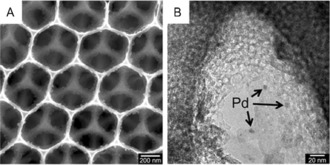
A) SEM and B) TEM images of a hierarchically porous Pd/TiO2 catalytic coating consisting of size controlled Pd nanoparticles derived from a colloidal synthesis. The nanoparticles were incorporated into the pore system of a hierarchically meso‐macro porous TiO2 obtained via dual pore templating with PMMA latex and micelles of Pluronic F127. The catalyst provides high activity and selectivity in the hydrogenation of butadiene. Reprinted with permission from Ref. 118, Copyright 2012, American Chemical Society.

References

    1. Thomas J. M., ChemSusChem 2014, 7, 1801–1832. - PubMed
    1. Schüth F., Chem. Ing. Tech. 2011, 83, 1984–1993.
    1. Chemical Energy Storage, Vol. 1. (Ed.: R. Schlögl), Walter de Gruyter, Berlin/Boston, 2013.
    1. Perathoner S., Centi G., Su D., ChemSusChem 2016, 9, 345–357. - PubMed
    1. Schlögl R., Angew. Chem. Int. Ed. 2015, 54, 4436–4439; - PubMed
    2. Angew. Chem. 2015, 127, 4512–4516. - PubMed