


The sink as a potential source of transmission of carbapenemase-producing Enterobacteriaceae in the intensive care unit
- PMID: 28239453
- PMCID: PMC5314675
- DOI: 10.1186/s13756-017-0182-3
The sink as a potential source of transmission of carbapenemase-producing Enterobacteriaceae in the intensive care unit
Abstract
Background: Carbapenemase-producing Enterobacteriaceae (CPE) are emerging pathogens that represent a major public health threat. In the University Hospital of Brussels, the incidence of new patients with CPE rose from 1 case in 2010 to 35 cases in 2015. Between January and August 2015, five patients became infected/colonized with CPE during their stay in the same room in the intensive care unit (ICU). Since the time period between those patients was relatively short and the strains belonged to different species with different antibiograms and mechanisms of resistance, the hypothesis was that the environment could be a possible source of transmission.
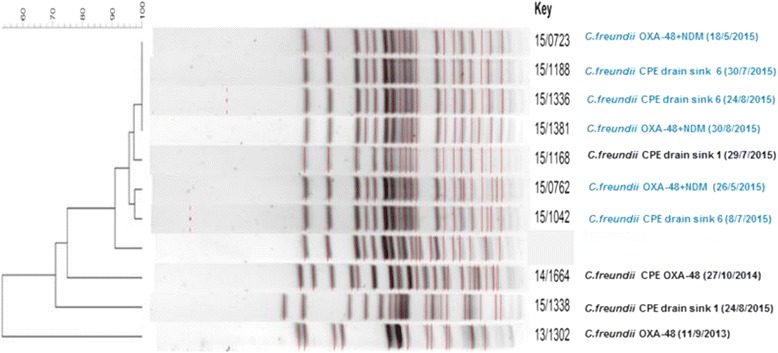
Methods and results: Environmental samples suggested that a contaminated sink was the source of the outbreak. Besides other strains, Citrobacter freundii type OXA-48 was frequently isolated from patients and sinks. To investigate the phylogenetic relationschip between those strains, pulsed-field gel electrophoresis was performed. The strains isolated from patients and the sink in the implicated room were highly related and pointed to sink-to-patient transmission. In total, 7 of 8 sinks in the isolation rooms of the ICU were found to be CPE contaminated. To control the outbreak, the sinks and their plumbings were replaced by new ones with another structure, they were flushed every morning with a glucoprotamin solution and routines regarding sink practices were improved leading to discontinuation of the outbreak.
Conclusions: This outbreak highlights that hospital sink drains can accumulate strains with resistance genes and become a potential source of CPE.
Keywords: Carbapenemase-producing Enterobacteriaceae; Citrobacter freundii OXA-48; Hospital sinks; Intensive care unit; Outbreak; Transmission.
Figures
References
-
- Döring G, Ulrich M, Müller W, Bitzer J, Schmidt-Koenig L, Münst L, Grupp H, Wolz C, Stern M, Botzenhart K. Generation of Pseudomonas aeruginosa aerosols during handwashing from contaminated sink drains, transmission to hands of hospital personnel, and its prevention by use of a new heating device. Zentralbl Hyg Umweltmed. 1991;191(5–6):494–505. - PubMed
-
- Kramer A, Daeschlein G, Niesytto C, Sissoko B, Sütterlin R, Blaschke M, Fusch C. Contamination of sinks and emission of nosocomial gramnegative pathogens in a NICU - outing of a reservoir as risk factor for nosocomial colonization and infection. Umweltmed. Forsch. Prax. 2005;10(5):327.
-
- Lowe C, Willey B, O’Shaughnessy A, Lee W, Lum M, Pike K, Larocque C, Dedier H, Dales L, Moore C. Outbreak of extended-spectrum β-lactamase-producing Klebsiella oxytoca infections associated with contaminated handwashing sinks. Emerg Infect Dis. 2012;18(8):1242–7. doi: 10.3201/eid1808.111268. - DOI - PMC - PubMed
LinkOut - more resources
Full Text Sources
Other Literature Sources
Research Materials
Miscellaneous
