


Gene profiling the window of implantation: Microarray analyses from human and rodent models
- PMID: 28239559
- PMCID: PMC5321051
- DOI: 10.1016/j.jrhm.2016.11.006
Gene profiling the window of implantation: Microarray analyses from human and rodent models
Abstract
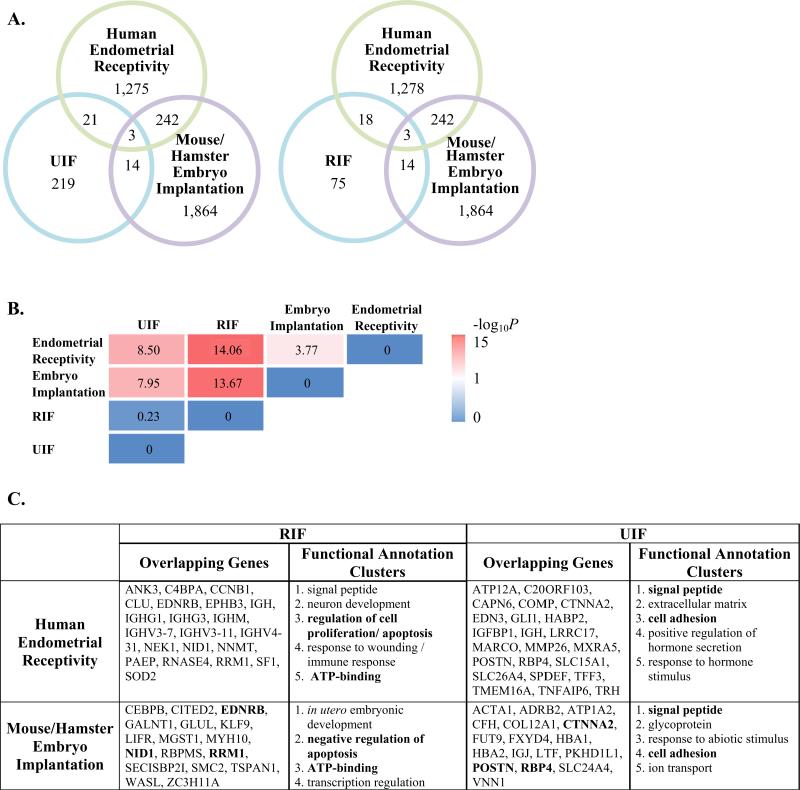
Poor uterine receptivity leads to implantation defects or failure. Identification of uterine molecules crucial to uterine receptivity and/or embryo implantation provides the opportunity to design a diagnostic screening toolkit for uterine receptivity or targeted drug discovery for treating implantation-based infertility. In this regard, gene-profiling studies performed in humans and rodents have identified numerous genes involved in the transcriptional regulation of uterine receptivity and embryo implantation. In this article, we compared available uterine microarray datasets collected during the time of uterine receptivity and implantation in humans, mice and hamsters to uncover conserved gene sets. We also compared the transcriptome signature of women with unexplained infertility (UIF) and recurrent implantation failure (RIF) to gain insight into genes potentially dysregulated during endometrial receptivity or embryo implantation. Among numerous differentially expressed genes, few were revealed that might have molecular diagnostic screening potential for identifying the uterine receptive state during the time of implantation. Finally, functional annotation of gene sets uncovered altered uterine apoptosis or cell adhesion pathways in women with UIF and RIF, respectively. These conserved or divergent gene sets provide insights into the uterine receptive state for supporting blastocyst implantation.
Keywords: Endometrial receptivity; Gene expression; Implantation site; Recurrent implantation failure; Unexplained infertility.
Figures
References
-
- Lee KY, Jeong JW, Tsai SY, Lydon JP, DeMayo FJ. Mouse models of implantation. Trends Endocrinol Metab. 2007;18:234–239. - PubMed
-
- Norwitz ER, Schust DJ, Fisher SJ. Implantation and the survival of early pregnancy. N Engl J Med. 2001;345:1400–1408. - PubMed
-
- Sharkey AM, Smith SK. The endometrium as a cause of implantation failure. Best Pract Res Clin Obstet Gynaecol. 2003;17:289–307. - PubMed
-
- Simon C, Moreno C, Remohi J, Pellicer A. Cytokines and embryo implantation. J Reprod Immunol. 1998;39:117–131. - PubMed
-
- Wilcox AJ, Baird DD, Weinberg CR. Time of implantation of the conceptus and loss of pregnancy. N Engl J Med. 1999;340:1796–1799. - PubMed
Grants and funding
LinkOut - more resources
Full Text Sources
Other Literature Sources