Review
. 2017;17(20):2271-2285.
doi: 10.2174/1568026617666170224122508.

Influenza A Virus Nucleoprotein: A Highly Conserved Multi-Functional Viral Protein as a Hot Antiviral Drug Target

Affiliations
Review

Influenza A Virus Nucleoprotein: A Highly Conserved Multi-Functional Viral Protein as a Hot Antiviral Drug Target

Yanmei Hu et al. Curr Top Med Chem. 2017.

Abstract

Prevention and treatment of influenza virus infection is an ongoing unmet medical need. Each year, thousands of deaths and millions of hospitalizations are attributed to influenza virus infection, which poses a tremendous health and economic burden to the society. Aside from the annual influenza season, influenza viruses also lead to occasional influenza pandemics as a result of emerging or re-emerging influenza strains. Influenza viruses are RNA viruses that exist in quasispecies, meaning that they have a very diverse genetic background. Such a feature creates a grand challenge in devising therapeutic intervention strategies to inhibit influenza virus replication, as a single agent might not be able to inhibit all influenza virus strains. Both classes of currently approved anti-influenza drugs have limitations: the M2 channel blockers amantadine and rimantadine are no longer recommended for use in the U.S. due to predominant drug resistance, and resistance to the neuraminidase inhibitor oseltamivir is continuously on the rise. In pursuing the next generation of antiviral drugs with broad-spectrum activity and higher genetic barrier of drug resistance, the influenza virus nucleoprotein (NP) stands out as a high-profile drug target. This review summarizes recent developments in designing inhibitors targeting influenza NP and their mechanisms of action.

Keywords: Antiviral drug resistance; Antivirals; Influenza virus; Nucleoprotein; Nucleozin; RNA viruses.


Figures

Fig. (1)
Fig. (1)
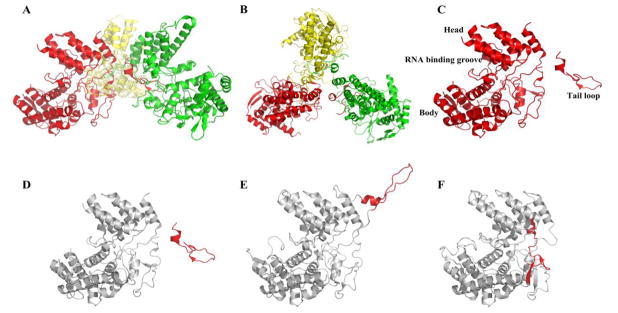
X-ray crystal structures of influenza A virus NP structures. (A) Side view of the H1N1 NP trimer (PDB: 2IQH); the monomers are colored in red, blue, and yellow. (B) Top view of the H1N1 NP trimer (PDB: 2IQH). (C) H1N1 NP monomer (PDB: 2IQH). (D) H1N1 NP monomer (PDB: 2IQH) with the tail-loop highlighted in red. (E) H5N1 NP monomer (PDB: 2Q06) with the tail-loop highlighted in red. (F) H1N1 NP_R416A mutant monomer (PDB: 3ZDP) with the tail-loop highlighted in red.
Fig. 2
Fig. 2
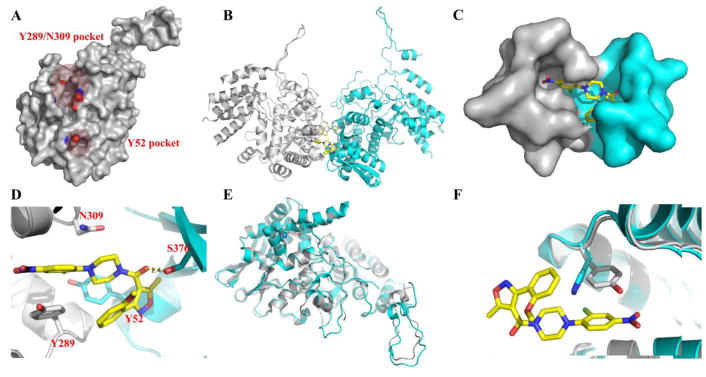
Co-crystal structures of compound 2–bound NP. (A) Surface representation of two drug-binding pockets in the body domain of NP. These two pockets are designated the Y289/N309 pocket (top) and the Y52 pocket (bottom). (B) Dimer structure of H1N1 NP in complex with compound 2 (PDB: 3RO5). (C) Surface representation of the drug-binding pocket located at the interface of two NP monomers. (D) Interactions between compound 2 and key residues surrounding the drug binding site. (E) Overlay structures of NP_Y289H (PDB: 4DYT) with compound 2–bound WT H1N1 NP (PDB: 3RO5). (F) Close view of the nucleozin binding pocket in the overlay structures (4DYT and 3RO5).
Fig. 3
Fig. 3
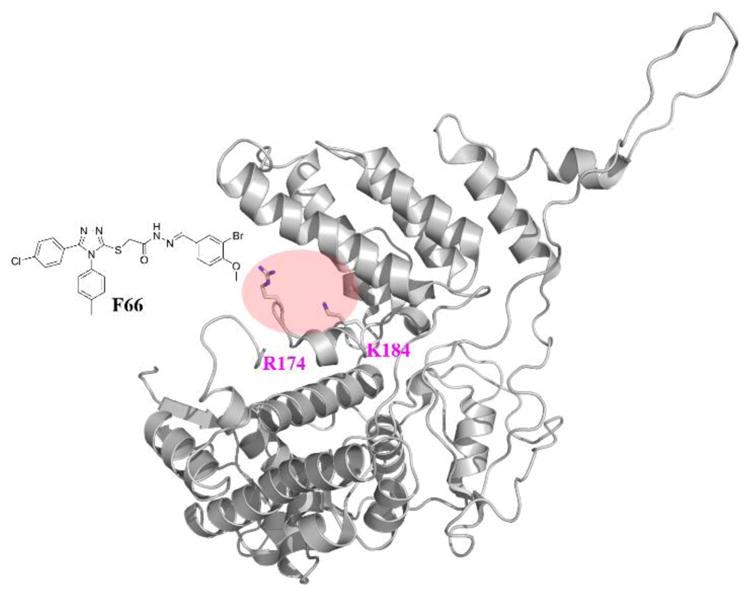
Chemical structure of F66 and its putative binding site in the RNA-binding groove of H5N1 NP (PDB: 2Q06).
Fig. 4
Fig. 4
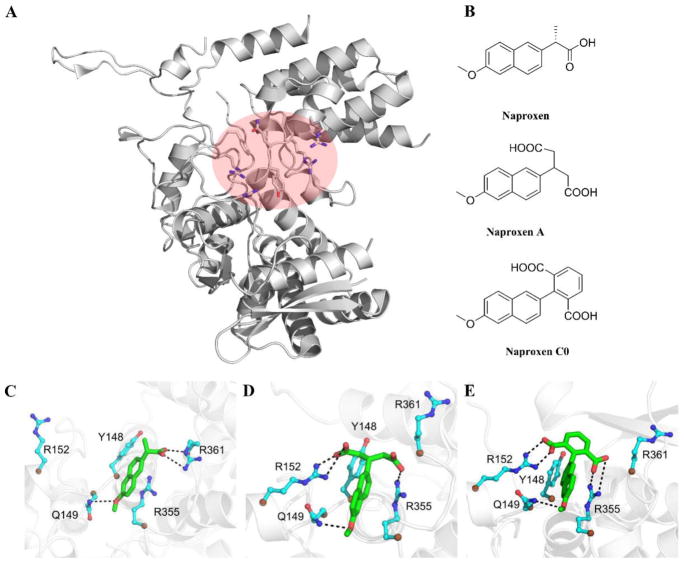
Binding of naproxen and its analogs to the H1N1 NP protein (PDB: 2IQH). (A) The drug binding site of naproxen in NP. (B) Chemical structures of naproxen and its analogs, naproxen A and naproxen C0. (C) One of the docked conformations of naproxen in the RNA-binding groove of NP. (D) Docked conformation of naproxen A in the RNA-binding groove of NP. (E) Docked conformation of naproxen C0 in the RNA-binding groove of NP. Figures 4C–E were reproduced from reference [88] with permission.
Fig. 5
Fig. 5
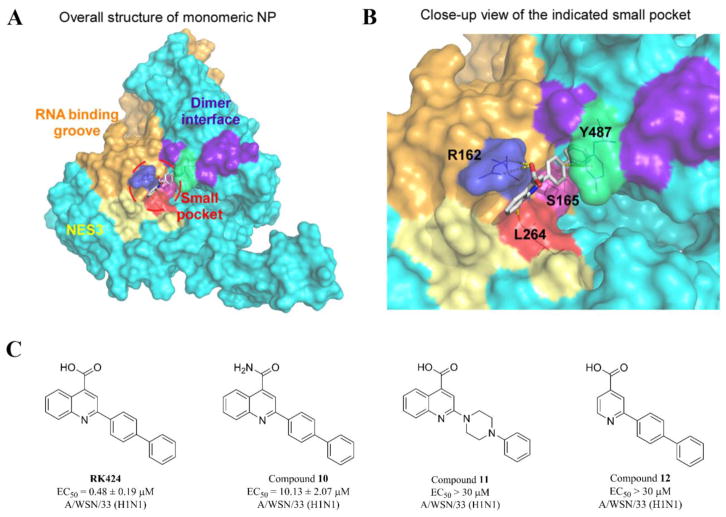
Binding mode of RK424 to H1N1 NP and structures of RK424 analogs. (A) Docked conformation of RK424 in H1N1 NP (PDB: 2IQH). The drug-binding pocket is adjacent to three critical domains: the RNA-binding groove, the dimer interface, and the NES3 domain. (B) Detailed molecular interaction between RK424 and NP. (C) Chemical structure and antiviral efficacy of RK424 and its analogs. Figures 5A–B were reproduced from reference [92] with permission.
Fig. 6
Fig. 6
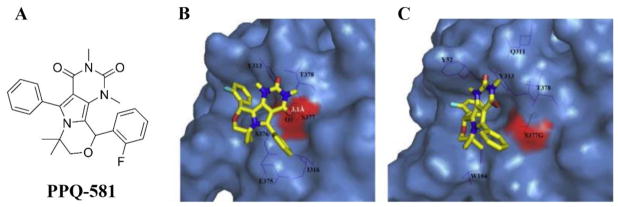
Chemical structure of PPQ-581 (A) and the docked poses of PPQ-581 in the wild-type NP (B) and the NP_S377G (C). Figures 6B–C were reproduced from reference [108], copyright © 2016 Elsevier Masson SAS. All rights reserved.
Fig. 7
Fig. 7
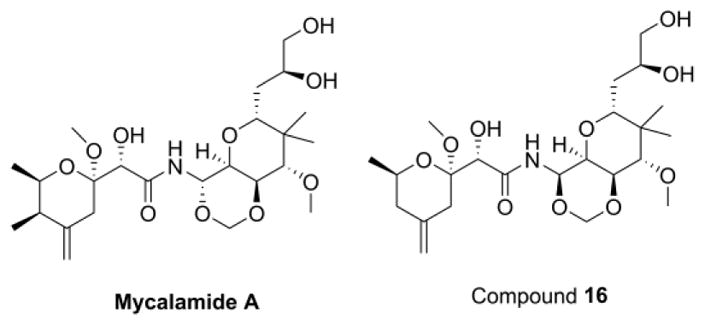
Chemical structures of mycalamide A and its analog compound 16.
Fig. 8
Fig. 8
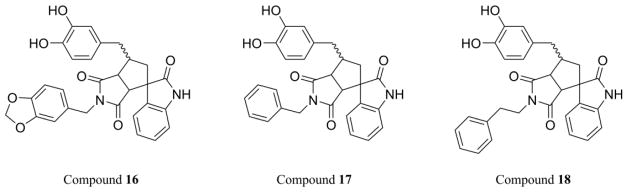
NP inhibitors identified from SPR screening.

References

    1. Thompson W, Shay D, Weintraub E, Brammer I, Bridges C, Cox N, Fukuda K. Influenza-associated hospitalizations in the United States. JAMA. 2004;292(11):1333–1340. - PubMed
    1. Thompson W, Shay D, Weintraub E, Brammer L, Cox N, Anderson L, Fukuda K. Mortality associated with influenza and respiratory syncytial virus in the United States. JAMA. 2003;289(2):179–186. - PubMed
    1. WHO. [Accessed Oct 7th 2015];Influenza fact sheet. http://www.who.int/mediacentre/factsheets/fs211/en/
    1. Taubenberger JK, Morens DM. The Pathology of Influenza Virus Infections. Annu Rev Pathol. 2008;3(1):499–522. - PMC - PubMed
    1. Killingley B, Nguyen-Van-Tam J. Routes of influenza transmission. Influenza Other Respir Viruses. 2013;7:42–51. - PMC - PubMed

MeSH terms