. 2017 Feb 27;12(2):e0172612.
doi: 10.1371/journal.pone.0172612. eCollection 2017.

Early post-treatment choroidal thickness to alert sunset glow fundus in patients with Vogt-Koyanagi-Harada disease treated with systemic corticosteroids

Affiliations

Early post-treatment choroidal thickness to alert sunset glow fundus in patients with Vogt-Koyanagi-Harada disease treated with systemic corticosteroids

Kiriko Hirooka et al. PLoS One. .

Abstract

Purpose: To determine if early post-treatment central choroidal thickness (CCT) changes can predict sunset glow fundus (SGF) development in patients with Vogt-Koyanagi-Harada (VKH) disease treated using systemic corticosteroids.

Methods: This retrospective case series included 39 eyes of 21 treatment-naïve patients with acute VKH disease who could be followed up for more than 12 months after systemic corticosteroid therapy. The eyes were divided into two groups according to whether SGF was present or absent at 12 months (9 eyes of 5 patients versus 30 eyes of 16 patients, respectively). Using enhanced depth imaging optical coherence tomography, CCT values were measured before treatment, then at 1 week and 1 and 3 months after treatment in both groups and compared between the two groups.

Results: Development of SGF was found 4-11 months after treatment. Mean post-treatment CCT decreased significantly at all examinations compared with baseline in both groups, along with resolution of serous retinal detachment. One week after treatment, mean CCT was significantly higher in eyes with SGF than in those without (P = 0.024). SGF was present at 12 months in 9 of 22 eyes with CCT values > 410 μm at 1 week after starting treatment, in contrast with none of 17 eyes with CCT ≤ 410 μm at this time (P = 0.003).

Conclusions: The current study suggested the potential validity of early post-treatment CCT as a feasible index to alert future progression to SGF in patients with VKH disease treated using systemic corticosteroids.


Conflict of interest statement

Competing Interests: The authors have declared that no competing interests exist.

Figures

Fig 1
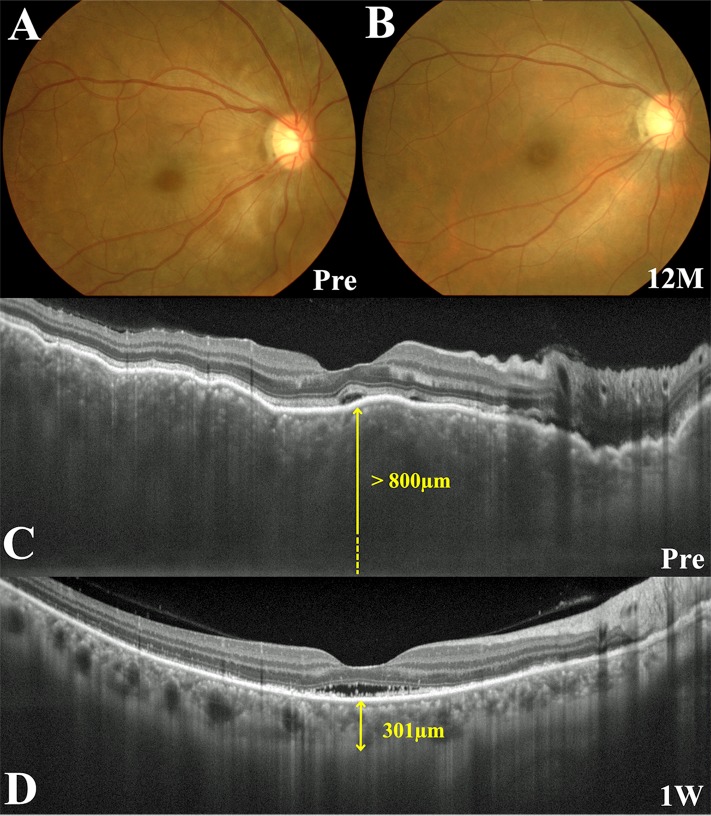
Fig 1. Images of the right eye in a patient with Vogt-Koyanagi-Harada disease who did not develop sunset glow fundus (SGF) during follow-up (Case 15).
(A, B) Fundus photographs show serous retinal detachment (SRD) extending from the peripapillary area to the posterior pole, choroidal folds, and optic disc swelling before treatment (A) and complete resolution of SRD without onset of SGF at 12 months after the start of systemic corticosteroid therapy (B). (C, D) Horizontal images through the fovea on enhanced depth imaging optical coherence tomography. A pretreatment image demonstrates SRD extending from the optic disc to the macula, bumpy undulation of the retinal pigment epithelium, and marked choroidal thickening. Central choroidal thickness (CCT) was > 800 μm (C). One week after initiation of systemic corticosteroid therapy, the SRD in the vicinity of the disc disappeared and the CCT decreased to 301.0 μm (D).
Fig 2
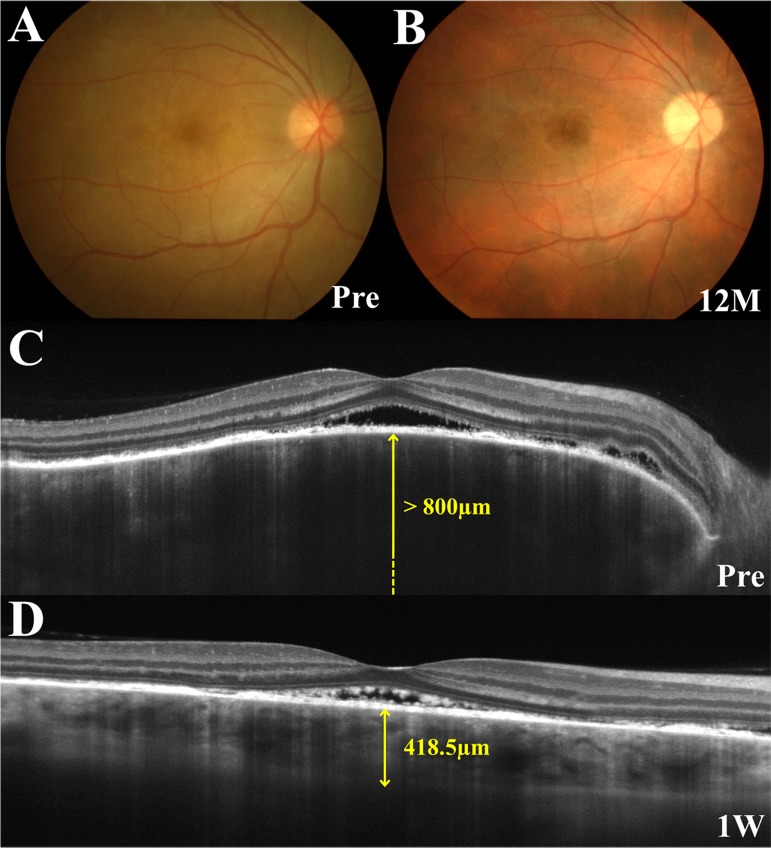
Fig 2. Images of the right eye in a patient with Vogt-Koyanagi-Harada disease who developed sunset glow fundus (SGF) during follow-up (Case 4).
(A, B) Fundus photographs show serous retinal detachment (SRD) extending from the disc to the macula and optic disc swelling before treatment (A) and the presence of SGF with disappearance of SRD at 12 months (B). (C, D) Horizontal images through the fovea on enhanced depth imaging optical coherence tomography. An image taken before treatment demonstrates SRD at the posterior pole and marked choroidal thickening. Central choroidal thickness (CCT) was > 800 μm (C). One week after start of systemic corticosteroids, the area of SRD reduced and the CCT also decreased to 418.5 μm (D).
Fig 3
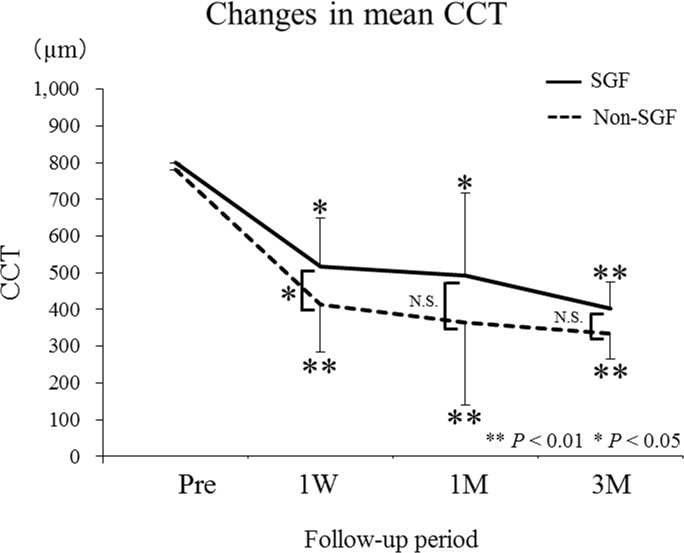
Fig 3. Changes in mean central choroidal thickness (CCT) in the sunset glow fundus (SGF) and non-SGF groups before and after systemic corticosteroid therapy.
The mean post-treatment CCT decreased significantly at all examinations in both groups when compared with baseline. Note that the mean CCT at 1 week after starting treatment was significantly higher in the SGF group (518.2 ± 131.6 μm) than in the non-SGF group (414.8 ± 141.6 μm).
Fig 4
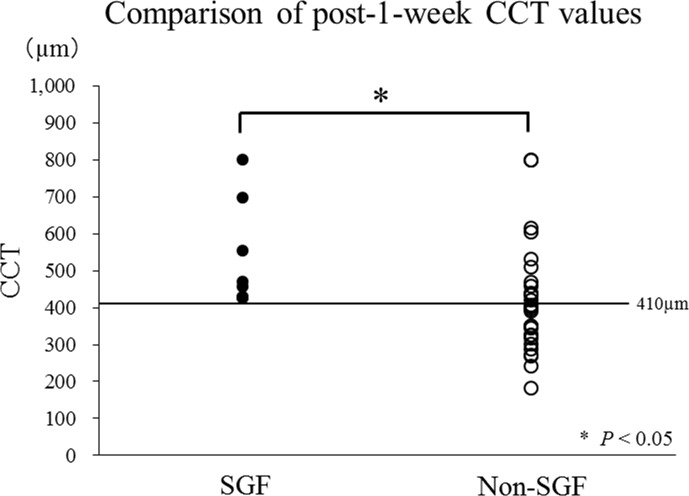
Fig 4. Comparison of central choroidal thickness (CCT) between the sunset glow fundus (SGF) and non-SGF groups at 1 week after starting treatment.
There was a significant difference in the thick:thin ratio with a cut-off value of 410 μm for CCT between the SGF (9:0 eyes) and non-SGF (13:17 eyes) groups at 1 week after starting treatment (P = 0.003).

References

    1. Greco A, Fusconi M, Gallo A, Turchetta R, Marinelli C, Macri GF, et al. Vogt-Koyanagi-Harada syndrome. Autoimmun Rev. 2013; 12: 1033–1038. 10.1016/j.autrev.2013.01.004 - DOI - PubMed
    1. Ohno S, Minakawa R, Matsuda H. Clinical studies of Vogt-Koyanagi-Harada's disease. Jpn J Ophthalmol. 1988; 32: 334–343. - PubMed
    1. Read RW, Rechodouni A, Butani N, Johnston R, LaBree LD, Smith RE, et al. Complications and prognostic factors in Vogt-Koyanagi-Harada disease. See comment in PubMed Commons belowAm J Ophthalmol. 2001; 131: 599–606. - PubMed
    1. Goto H, Rao NA. Sympathetic ophthalmia and Vogt-Koyanagi-Harada syndrome. Int Ophthalmol Clin. 1990; 30: 279–285. - PubMed
    1. Keino H, Goto H, Mori H, Iwasaki T, Usui M. Association between severity of inflammation in CNS and development of sunset glow fundus in Vogt-Koyanagi-Harada disease. Am J Ophthalmol. 2006; 141: 1140–1142. 10.1016/j.ajo.2006.01.017 - DOI - PubMed