


Stress, self-esteem and well-being among female health professionals: A randomized clinical trial on the impact of a self-care intervention mediated by the senses
- PMID: 28241070
- PMCID: PMC5328264
- DOI: 10.1371/journal.pone.0172455
Stress, self-esteem and well-being among female health professionals: A randomized clinical trial on the impact of a self-care intervention mediated by the senses
Abstract
Background: Stress levels are evident among health professionals. However, there are few studies on sensory-based self-care aimed at stress management, self-esteem and subjective well-being in this group of professionals.
Objective: To assess the impact of a self-care intervention mediated by the senses on the stress levels, self-esteem and well-being of health professionals in a hospital environment.
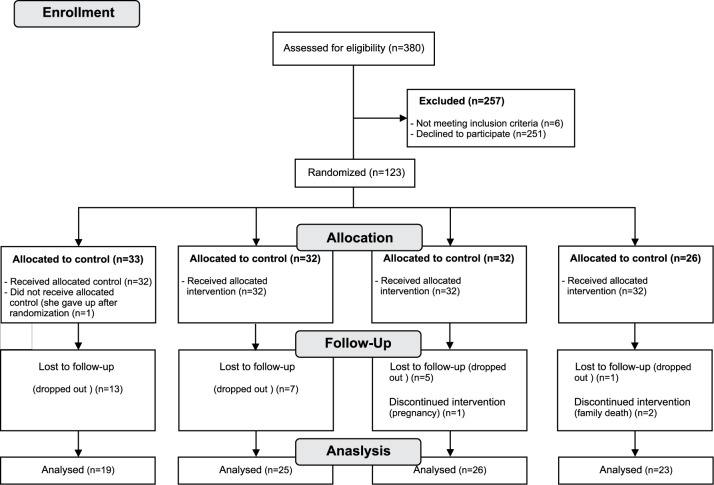
Methods: A total of 93 health professionals participated in an unblinded clinical trial, randomized into four groups: 1) control (no intervention); 2) Monosensory-daily body moisturizing (DBM) with odorless cream; 3) Bisensory-DBM with scented cream; 4) Multisensory-DBM with scented cream associated with audiovisual material. Participants answered specific questionnaires to assess stress, self-esteem and well-being and cortisol samples were collected at baseline, 15 and 30 days following intervention, and at the 30-day follow-up.
Results: Self-care was characterized as neglected, with most participants reporting inadequate hours of sleep (74%), irregular physical activity (68%), and inadequate nutrition (45%). Compared to the other groups, the Bisensory group had lower stress on all three assessments (p = 0.017; 0.012; 0.036), a life satisfaction 8% higher at follow-up than at baseline (95% CI: 2% to 15%, p = 0.016), a 10% increase in positive affect (95% CI: 2% to 19%, p = 0.011) and a 12% reduction in negative affect (95% CI: 3% to 21% less, p = 0.014) after 30 days. The Multisensory group showed improvement in self-esteem (p = 0.012) and reduced cortisol (p = 0.036) after 30 days of intervention. The control group showed no changes in the variables studied, except for cortisol: an increase at the 15-day evaluation (denoting higher risk for stress, p = 0.009) and a reduction at follow-up (p = 0.028), which was nevertheless within normal levels.
Trial registration: Clinicaltrials.gov NCT02406755.
Conflict of interest statement
References
-
- Blegen MA. Nurses’ job satisfaction: a meta-analysis of related variables. Nursing Research. 1993; 42:36–41. - PubMed
-
- Cooper CL, Dewe PJ, O`Driscoll MO. Organizational stress: a review and critique of theory, research, and applications. London: Sage; 2001.
-
- Borda RC, Norman IJ. Factors influencing turnover and absence of nurses: a research review. Int J Nurs Stud.1997; 34:385–94. - PubMed
-
- Cascio WF. Whiter industrial and organizational psychology in a changing world of work? Am Psychol. 1995; 50:928–39.
-
- Silva MCM, Gomes RS. Occupational stress in health professionals: a study with portuguese doctor’s and nurse practitioners.Psychol Studies. 2009; 14(3):239–48.
Publication types
MeSH terms
Substances
Associated data
LinkOut - more resources
Full Text Sources
Other Literature Sources
Medical
