Timed Light Therapy for Sleep and Daytime Sleepiness Associated With Parkinson Disease: A Randomized Clinical Trial
- PMID: 28241159
- PMCID: PMC5470356
- DOI: 10.1001/jamaneurol.2016.5192
Timed Light Therapy for Sleep and Daytime Sleepiness Associated With Parkinson Disease: A Randomized Clinical Trial
Abstract
Importance: Impaired sleep and alertness are some of the most common nonmotor manifestations of Parkinson disease (PD) and currently have only limited treatment options. Light therapy (LT), a widely available treatment modality in sleep medicine, has not been systematically studied in the PD population.
Objective: To determine the safety and efficacy of LT on excessive daytime sleepiness (EDS) associated with PD.
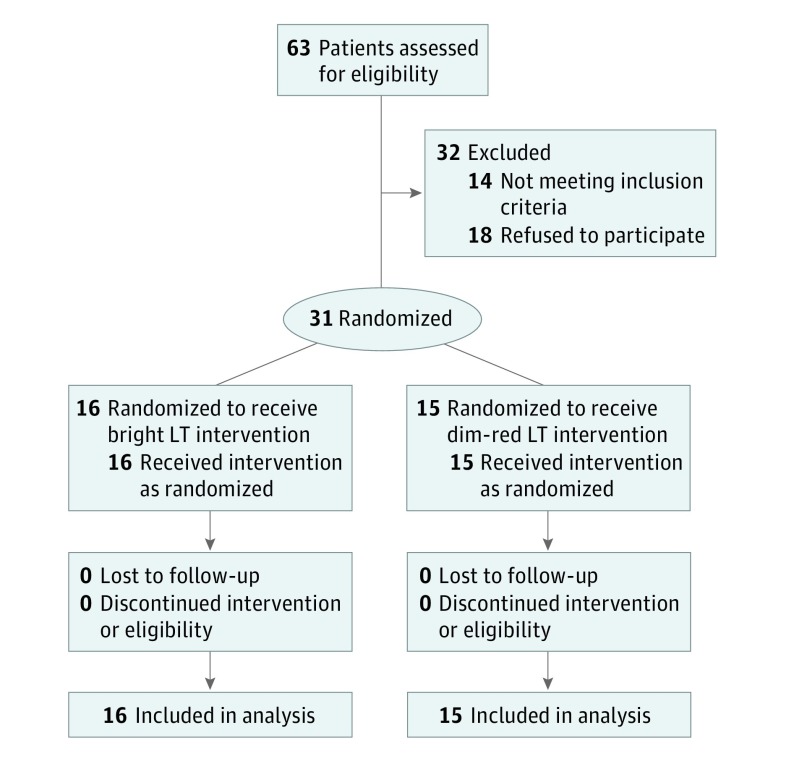
Design, settings, and participants: This randomized, placebo-controlled, clinical intervention study was set in PD centers at Northwestern University and Rush University. Participants were 31 patients with PD receiving stable dopaminergic therapy with coexistent EDS, as assessed by an Epworth Sleepiness Scale score of 12 or greater, and without cognitive impairment or primary sleep disorder. Participants were randomized 1:1 to receive bright LT or dim-red LT (controlled condition) twice daily in 1-hour intervals for 14 days. This trial was conducted between March 1, 2007, and October 31, 2012. Data analysis of the intention-to-treat population was conducted from November 1, 2012, through April 30, 2016.
Main outcomes and measures: The primary outcome measure was the change in the Epworth Sleepiness Scale score comparing the bright LT with the dim-red LT. Secondary outcome measures included the Pittsburgh Sleep Quality Index score, the Parkinson's Disease Sleep Scale score, the visual analog scale score for daytime sleepiness, and sleep log-derived and actigraphy-derived metrics.
Results: Among the 31 patients (13 males and 18 females; mean [SD] disease duration, 5.9 [3.6] years), bright LT resulted in significant improvements in EDS, as assessed by the Epworth Sleepiness Scale score (mean [SD], 15.81 [3.10] at baseline vs 11.19 [3.31] after the intervention). Both bright LT and dim-red LT were associated with improvements in sleep quality as captured by mean (SD) scores on the Pittsburg Sleep Quality Index (7.88 [4.11] at baseline vs 6.25 [4.27] after bright LT, and 8.87 [2.83] at baseline vs 7.33 [3.52] after dim-red LT) and the Parkinson's Disease Sleep Scale (97.24 [22.49] at baseline vs 106.98 [19.37] after bright LT, and 95.11 [19.86] at baseline vs 99.28 [16.94] after dim-red LT). Bright LT improved several self-reported mean (SD) sleep metrics, including sleep fragmentation (number of overnight awakenings, 1.51 [1.03] at baseline vs 0.92 [0.97] after the intervention), sleep quality (sleep diary score, 3.03 [1.01] at baseline vs 3.53 [0.91] after the intervention), and ease of falling asleep (sleep diary score, 2.32 [0.89] at baseline vs 1.83 [0.88] after the intervention). Light therapy was associated with increased daily physical activity as assessed by actigraphy (average activity [SD] counts, 165.01 [66.87] at baseline vs 194.59 [87.81] after the intervention).
Conclusions and relevance: Light therapy was well tolerated and may be a feasible intervention for improving the sleep-wake cycles in patients with PD. Further studies are required to determine optimal parameters of LT for PD.
Trial registration: clinicaltrials.gov Identifier: NCT01338649.
Conflict of interest statement
Figures
Comment in
-
Circadian Rhythms and Chronotherapeutics-Underappreciated Approach to Improving Sleep and Wakefulness in Parkinson Disease.JAMA Neurol. 2017 Apr 1;74(4):387-388. doi: 10.1001/jamaneurol.2016.5519. JAMA Neurol. 2017. PMID: 28241156 No abstract available.
-
Light Therapy Promoting Dopamine Release by Stimulating Retina in Parkinson Disease-Reply.JAMA Neurol. 2017 Oct 1;74(10):1268-1269. doi: 10.1001/jamaneurol.2017.1909. JAMA Neurol. 2017. PMID: 28806434 No abstract available.
-
Light Therapy Promoting Dopamine Release by Stimulating Retina in Parkinson Disease.JAMA Neurol. 2017 Oct 1;74(10):1267-1268. doi: 10.1001/jamaneurol.2017.1906. JAMA Neurol. 2017. PMID: 28806435 No abstract available.
References
-
- Alves G, Forsaa EB, Pedersen KF, Dreetz Gjerstad M, Larsen JP. Epidemiology of Parkinson’s disease. J Neurol. 2008;255(suppl 5):18-32. - PubMed
-
- Dorsey ER, Constantinescu R, Thompson JP, et al. . Projected number of people with Parkinson disease in the most populous nations, 2005 through 2030. Neurology. 2007;68(5):384-386. - PubMed
-
- Lees AJ, Blackburn NA, Campbell VL. The nighttime problems of Parkinson’s disease. Clin Neuropharmacol. 1988;11(6):512-519. - PubMed
-
- Tandberg E, Larsen JP, Karlsen K. A community-based study of sleep disorders in patients with Parkinson’s disease. Mov Disord. 1998;13(6):895-899. - PubMed
Publication types
MeSH terms
Associated data
Grants and funding
LinkOut - more resources
Full Text Sources
Other Literature Sources
Medical
Miscellaneous