Association Between Telomere Length and Risk of Cancer and Non-Neoplastic Diseases: A Mendelian Randomization Study
- PMID: 28241208
- PMCID: PMC5638008
- DOI: 10.1001/jamaoncol.2016.5945
Association Between Telomere Length and Risk of Cancer and Non-Neoplastic Diseases: A Mendelian Randomization Study
Abstract
Importance: The causal direction and magnitude of the association between telomere length and incidence of cancer and non-neoplastic diseases is uncertain owing to the susceptibility of observational studies to confounding and reverse causation.
Objective: To conduct a Mendelian randomization study, using germline genetic variants as instrumental variables, to appraise the causal relevance of telomere length for risk of cancer and non-neoplastic diseases.
Data sources: Genomewide association studies (GWAS) published up to January 15, 2015.
Study selection: GWAS of noncommunicable diseases that assayed germline genetic variation and did not select cohort or control participants on the basis of preexisting diseases. Of 163 GWAS of noncommunicable diseases identified, summary data from 103 were available.
Data extraction and synthesis: Summary association statistics for single nucleotide polymorphisms (SNPs) that are strongly associated with telomere length in the general population.
Main outcomes and measures: Odds ratios (ORs) and 95% confidence intervals (CIs) for disease per standard deviation (SD) higher telomere length due to germline genetic variation.
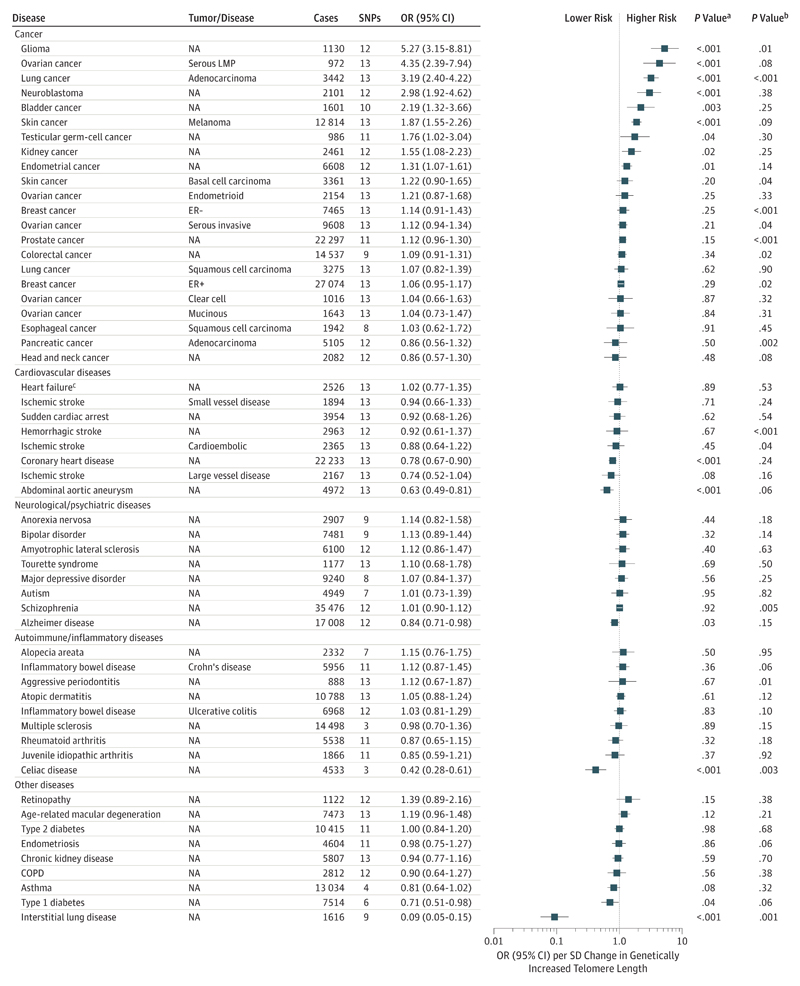
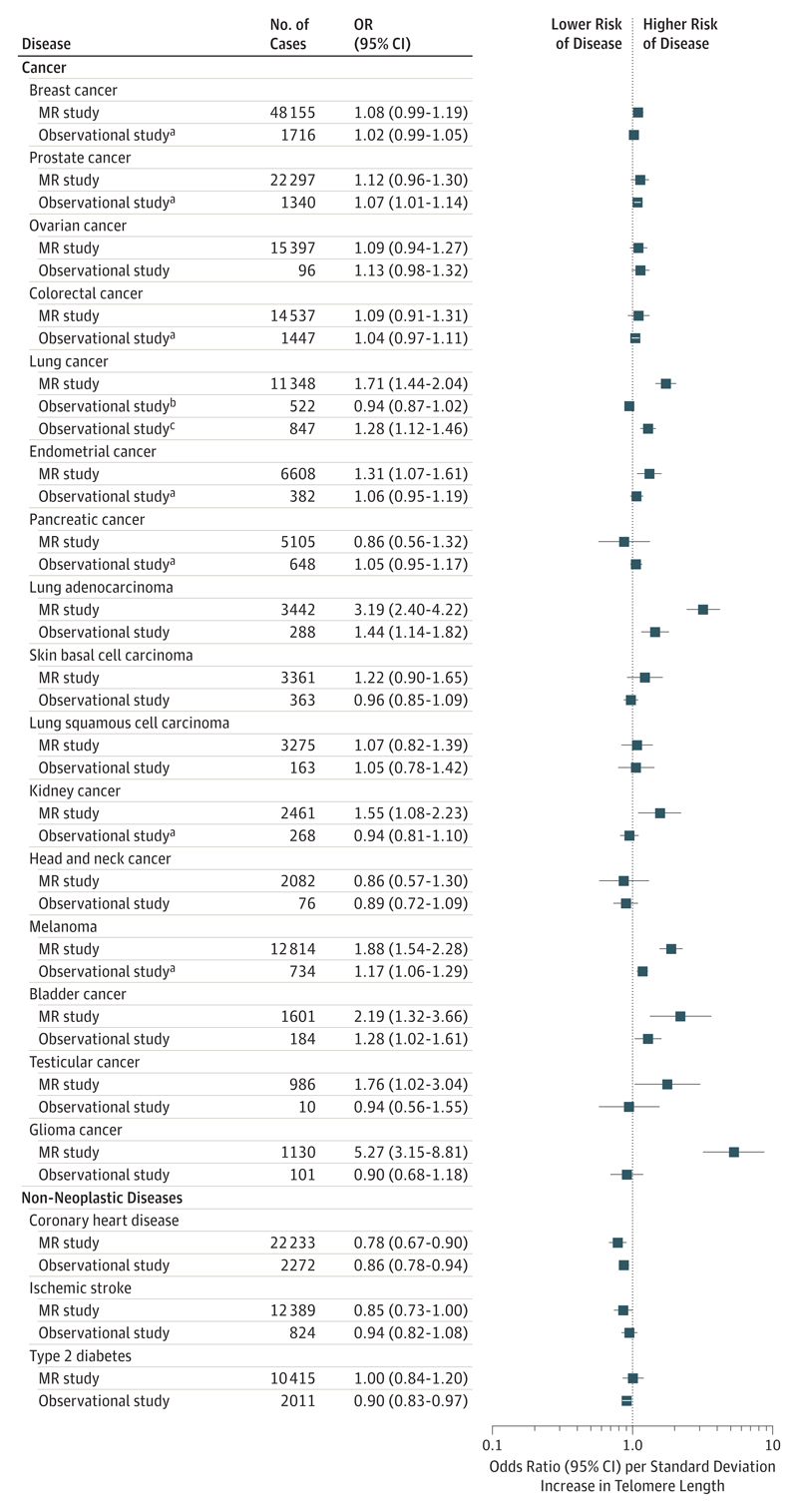
Results: Summary data were available for 35 cancers and 48 non-neoplastic diseases, corresponding to 420 081 cases (median cases, 2526 per disease) and 1 093 105 controls (median, 6789 per disease). Increased telomere length due to germline genetic variation was generally associated with increased risk for site-specific cancers. The strongest associations (ORs [95% CIs] per 1-SD change in genetically increased telomere length) were observed for glioma, 5.27 (3.15-8.81); serous low-malignant-potential ovarian cancer, 4.35 (2.39-7.94); lung adenocarcinoma, 3.19 (2.40-4.22); neuroblastoma, 2.98 (1.92-4.62); bladder cancer, 2.19 (1.32-3.66); melanoma, 1.87 (1.55-2.26); testicular cancer, 1.76 (1.02-3.04); kidney cancer, 1.55 (1.08-2.23); and endometrial cancer, 1.31 (1.07-1.61). Associations were stronger for rarer cancers and at tissue sites with lower rates of stem cell division. There was generally little evidence of association between genetically increased telomere length and risk of psychiatric, autoimmune, inflammatory, diabetic, and other non-neoplastic diseases, except for coronary heart disease (OR, 0.78 [95% CI, 0.67-0.90]), abdominal aortic aneurysm (OR, 0.63 [95% CI, 0.49-0.81]), celiac disease (OR, 0.42 [95% CI, 0.28-0.61]) and interstitial lung disease (OR, 0.09 [95% CI, 0.05-0.15]).
Conclusions and relevance: It is likely that longer telomeres increase risk for several cancers but reduce risk for some non-neoplastic diseases, including cardiovascular diseases.
Conflict of interest statement
Figures

Comment in
-
Telomere Length and Risk of Cancer and Non-neoplastic Diseases: Is Survivin the Ariadne's Thread?JAMA Oncol. 2017 Dec 1;3(12):1740-1741. doi: 10.1001/jamaoncol.2017.2313. JAMA Oncol. 2017. PMID: 28796863 No abstract available.
-
Telomere Length and Risk of Cancer and Non-neoplastic Diseases: Is Survivin the Ariadne's Thread?-Reply.JAMA Oncol. 2017 Dec 1;3(12):1741-1742. doi: 10.1001/jamaoncol.2017.2316. JAMA Oncol. 2017. PMID: 28796865 No abstract available.
References
-
- Blackburn EH, Epel ES, Lin J. Human telomere biology: a contributory and interactive factor in aging, disease risks, and protection. Science. 2015;350(6265):1193–1198. - PubMed
-
- Samani NJ, van der Harst P. Biological ageing and cardiovascular disease. Heart. 2008;94(5):537–539. - PubMed
-
- Houben JMJ, Moonen HJJ, van Schooten FJ, Hageman GJ. Telomere length assessment: biomarker of chronic oxidative stress? Free Radic Biol Med. 2008;44(3):235–246. - PubMed
MeSH terms
Grants and funding
- R01 DK106621/DK/NIDDK NIH HHS/United States
- ZIA EY000403/ImNIH/Intramural NIH HHS/United States
- 19169/CRUK_/Cancer Research UK/United Kingdom
- T32 NS047996/NS/NINDS NIH HHS/United States
- R01 HL077612/HL/NHLBI NIH HHS/United States
- Z01 EY000403/ImNIH/Intramural NIH HHS/United States
- G1001158/MRC_/Medical Research Council/United Kingdom
- UL1 TR000124/TR/NCATS NIH HHS/United States
- 19167/CRUK_/Cancer Research UK/United Kingdom
- P50 CA102701/CA/NCI NIH HHS/United States
- P50 CA097257/CA/NCI NIH HHS/United States
- MC_UU_12013/4/MRC_/Medical Research Council/United Kingdom
- R01 DK107904/DK/NIDDK NIH HHS/United States
- R33 HL120770/HL/NHLBI NIH HHS/United States
- MC_UU_12013/8/MRC_/Medical Research Council/United Kingdom
- P20 GM103534/GM/NIGMS NIH HHS/United States
- P01 HL092870/HL/NHLBI NIH HHS/United States
- MC_UU_12013/3/MRC_/Medical Research Council/United Kingdom
- Z99 EY999999/ImNIH/Intramural NIH HHS/United States
- U01 HG006382/HG/NHGRI NIH HHS/United States
- RG/08/014/24067/BHF_/British Heart Foundation/United Kingdom
- G0700491/MRC_/Medical Research Council/United Kingdom
- MR/L003120/1/MRC_/Medical Research Council/United Kingdom
- P30 CA023108/CA/NCI NIH HHS/United States
- R01 HL105756/HL/NHLBI NIH HHS/United States
- MC_UU_00002/7/MRC_/Medical Research Council/United Kingdom
- MC_EX_MR/L012286/1/MRC_/Medical Research Council/United Kingdom
- P30 DK063491/DK/NIDDK NIH HHS/United States
- MR/M012816/1/MRC_/Medical Research Council/United Kingdom
- 16563/CRUK_/Cancer Research UK/United Kingdom
- P30 AR070549/AR/NIAMS NIH HHS/United States
- 20138/CRUK_/Cancer Research UK/United Kingdom
- R01 HL064310/HL/NHLBI NIH HHS/United States
- R01 HL097163/HL/NHLBI NIH HHS/United States
- 204623/Z/16/Z/WT_/Wellcome Trust/United Kingdom
- UL1 TR001881/TR/NCATS NIH HHS/United States
- 202802/Z/16/Z/WT_/Wellcome Trust/United Kingdom
- UM1 CA182883/CA/NCI NIH HHS/United States
- P30 AR047363/AR/NIAMS NIH HHS/United States
- 001/WHO_/World Health Organization/International
- R01 CA052689/CA/NCI NIH HHS/United States
- MC_UU_12013/2/MRC_/Medical Research Council/United Kingdom
LinkOut - more resources
Full Text Sources
Other Literature Sources