Management of Severe Pancreatic Fistula After Pancreatoduodenectomy
- PMID: 28241220
- PMCID: PMC5831426
- DOI: 10.1001/jamasurg.2016.5708
Management of Severe Pancreatic Fistula After Pancreatoduodenectomy
Abstract
Importance: Postoperative pancreatic fistula is a potentially life-threatening complication after pancreatoduodenectomy. Evidence for best management is lacking.
Objective: To evaluate the clinical outcome of patients undergoing catheter drainage compared with relaparotomy as primary treatment for pancreatic fistula after pancreatoduodenectomy.
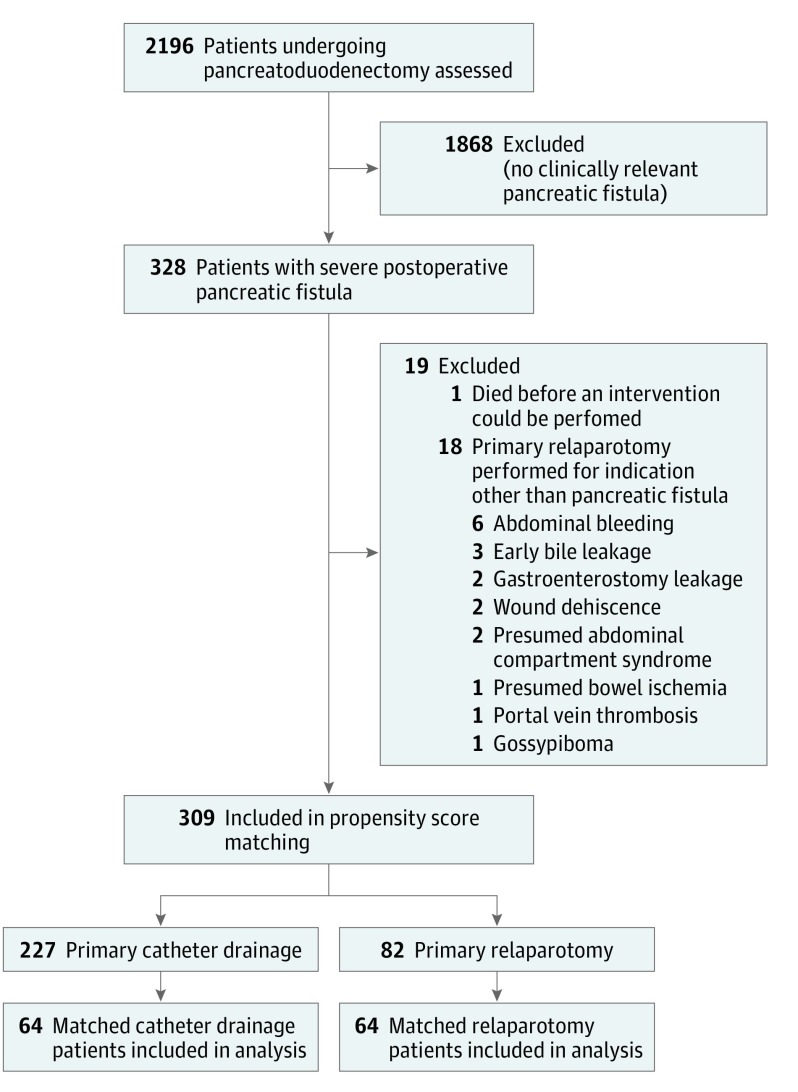
Design, setting, and participants: A multicenter, retrospective, propensity-matched cohort study was conducted in 9 centers of the Dutch Pancreatic Cancer Group from January 1, 2005, to September 30, 2013. From a cohort of 2196 consecutive patients who underwent pancreatoduodenectomy, 309 patients with severe pancreatic fistula were included. Propensity score matching (based on sex, age, comorbidity, disease severity, and previous reinterventions) was used to minimize selection bias. Data analysis was performed from January to July 2016.
Exposures: First intervention for pancreatic fistula: catheter drainage or relaparotomy.
Main outcomes and measures: Primary end point was in-hospital mortality; secondary end points included new-onset organ failure.
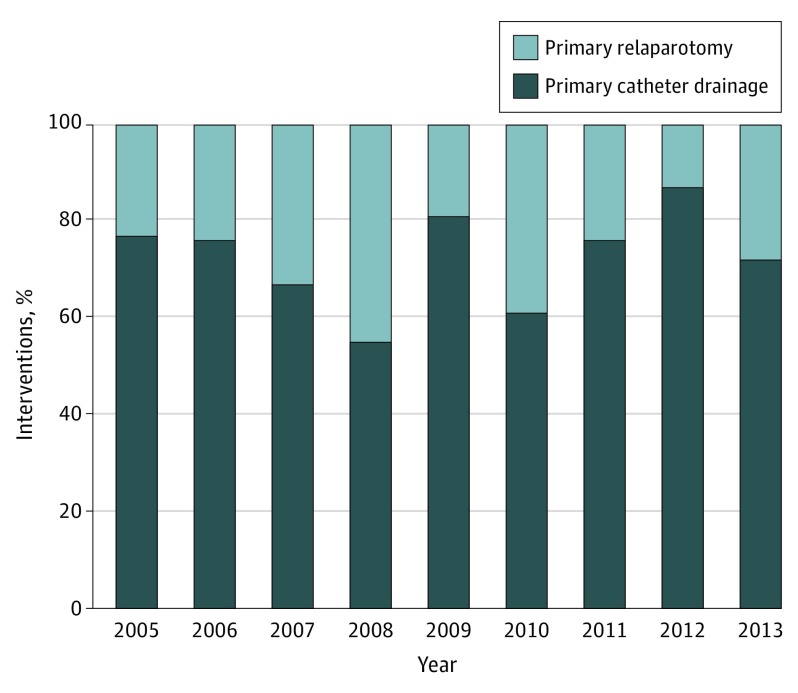
Results: Of the 309 patients included in the analysis, 209 (67.6%) were men, and mean (SD) age was 64.6 (10.1) years. Overall in-hospital mortality was 17.8% (55 patients): 227 patients (73.5%) underwent primary catheter drainage and 82 patients (26.5%) underwent primary relaparotomy. Primary catheter drainage was successful (ie, survival without relaparotomy) in 175 patients (77.1%). With propensity score matching, 64 patients undergoing primary relaparotomy were matched to 64 patients undergoing primary catheter drainage. Mortality was lower after catheter drainage (14.1% vs 35.9%; P = .007; risk ratio, 0.39; 95% CI, 0.20-0.76). The rate of new-onset single-organ failure (4.7% vs 20.3%; P = .007; risk ratio, 0.15; 95% CI, 0.03-0.60) and new-onset multiple-organ failure (15.6% vs 39.1%; P = .008; risk ratio, 0.40; 95% CI, 0.20-0.77) were also lower after primary catheter drainage.
Conclusions and relevance: In this propensity-matched cohort, catheter drainage as first intervention for severe pancreatic fistula after pancreatoduodenectomy was associated with a better clinical outcome, including lower mortality, compared with primary relaparotomy.
Conflict of interest statement
Figures
Comment in
-
"Step-Up Approach" for the Treatment of Postoperative Severe Pancreatic Fistula: Is It Really Possible and Useful?JAMA Surg. 2017 Jun 1;152(6):548-549. doi: 10.1001/jamasurg.2016.5710. JAMA Surg. 2017. PMID: 28241218 No abstract available.
-
Nonoperative Management of Pancreatic Fistula: Why Not an Endoscopic Approach?JAMA Surg. 2018 Jan 1;153(1):94. doi: 10.1001/jamasurg.2017.3381. JAMA Surg. 2018. PMID: 28877299 No abstract available.
-
Nonoperative Management of Pancreatic Fistula-Reply.JAMA Surg. 2018 Jan 1;153(1):94-95. doi: 10.1001/jamasurg.2017.3378. JAMA Surg. 2018. PMID: 28877313 No abstract available.
References
-
- Hidalgo M. Pancreatic cancer. N Engl J Med. 2010;362(17):1605-1617. - PubMed
-
- Büchler MW, Wagner M, Schmied BM, Uhl W, Friess H, Z’graggen K. Changes in morbidity after pancreatic resection: toward the end of completion pancreatectomy. Arch Surg. 2003;138(12):1310-1314. - PubMed
-
- de Castro SMM, Busch ORC, Van Gulik TM, Obertop H, Gouma DJ. Incidence and management of pancreatic leakage after pancreatoduodenectomy. Br J Surg. 2005;92(9):1117-1123. - PubMed
-
- Bassi C, Dervenis C, Butturini G, et al. ; International Study Group on Pancreatic Fistula Definition . Postoperative pancreatic fistula: an international study group (ISGPF) definition. Surgery. 2005;138(1):8-13. - PubMed
-
- Harnoss JC, Ulrich AB, Harnoss JM, Diener MK, Büchler MW, Welsch T. Use and results of consensus definitions in pancreatic surgery: a systematic review. Surgery. 2014;155(1):47-57. - PubMed
Publication types
MeSH terms
LinkOut - more resources
Full Text Sources
Other Literature Sources
Medical