Effect of Testosterone Treatment on Volumetric Bone Density and Strength in Older Men With Low Testosterone: A Controlled Clinical Trial
- PMID: 28241231
- PMCID: PMC5433755
- DOI: 10.1001/jamainternmed.2016.9539
Effect of Testosterone Treatment on Volumetric Bone Density and Strength in Older Men With Low Testosterone: A Controlled Clinical Trial
Erratum in
-
Incorrect Conflict of Interest Disclosure and Incorrect Author Affiliation.JAMA Intern Med. 2017 Apr 1;177(4):600. doi: 10.1001/jamainternmed.2017.0968. JAMA Intern Med. 2017. PMID: 28384757 No abstract available.
-
Error in Figure Legend.JAMA Intern Med. 2019 Mar 1;179(3):457. doi: 10.1001/jamainternmed.2019.0249. JAMA Intern Med. 2019. PMID: 30830180 Free PMC article. No abstract available.
Abstract
Importance: As men age, they experience decreased serum testosterone concentrations, decreased bone mineral density (BMD), and increased risk of fracture.
Objective: To determine whether testosterone treatment of older men with low testosterone increases volumetric BMD (vBMD) and estimated bone strength.
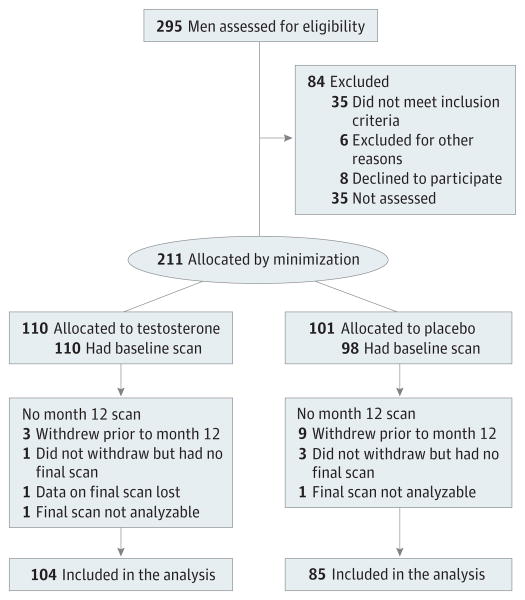
Design, setting, and participants: Placebo-controlled, double-blind trial with treatment allocation by minimization at 9 US academic medical centers of men 65 years or older with 2 testosterone concentrations averaging less than 275 ng/L participating in the Testosterone Trials from December 2011 to June 2014. The analysis was a modified intent-to-treat comparison of treatment groups by multivariable linear regression adjusted for balancing factors as required by minimization.
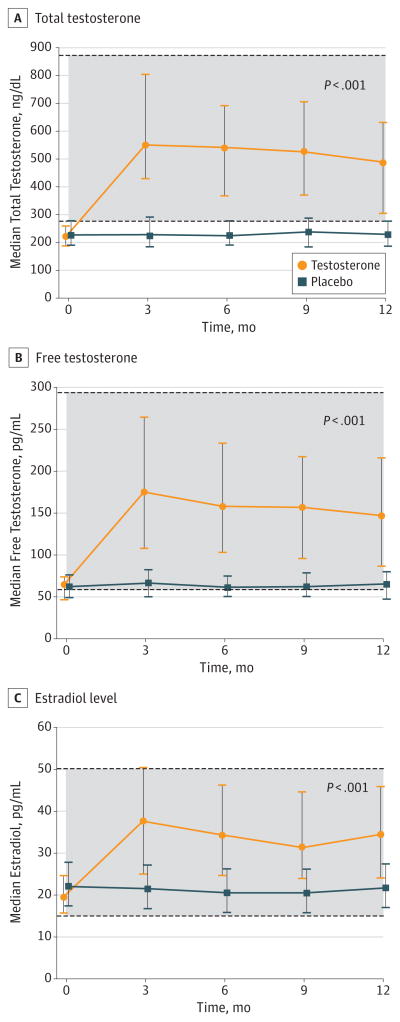
Interventions: Testosterone gel, adjusted to maintain the testosterone level within the normal range for young men, or placebo gel for 1 year.
Main outcomes and measures: Spine and hip vBMD was determined by quantitative computed tomography at baseline and 12 months. Bone strength was estimated by finite element analysis of quantitative computed tomography data. Areal BMD was assessed by dual energy x-ray absorptiometry at baseline and 12 months.
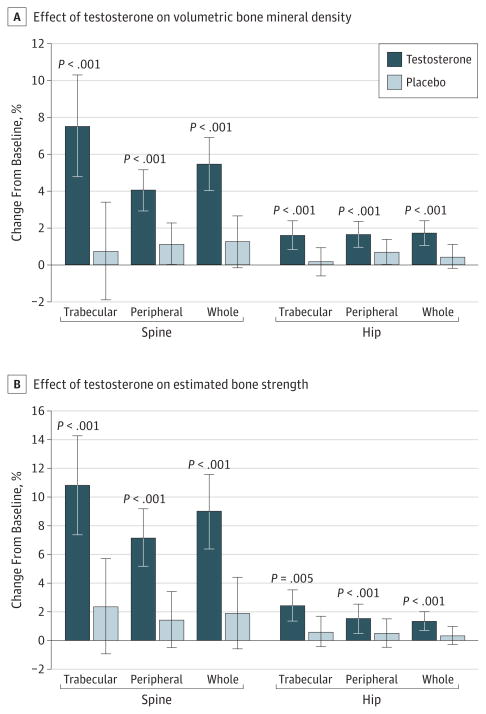
Results: There were 211 participants (mean [SD] age, 72.3 [5.9] years; 86% white; mean [SD] body mass index, 31.2 [3.4]). Testosterone treatment was associated with significantly greater increases than placebo in mean spine trabecular vBMD (7.5%; 95% CI, 4.8% to 10.3% vs 0.8%; 95% CI, -1.9% to 3.4%; treatment effect, 6.8%; 95% CI, 4.8%-8.7%; P < .001), spine peripheral vBMD, hip trabecular and peripheral vBMD, and mean estimated strength of spine trabecular bone (10.8%; 95% CI, 7.4% to 14.3% vs 2.4%; 95% CI, -1.0% to 5.7%; treatment effect, 8.5%; 95% CI, 6.0%-10.9%; P < .001), spine peripheral bone, and hip trabecular and peripheral bone. The estimated strength increases were greater in trabecular than peripheral bone and greater in the spine than hip. Testosterone treatment increased spine areal BMD but less than vBMD.
Conclusions and relevance: Testosterone treatment for 1 year of older men with low testosterone significantly increased vBMD and estimated bone strength, more in trabecular than peripheral bone and more in the spine than hip. A larger, longer trial could determine whether this treatment also reduces fracture risk.
Trial registration: clinicaltrials.gov Identifier: NCT00799617.
Conflict of interest statement
Figures
Comment in
-
Meta-Epidemiology of Testosterone's Risks and Benefits-Will We Ever Know the Answer?JAMA Intern Med. 2017 Sep 1;177(9):1392. doi: 10.1001/jamainternmed.2017.2961. JAMA Intern Med. 2017. PMID: 28873185 No abstract available.
References
-
- Harman SM, Metter EJ, Tobin JD, Pearson J, Blackman MR. Baltimore Longitudinal Study of Aging. Longitudinal effects of aging on serum total and free testosterone levels in healthy men. J Clin Endocrinol Metab. 2001;86(2):724–731. - PubMed
-
- Wu FC, Tajar A, Pye SR, et al. European Male Aging Study Group Hypothalamic-pituitary-testicular axis disruptions in older men are differentially linked to age and modifiable risk factors: the European Male Aging Study. J Clin Endocrinol Metab. 2008;93(7):2737–2745. - PubMed
-
- Orwoll ES, Oviatt SK, McClung MR, Deftos LJ, Sexton G. The rate of bone mineral loss in normal men and the effects of calcium and cholecalciferol supplementation. Ann Intern Med. 1990;112(1):29–34. - PubMed
-
- Zmuda JM, Cauley JA, Glynn NW, Finkelstein JS. Posterior-anterior and lateral dual-energy x-ray absorptiometry for the assessment of vertebral osteoporosis and bone loss among older men. J Bone Miner Res. 2000;15(7):1417–1424. - PubMed
Publication types
MeSH terms
Substances
Associated data
Grants and funding
LinkOut - more resources
Full Text Sources
Other Literature Sources
Medical
Research Materials
Miscellaneous