Thiazolidinediones and Advanced Liver Fibrosis in Nonalcoholic Steatohepatitis: A Meta-analysis
- PMID: 28241279
- PMCID: PMC5470366
- DOI: 10.1001/jamainternmed.2016.9607
Thiazolidinediones and Advanced Liver Fibrosis in Nonalcoholic Steatohepatitis: A Meta-analysis
Erratum in
-
Error in Figure Labels.JAMA Intern Med. 2017 May 1;177(5):747. doi: 10.1001/jamainternmed.2017.0967. JAMA Intern Med. 2017. PMID: 28384753 Free PMC article. No abstract available.
Abstract
Importance: Nonalcoholic steatohepatitis (NASH) is projected to be the leading cause of liver transplantation by 2020. Advanced fibrosis (stage F3-F4) on liver biopsy independently predicts all-cause and liver-related mortality in NASH. There are no known efficacious treatments for advanced fibrosis related to NASH. Thiazolidinedione therapy has been extensively evaluated in NASH, and new randomized clinical trials (RCTs) of its efficacy have been completed.
Objective: To synthesize the evidence about the association of thiazolidinedione therapy with advanced liver fibrosis in NASH.
Data sources: MEDLINE, Ovid MEDLINE In-Process, Cochrane Library, EMBASE, clinicaltrials.gov, PubMed, and Scopus databases (without language restrictions), as well as other registries and scientific meeting presentations, from database inception through August 15, 2016.
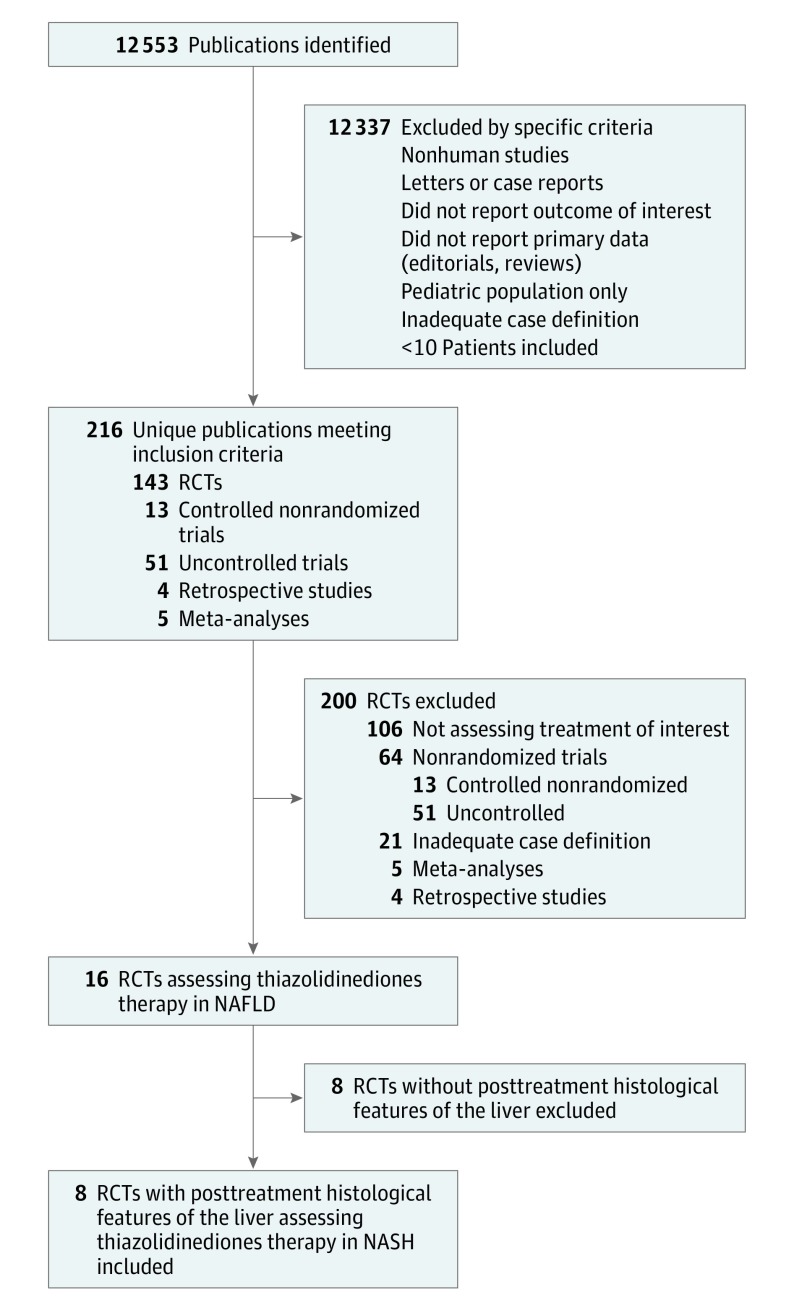
Study selection: Randomized clinical trials evaluating the effect of thiazolidinedione therapy on histologic features of the liver in biopsy-proven NASH.
Data extraction and synthesis: Two investigators extracted study data independently and in duplicate and rated the risk of bias using the Cochrane Risk of Bias Tool.
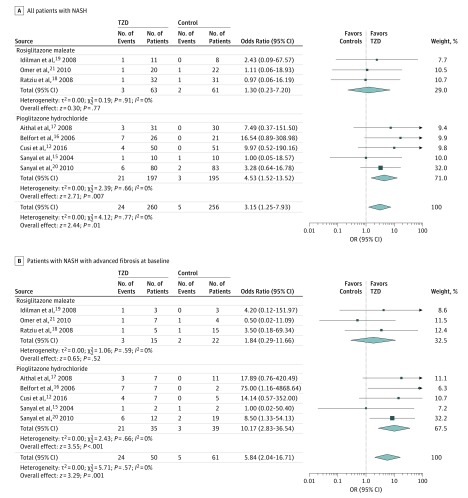
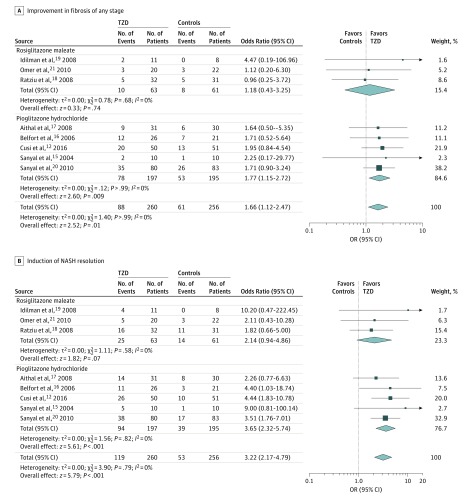
Main outcomes and measures: The primary outcome was a dichotomous improvement in advanced fibrosis on liver biopsy, defined as an improvement in fibrosis stage from F3-F4 to F0-F2. Secondary outcomes were at least a 1-point improvement in fibrosis of any stage and NASH resolution. This meta-analysis also evaluated adverse effects of thiazolidinedione therapy, including weight gain, lower limb edema, congestive heart failure, bone fractures, cancer, and anemia. With the use of random-effects models, dichotomous variables are presented as odds ratios (ORs) with 95% CIs, and continuous variables are presented as weighted mean differences with 95% CIs.
Results: This study analyzed 8 RCTs (5 evaluating pioglitazone use and 3 evaluating rosiglitazone maleate use) enrolling 516 patients with biopsy-proven NASH for a duration of 6 to 24 months. Among all studies combined, thiazolidinedione therapy was associated with improved advanced fibrosis (OR, 3.15; 95% CI, 1.25-7.93; P = .01; I2 = 0%), fibrosis of any stage (OR, 1.66; 95% CI, 1.12-2.47; P = .01; I2 = 0%), and NASH resolution (OR, 3.22; 95% CI, 2.17-4.79; P < .001; I2 = 0%). Analyses restricted to RCTs enrolling patients without diabetes yielded similar results for improvement in advanced fibrosis (OR, 2.95; 95% CI, 1.04-10.90; P = .02; I2 = 0%), improvement in fibrosis of any stage (OR, 1.76; 95% CI, 1.02-3.03; P = .02; I2 = 0%), and NASH resolution (OR, 3.40; 95% CI, 1.95-5.93; P < .001; I2 = 0%). All effects were accounted for by pioglitazone use. Weight gain and lower limb edema occurred more frequently with thiazolidinedione therapy (initial body weight +2.70%; 95% CI, 1.96%-4.34%; P = .001). The small sample size of included RCTs prevented evaluation of more serious adverse effects of thiazolidinedione therapy.
Conclusions and relevance: Pioglitazone use improves advanced fibrosis in NASH, even in patients without diabetes. Whether this finding translates to improvement in risk for clinical outcomes requires further study.
Conflict of interest statement
Figures
Comment in
-
The Role of Pioglitazone in the Management of Nonalcoholic Steatohepatitis: Are We There Yet?JAMA Intern Med. 2017 May 1;177(5):640-641. doi: 10.1001/jamainternmed.2016.9669. JAMA Intern Med. 2017. PMID: 28241265 No abstract available.
References
-
- Chalasani N, Younossi Z, Lavine JE, et al. The diagnosis and management of non-alcoholic fatty liver disease: practice guideline by the American Association for the Study of Liver Diseases, American College of Gastroenterology, and the American Gastroenterological Association. Hepatology. 2012;55:2005-2023. - PubMed
-
- Wong RJ, Aguilar M, Cheung R, et al. Nonalcoholic steatohepatitis is the second leading etiology of liver disease among adults awaiting liver transplantation in the United States. Gastroenterology. 2015;148(3):547-555. - PubMed
-
- Singal AK, Guturu P, Hmoud B, Kuo YF, Salameh H, Wiesner RH. Evolving frequency and outcomes of liver transplantation based on etiology of liver disease. Transplantation. 2013;95(5):755-760. - PubMed
-
- Ekstedt M, Hagström H, Nasr P, et al. Fibrosis stage is the strongest predictor for disease-specific mortality in NAFLD after up to 33 years of follow-up. Hepatology. 2015;61(5):1547-1554. - PubMed
Publication types
MeSH terms
Substances
LinkOut - more resources
Full Text Sources
Other Literature Sources
Medical
Miscellaneous