Review
. 2017 Feb 23;22(3):344.
doi: 10.3390/molecules22030344.

Sphingosine 1-Phosphate Receptor 1 Signaling in Mammalian Cells

Affiliations
Review

Sphingosine 1-Phosphate Receptor 1 Signaling in Mammalian Cells

Nigel J Pyne et al. Molecules. .

Abstract

The bioactive lipid, sphingosine 1-phosphate (S1P) binds to a family of G protein-coupled receptors, termed S1P₁-S1P₅. These receptors function in, for example, the cardiovascular system to regulate vascular barrier integrity and tone, the nervous system to regulate neuronal differentiation, myelination and oligodendrocyte/glial cell survival and the immune system to regulate T- and B-cell subsets and trafficking. S1P receptors also participate in the pathophysiology of autoimmunity, inflammatory disease, cancer, neurodegeneration and others. In this review, we describe how S1P₁ can form a complex with G-protein and β-arrestin, which function together to regulate effector pathways. We also discuss the role of the S1P₁-Platelet derived growth factor receptor β functional complex (which deploys G-protein/β-arrestin and receptor tyrosine kinase signaling) in regulating cell migration. Possible mechanisms by which different S1P-chaperones, such as Apolipoprotein M-High-Density Lipoprotein induce biological programmes in cells are also described. Finally, the role of S1P₁ in health and disease and as a target for clinical intervention is appraised.

Keywords: G-protein coupled receptor megaplex; cancer; cardiovascular; immune trafficking; neovascularisation; receptor tyrosine kinase; sphingosine 1-phosphate; sphingosine 1-phosphate receptor 1.


Conflict of interest statement

The authors declare no conflict of interest.

Figures
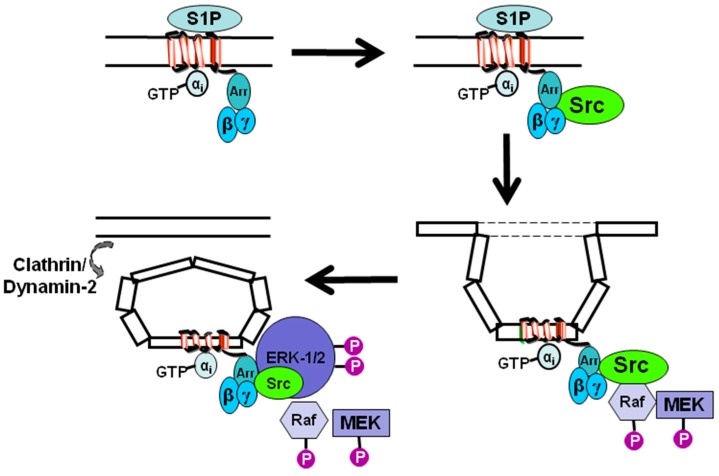
Figure 1
Figure 1
Schematic demonstrating the role of inhibitory G-protein (Gi) and β-arrestin in regulating sphingosine 1-phosphate receptor 1 (S1P1) signaling in mammalian cells. β-Arrestin (Arr) associates with S1P1 and recruits c-Src to the receptor in response to S1P ligation of the receptor. G-protein βγ subunits are essential for subsequent activation of c-Src, Raf, MEK (mitogen activated protein kinase kinase) and ERK-1/2 (extracellular signal regulated kinase-1/2). S1P1 is internalised in endosomes via a β-arrestin-dependent mechanism and extracellular signal regulated kinase-1/2 (ERK-1/2) is recruited to the complex.
Figure 2
Figure 2
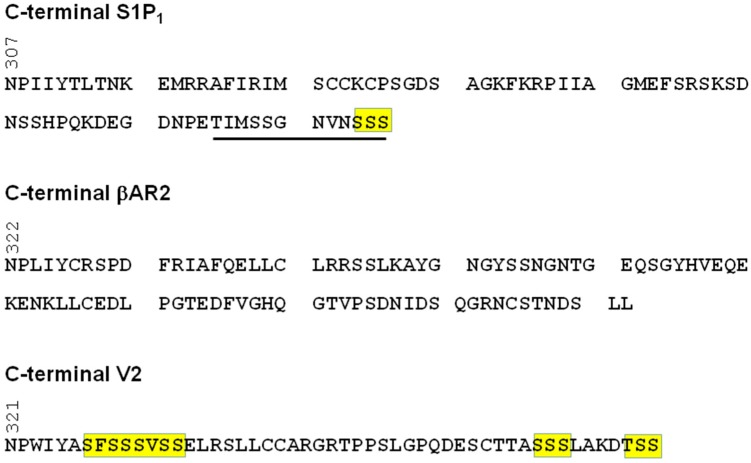
S1P1 C-terminal tail showing a Ser cluster at the extreme C-terminus possibly required for stable interaction with β-arrestin. The sequence underlined in the S1P1 C-terminal tail is essential for endocytosis of S1P1. Comparison is made with the class A β2 adrenergic receptor (β2AR) (that lacks Ser/Thr clusters) and the class B vasopressin receptor 2 (V2R) (which contains Ser/Thr clusters).
Figure 3
Figure 3
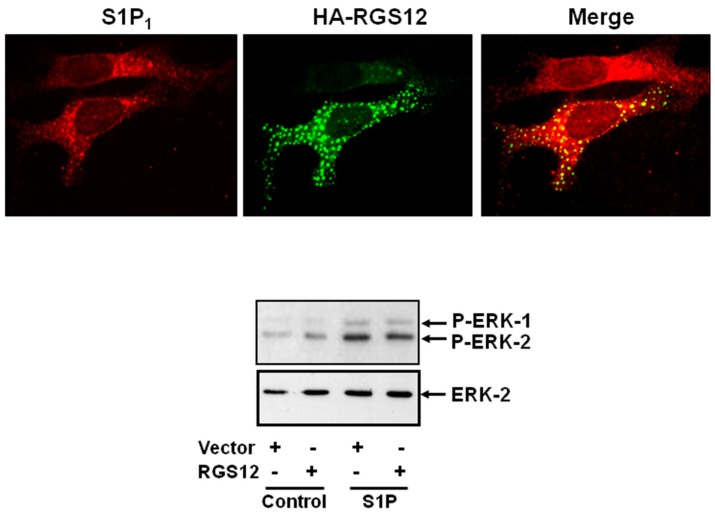
RGS-12 (Regulator of G-protein signaling-12) co-localises with the S1P1 in airway smooth muscle cells and reduces S1P-stimulation of the ERK-1/2 pathway. Airway smooth muscle cells were transfected with plasmid constructs encoding myc-tagged S1P1 and hemagglutinin (HA) tagged RGS12 and stimulated with S1P (1 μM, 5 min). The data shows that RGS12 co-localises with S1P1 in cytoplasmic vesicles. It remains to be determined whether S1P1 in these vesicles is competent to signal. However, RGS12 dampens the activation of ERK-1/2 by S1P in these cells. The results are representative of three independent experiments.
Figure 4
Figure 4
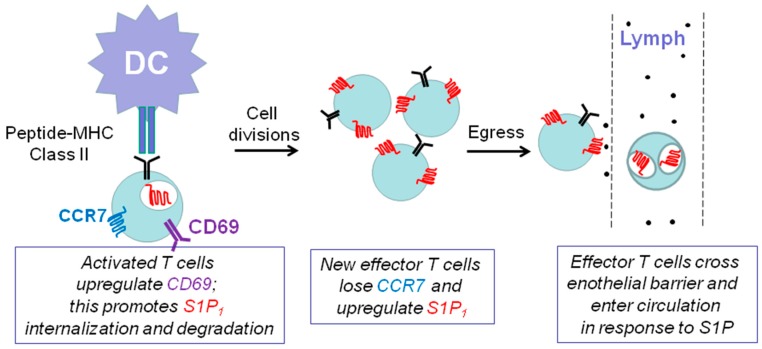
Schematic demonstrating the role of S1P/S1P1 in T-cell trafficking in the immune system. Engagement with Dendritic Cells (DC) presenting antigen in a major histocompatibility class II (MHC class II) complex causes expansion of CD4+ (Cluster of Differentiation), which requires retention in lymph nodes and is achieved by the chemokine receptor 7 (CCR7) and CD69-mediated down-regulation of S1P1. Newly formed effector T-cells then lose CCR7 and up-regulate S1P1 so that they can sense an S1P gradient between lymph nodes and lymph thereby allowing their egress into lymph.
Figure 5
Figure 5
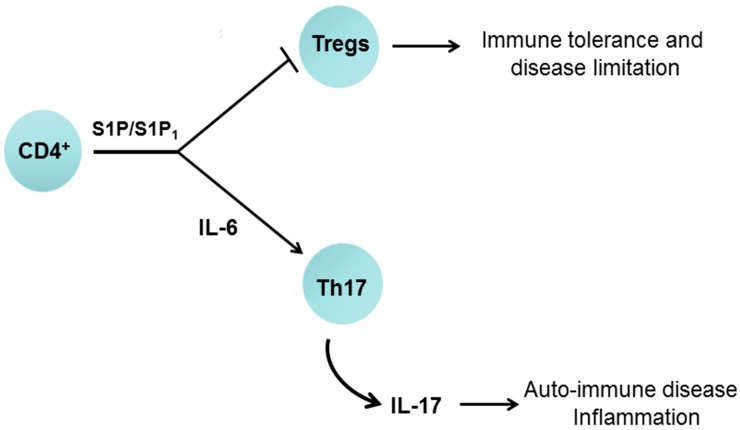
Schematic demonstrating the role of S1P/S1P1 in T-cell differentiation. S1P acting via S1P1 can promote an interleukin-6 (IL-6)-dependent polarisation of CD4+ cells to form T helper 17 (Th17) cells, which release IL-17. S1P binding to S1P1 also inhibits regulatory T cells (T(reg)) formation thereby exacerbating the polarisation of Th17 cells.

References

    1. Pyne S., Pyne N.J. Translational aspects of sphingosine 1-phosphate biology. Trends Mol. Med. 2011;17:463–472. doi: 10.1016/j.molmed.2011.03.002. - DOI - PubMed
    1. Kobayashi N., Kobayashi N., Yamaguchi A., Nishi T. Characterisation of the ATP dependent sphingosine 1-phosphate transporter in rat erythrocytes. J. Biol. Chem. 2009;284:21192–21200. doi: 10.1074/jbc.M109.006163. - DOI - PMC - PubMed
    1. Hisano Y., Kobayashi N., Yamaguchi A., Nishi T. Mouse SPNS2 functions as a sphingosine-1-phosphate transporter in vascular endothelial cells. PLoS ONE. 2012;7:e38941. doi: 10.1371/journal.pone.0038941. - DOI - PMC - PubMed
    1. Nishi T., Kobayashi N., Hisano Y., Kawahara A., Yamaguchi A. Molecular and physiological functions of sphingosine 1-phosphate transporters. Biochim. Biophys. Acta. 2014;1841:759–765. doi: 10.1016/j.bbalip.2013.07.012. - DOI - PubMed
    1. Donoviel M.S., Hait N.C., Ramachandran S., Maceyka M., Takabe K., Milstien S., Oravecz T., Spiegel S. Spinster 2, a sphingosine-1-phosphate transporter, plays a critical role in inflammatory and autoimmune diseases. FASEB J. 2015;29:5018–5028. doi: 10.1096/fj.15-274936. - DOI - PMC - PubMed

LinkOut - more resources