


Bites before and after bedtime can carry a high risk of human malaria infection
- PMID: 28241888
- PMCID: PMC5329919
- DOI: 10.1186/s12936-017-1740-0
Bites before and after bedtime can carry a high risk of human malaria infection
Abstract
Background: Understanding biting distribution of potentially infectious (parous) mosquitoes at various hours of the night would be useful in establishing the likely impact of bed nets on malaria transmission. Bed nets are highly effective at preventing biting by older malaria vectors, which occurs when most people are in bed. However, this behaviour is likely to vary across ecological settings and among mosquito populations.
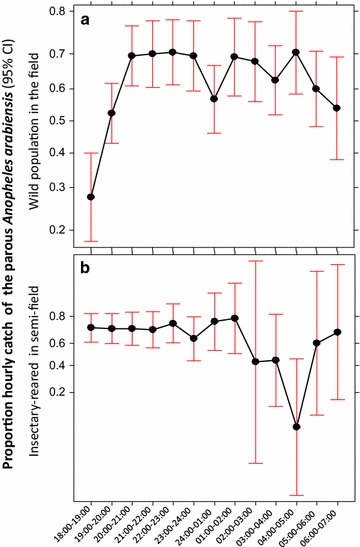
Methods: Field experiments were conducted in Minepa village within Kilombero Valley. Two outdoor catching stations located approximately 50 m from each other were established for mosquito collection. On each experimental night, mosquitoes were collected using human landing catch (HLC) by a single adult male at each station from 18:00 to 07:00 h. To compare the distribution of mosquito biting and the composition of their age structure, mosquitoes were sorted and recorded according to the hour they were collected. A sub-sample of Anopheles arabiensis was dissected to determine their parity status. Insectary-reared An. arabiensis within the semi-field system (SFS) with known age were also released in the SFS (10 m × 20 m) and recaptured hourly using HLC to determine the effect of parity on biting distribution.
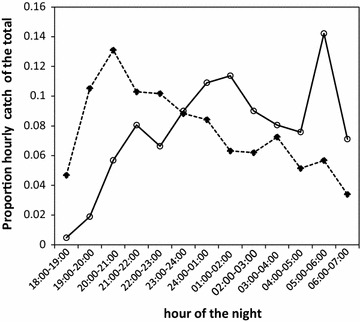
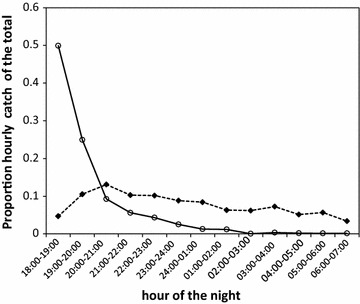
Results: Overall, there was no statistical association between the parity status and the biting time of An. arabiensis either in the field or in the SFS (P ≥ 0.05). The wild and insectary-reared An. arabiensis were observed to exhibit different hourly biting patterns.
Conclusion: The study has shown that mosquito biting time phenotype is not influenced by their parity status. These findings imply that the risk of human exposure to potentially infectious bites is equally distributed throughout the night, thus supplementary measures to protect people against bites in evening and morning are desirable.
Keywords: Biting time; Distribution; Malaria; Mosquito; Mosquito age; Parity; Transmission.
Figures
References
-
- Gillies MT, DeMeillon B. The Anophelinae of Africa south of the Sahara (Ethiopian zoogeographical region) Johannesburg: South African Institute for Medical Research; 1968.
-
- Gillies MT. Anopheline mosquitos: vector behaviour and bionomics. Edinburgh: Churchill Livingstone; 1988.
-
- MacDonald G. The epidemiology and control of malaria. London: Oxford University Press; 1957.
Publication types
MeSH terms
Grants and funding
LinkOut - more resources
Full Text Sources
Other Literature Sources
Medical
