. 2017 Mar 14;114(11):2819-2824.
doi: 10.1073/pnas.1616019114. Epub 2017 Feb 27.

Previously unknown class of metalorganic compounds revealed in meteorites

Affiliations

Previously unknown class of metalorganic compounds revealed in meteorites

Alexander Ruf et al. Proc Natl Acad Sci U S A. .

Abstract

The rich diversity and complexity of organic matter found in meteorites is rapidly expanding our knowledge and understanding of extreme environments from which the early solar system emerged and evolved. Here, we report the discovery of a hitherto unknown chemical class, dihydroxymagnesium carboxylates [(OH)2MgO2CR]-, in meteoritic soluble organic matter. High collision energies, which are required for fragmentation, suggest substantial thermal stability of these Mg-metalorganics (CHOMg compounds). This was corroborated by their higher abundance in thermally processed meteorites. CHOMg compounds were found to be present in a set of 61 meteorites of diverse petrological classes. The appearance of this CHOMg chemical class extends the previously investigated, diverse set of CHNOS molecules. A connection between the evolution of organic compounds and minerals is made, as Mg released from minerals gets trapped into organic compounds. These CHOMg metalorganic compounds and their relation to thermal processing in meteorites might shed new light on our understanding of carbon speciation at a molecular level in meteorite parent bodies.

Keywords: Fourier transform ion cyclotron resonance mass spectrometry; astrochemistry; metalorganic chemistry; meteorites; organic evolution.


Conflict of interest statement

The authors declare no conflict of interest.

Figures
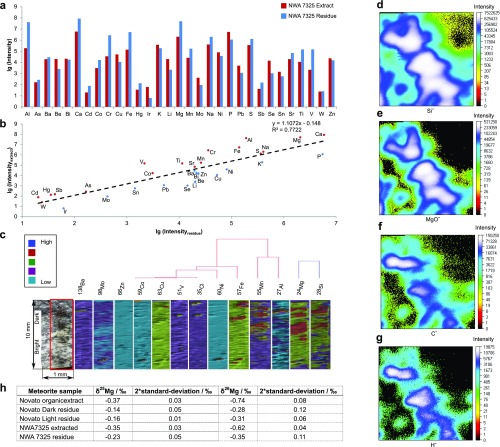
Fig. S1.
Fig. S1.
Elemental analysis. Element abundances in the methanolic extract and the residue sample of the NWA 7325 meteorite are shown, as obtained from ICP-MS data. (A) A bar graph with the decimal logarithm of the measured element’s intensities, provided for 31 elements in the extract (red) and in the residue (blue). (B) A linear regression between the extract’s intensity and the residue’s intensity, both expressed in the decimal logarithm, is presented to reflect the solubility potential of the measured elements. The red data points represent elements enriched in extracts, and the blue-labeled elements remain in residue. High abundances for Al, Ca, and Mg and volatile elements are enriched in the extract, with exceptions, mainly observed at trace levels. Spatially resolved elemental distribution of the Novato meteorite surface is depicted, as gained from LA-ICP-MS measurements, for the dark and the bright site of the specimen (C). HCA of 13 element profiles reveals extensive concordance of the abundant elements Mg and Si, which is in agreement with dominant magnesium silicates in the solid-state phase. SIMS analyses results of a glassy vein of the LL5 ordinary chondrite Chelyabinsk specimen are shown with the mapped intensities of Si, MgO, C, and H (DG) This supports that the analyzed specimen is rich, both in C and H (likely organic matter), next to congruent areas of Si and MgO (magnesium silicates). (H) Mg isotope results of organic extract and whole-rock residues for Novato and NWA 7325.
Fig. 1.
Fig. 1.
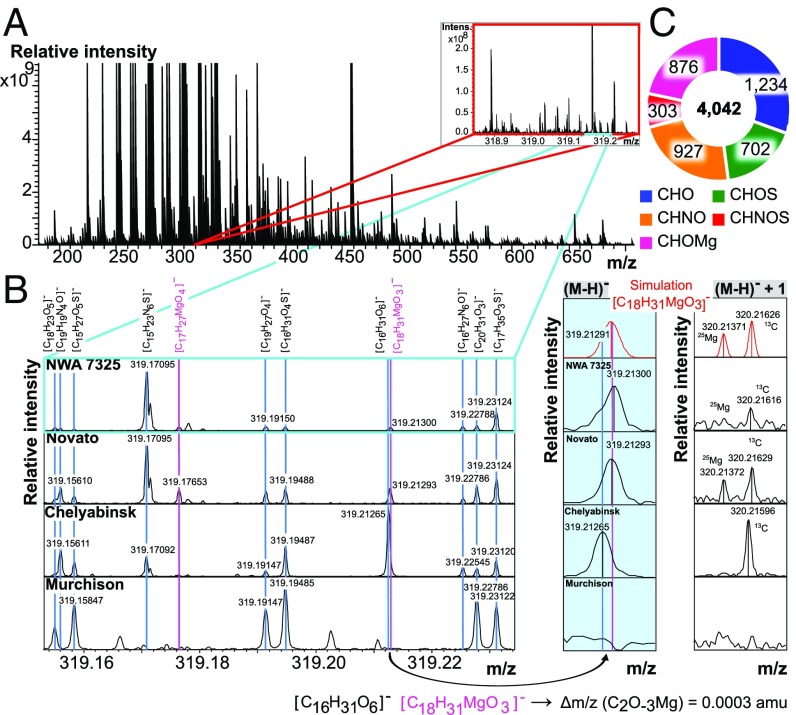
Detection of the CHOMg chemical space. Negative ionization mode ESI-FT-ICR mass spectrum of an ungrouped achondrite (NWA 7325) is shown (A). It is aligned together with two ordinary chondrites (Novato and Chelyabinsk) and a carbonaceous chondrite meteorite (Murchison) by CHNOS compounds (B). Some distinct mass peaks were detected that are nonaligned and represent CHOMg compounds (pink labels). Less than one electron mass difference (Δm/z = 0.0003 amu) between the isobaric molecule ions [C16H31O6] and [C18H31MgO3], with the corresponding mass difference of C2O-3Mg, requires an ultrahigh mass resolving power and high mass accuracy to enable unambiguous differentiation between the CHNOS and the CHOMg chemical spaces. The second most abundant CHOMg isotopologue, here at m/z = 320, consists of two peaks (25Mg and 13C) of comparable amplitude. The specific presence of [C18H31MgO3] is confirmed in NWA 7325 and Novato but excluded in Chelyabinsk and Murchison meteorites, which only display the single 13C-based peak and no second isotopologue mass peak at m/z = 320. (C) Relative abundances of NWA 7325 chemical species are depicted.
Fig. S2.
Fig. S2.
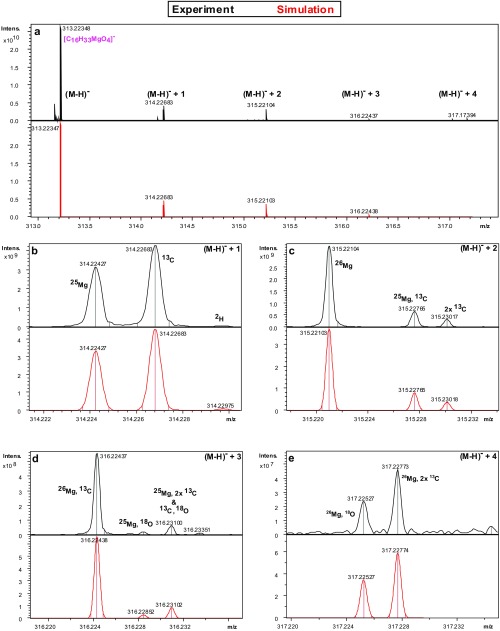
(AE) Isotopic fine structure for the [C16H33MgO4] molecule ion. [C16H33MgO4] was identified via its isotopologues in the Novato methanolic extract, as seen in ESI-FT-ICR mass spectra. The black spectrum is the experimental mass spectrum from Novato extract, and the red profile represents the theoretically computed isotopic pattern at natural abundance of C, H, O and Mg. The observed isotopic distribution is primarily caused by the isotopes 24/25/26Mg, 12/13C, 16/18O and 1/2H. To separate each isotopologue at FWHM, a minimum mass resolving power of R ∼125,000 at m/z = 313 is required. Beyond CHOMg, the total combinatorial molecular complexity within the sample set includes N and S compositions. The mass resolving power of R ∼500,000 helps to exclude more complex combinatorial formula solutions, which contain, for example, nitrogen and sulfur and discriminates unambiguously the CHOMg from the CHNOS chemical compositions.
Fig. 2.
Fig. 2.
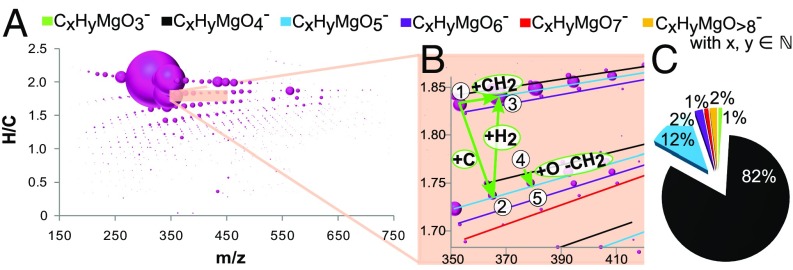
Characteristics of the CHOMg chemical space. CHOMg chemical compositions of NWA 7325 soluble organic matter are depicted by mass-edited H/C ratio, for the complete (A) and zoomed-in compositional space (B), illustrating the density of fairly complete homologous series within the CHOMg compositional space. The bubble size represents the relative intensity of the mass peaks. The detailed arrangement of CHOMg compounds allows visualization of nominal elemental/molecular transformations, with examples provided (circled numbers: ①, C18H33MgO5; ②, C19H33MgO5; ③, C19H35MgO5; ④, C21H37MgO4; and ⑤, C20H35MgO5). (C) Relative abundances of these Mg-metalorganics, shown in different colors (B and C), demonstrate the dominance of the MgO4R molecular subspace, with R = hydrocarbon CxHy and x, y ∈ ℕ.
Fig. S3.
Fig. S3.
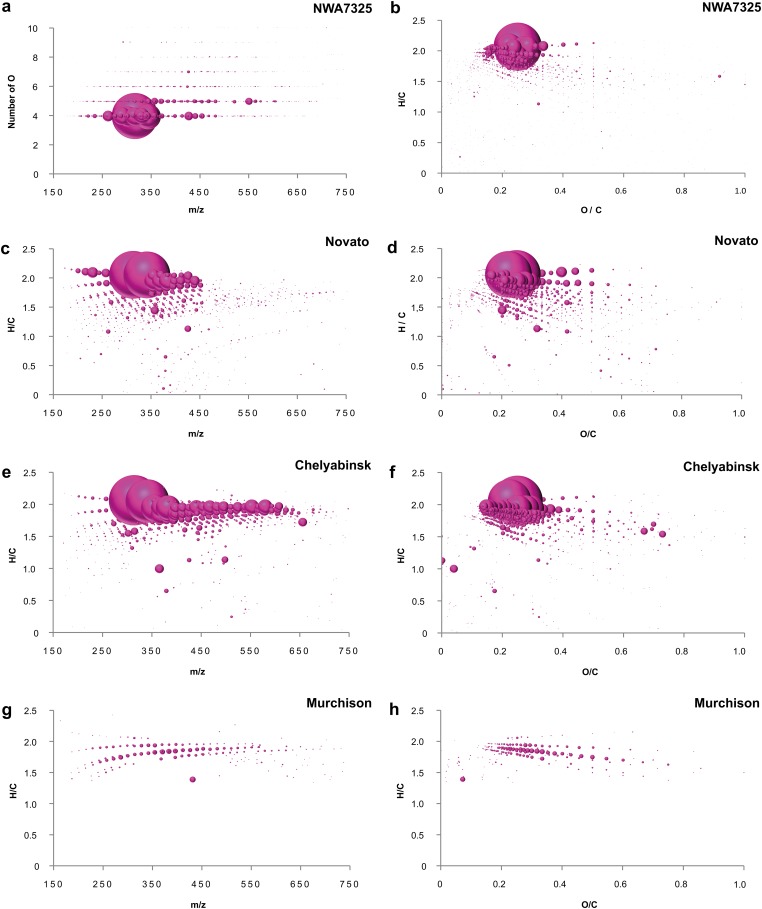
Complexity of the CHOMg chemical space. (A) The dominance of CHOMg molecules possessing four oxygen atoms compared with the whole CHOMg chemical space for the soluble organic matter of NWA 7325. H/C vs. O/C for NWA 7325 (B), H/C vs. O/C and H/C vs. m/z representations of CHOMg chemical compositions for Novato (C and D), Chelyabinsk (E and F), and Murchison (G and H) meteorite samples illustrate the chemical complexity of their organic extracts. The bubble size represents the relative intensity of the mass peaks. The mass-edited H/C ratio diagram of NWA 7325 is shown in Fig. 2A in the main text.
Fig. S4.
Fig. S4.
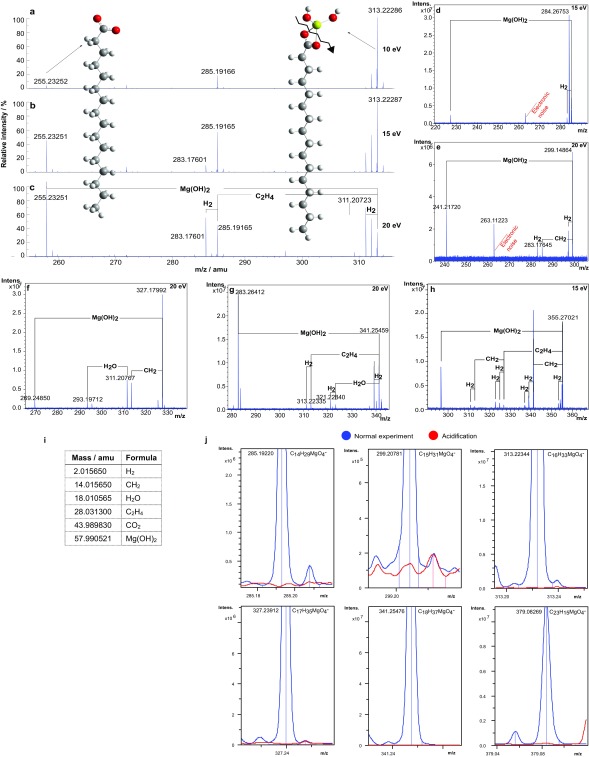
Fragmentation experiments to characterize dihydroxymagnesium carboxylates. (AC) CID mass spectra of NWA 7325 of C16-dihydroxymagnesium carboxylate [C16H33MgO4] complex are shown at collision energies of 10 eV, 15 eV, and 20 eV to identify the MgO4R structures with R = hydrocarbon CxHy and x, y ∈ . Additionally, five precursor molecular ions, m/z = 285 for [C14H29MgO4] (D), m/z = 299 for [C15H31MgO4] (E), m/z = 327 for [C17H35MgO4] (F), m/z = 341 for [C18H37MgO4] (G), and m/z = 355 for [C19H39MgO4] (H) show fairly congruent fragmentation patterns of dihydroxymagnesium carboxylates with the release of Mg(OH)2 out of the fragmented parent molecule. The collision energies used in these CID MS/MS experiments were high (15–20 eV) to ensure fragmentation of the complexes. The computed coordinates of the structures of C16-dihydroxymagnesium carboxylate ([C16H33MgO4]) and its product ion (hexadecanoic acid) are presented in Table S2. (I) Exact masses of the fragmented molecules. (J) Negative ionization mode ESI-FT-ICR mass spectra of selected dihydroxymagnesium carboxylates [(OH)2MgO2CR] in the NWA 7325 methanolic extract are shown, where the standard extract is labeled blue and the red signal is the extract in presence of formic acid (HCOOH). The complex is hydrolyzed in the presence of formic acid and Mg(OH)2 is precipitated. This indicates that the CHOMg anionic complexes possess Mg(OH)2 functional groups. The peaks were smoothed via the Gauss smoothing algorithm, as implemented in Bruker Compass DataAnalysis 4.2 SR1, with a smoothing width of 0.001 amu (2.1 points).
Fig. 3.
Fig. 3.
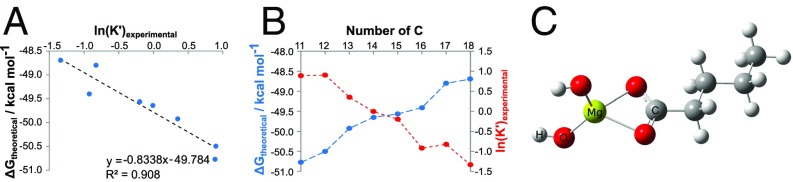
Characterization of dihydroxymagnesium carboxylates. (A) The negative correlation between the experimental equilibrium constant, expressed as ln(K′), and the computed Gibbs free energy ΔG of the [(OH)2MgO2CCnH2n+1] complex formation with n ∈ ℕ for different linear alkyl chain lengths between C11 and C18, as computed with density functional theory (DFT). (B) The dependency of ln(K′) (experimentally via MS) and ΔG (theoretically via DFT) on different alkyl chain lengths is displayed to illustrate the reactivity of dihydroxymagnesium carboxylates, whereas the optimized computed geometry for the representative ion dihydroxymagnesium-n-pentanoate [(OH)2MgO2CC4H9] is depicted in C (see Table S2 for the computed coordinates of relaxed geometry of C5-dihydroxymagnesium carboxylate complex anion).
Fig. S5.
Fig. S5.
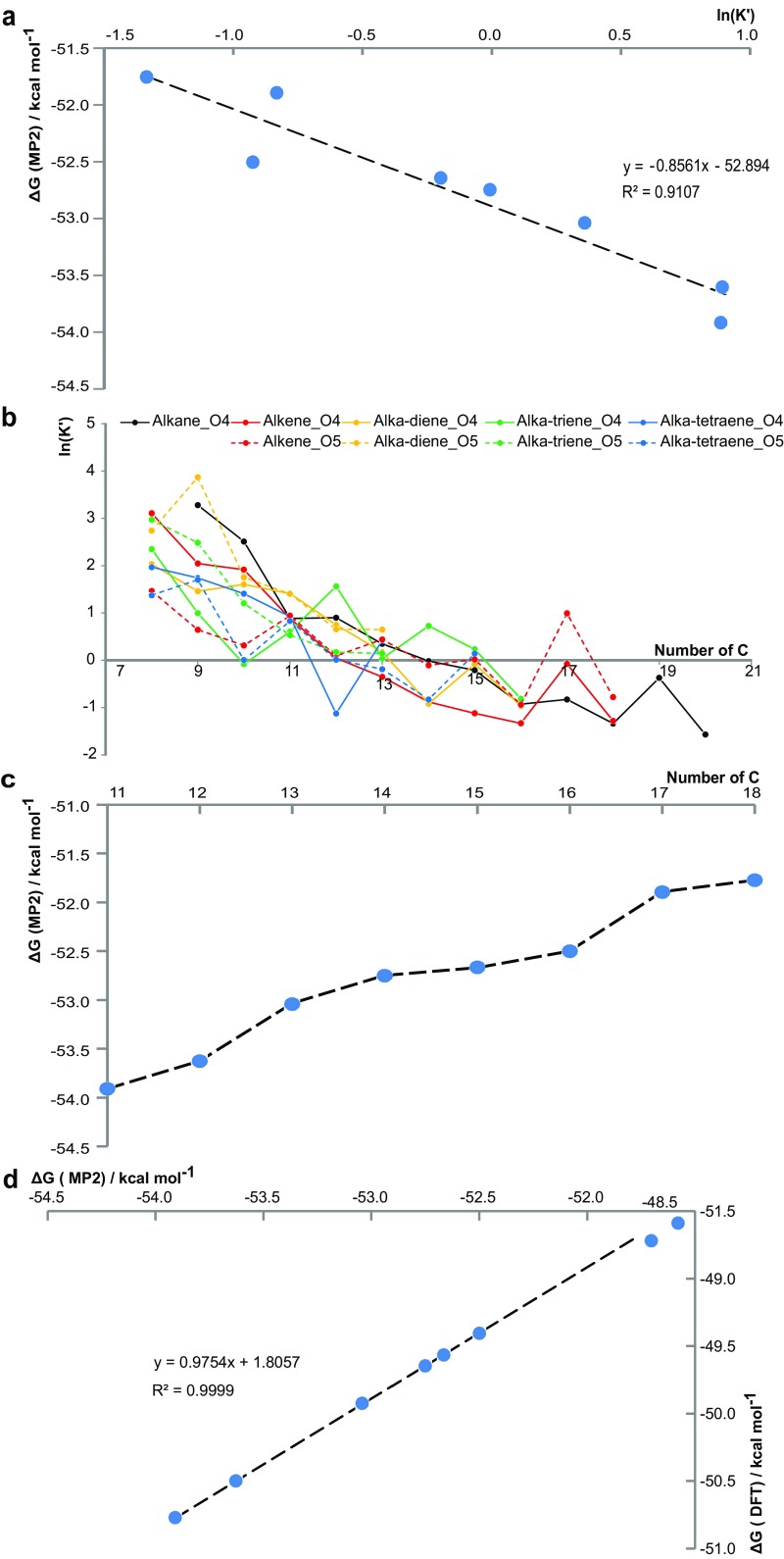
General CHOMg reactivity and verification of DFT simulations with MP2 level of theory. (A) Negative correlation of the Gibbs free energy ΔG with ln(K′), following Eq. 2 for different linear alkyl chain lengths between C11 and C18, computed with MP2 extracts (discussed in the main text). (B) ln(K′) is plotted vs. the number of carbon atoms for several homologous series, varying by alkyl saturation and number of oxygen atoms in the aliphatic chain. A general decreasing trend with increasing numbers of C atoms is observed, indicating that smaller alkyl chain CHO molecules are more reactive to form CHOMg compounds, relatively longer aliphatic chain molecules. Additionally, local reactivity anomalies are highlighted by functional fluctuations. (C) ΔG is plotted vs. the number of carbon atoms in linear alkyl chain lengths of the [(OH)2MgO2CCn] complex formation with n ∈ , as computed on MP2-level of theory. (D) Correlation between the DFT-B3LYP and MP2 methods, which illustrates the accuracy of DFT, describing this complex formation reaction properly.
Fig. 4.
Fig. 4.
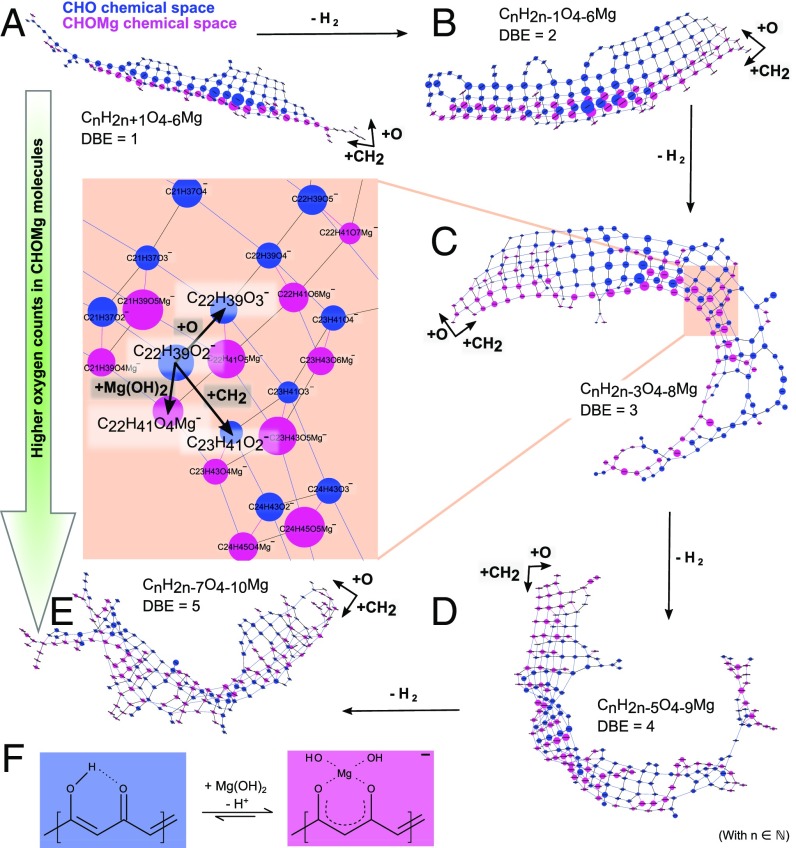
Mass difference networks, presenting the chemical complexity/reactivity of the CHOMg space and its connection to CHO compositions. (AE) Five subnetworks, each representing one distinct degree of unsaturation, as well as a gradual increase in the number of oxygen in CHOMg molecules, are shown for NWA 7325 soluble organic matter. The variance in unsaturation is expressed via DBE values. CHOMg nodes are pink and CHO nodes are blue. The nodal diameter is proportional to the natural logarithm of each mass peak’s intensity. Three types of edges are defined, the mass differences of CH2 and O illustrate the systematic connection within the CHO or CHOMg chemical space, and Δm/z(Mg(OH)2) addresses reaction pairs that connect CHO and CHOMg compositions. (F) Proposed alternative organomagnesium complex formation with unsaturated β-hydroxy ketones as chelate ligands.
Fig. S6.
Fig. S6.
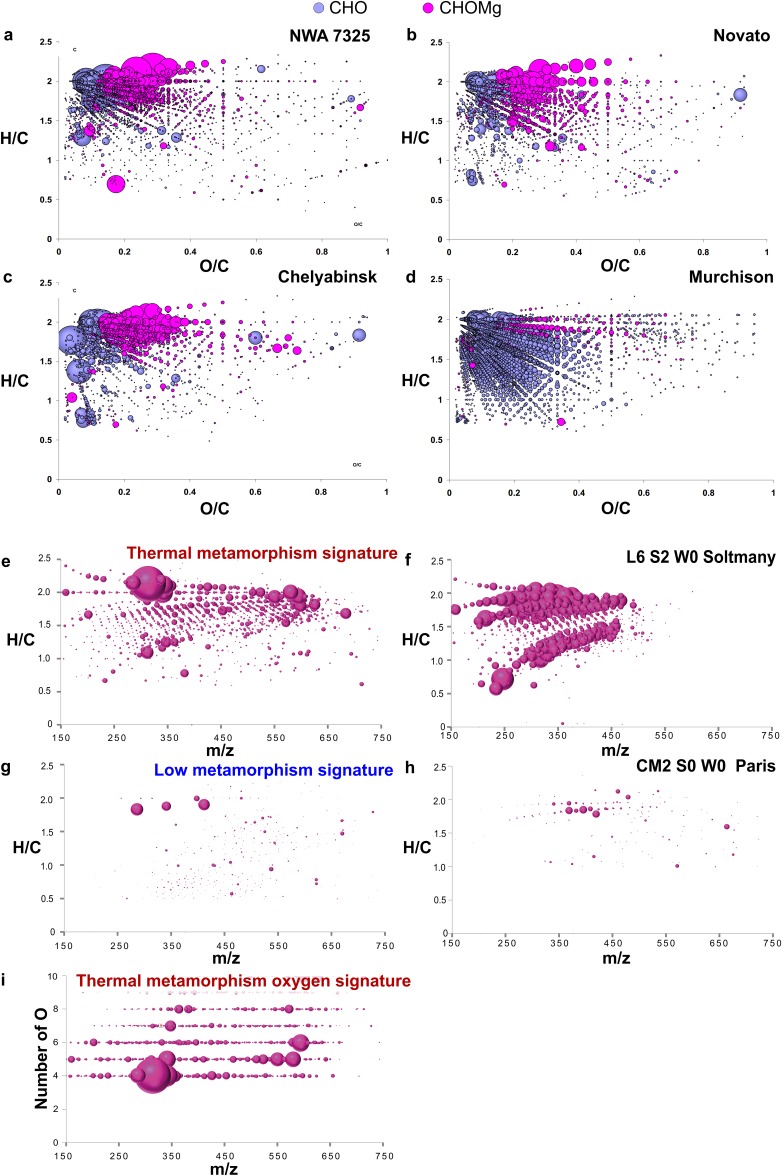
Van Krevelen diagrams for the comparison of CHO and CHOMg compositions for several meteorites and modified van Krevelen diagrams representing the thermal metamorphism signature. Van Krevelen representations of soluble organic matter in NWA 7325 (A), Novato (B), Chelyabinsk (C), and Murchison (D) are shown. It is obvious that the less-altered CM2 chondrite Murchison is poor in CHOMg compositions, compared with the ungrouped achondrite NWA 7325 and the ordinary chondrites, Novato and Chelyabinsk. Modified van Krevelen diagrams of the overlapped CHOMg molecules (50th percentile of positive loading values on the x axis) reflect the highly aliphatic structure of the CHOMg compositional space (A) for relevant loadings, which represent high (E) and low (G) thermal metamorphism signatures seen in the 61 meteorites studied. These plotted m/z values reflect the 50th percentile of the variables, which are unique for the positive (E) and negative (G) values of the first component (x axis) of the OPLS score plot (Fig. 5). These compounds in E may represent thermal metamorphism markers. The bubble size represents the relative intensity of the mass peaks. (F and H) Mass-edited H/C ratios of two representative examples for low- (Paris) and high-degree thermally processed meteorites (Soltmany) (35). Paris is known to be one of the least-altered meteorites (36). The convergence of O = 4 in CHOMg molecular formulas for thermal stress loading values is presented by an oxygen number-m/z diagram. (I) Again, these plotted m/z values reflect the 50th percentile of the variables, which are unique for the positive values of the first component (x axis) of the OPLS score plot (Fig. 5).
Fig. 5.
Fig. 5.
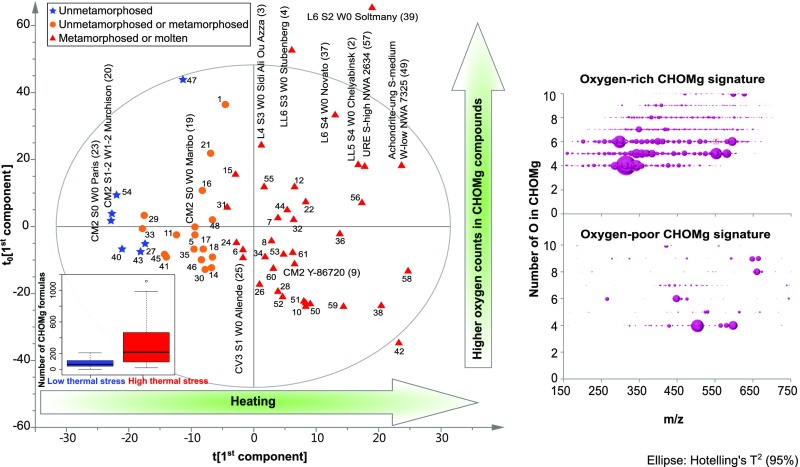
Relationship of CHOMg signatures with different thermal processing stages of meteorites. An OPLS score scatter plot for 61 meteorites (CI, CK, CM, CO, CR, CV, EUC, H, L, LL, URE, and achondrite classes) with different inter- and intrameteorite class metamorphism stages is shown, based on the abundance and molecular diversity of CHOMg compounds. Details on the OPLS analysis are given in SI Materials and Methods and meteorite assignments are listed in Table S1. The box plots represent the averaged numbers of CHOMg molecular formulas for low and highly thermally altered meteorites, respectively. Thermal processing states vary from low to high along the x axis (first component), proceeding from negative to positive values. This first component (x axis) is related to the number and intensity of CHOMg molecular formulas, as represented in the box plot. The y axis (orthogonal to the first component) represents the proportion of oxygen atoms within the molecular formulas, as illustrated by modified van Krevelen diagrams of the most relevant loading values. Independent of the specimen, CHOMg signatures were observed with increased Mg-metalorganic diversity for thermally stressed meteorites. The two CM2 chondrites, Y-793321 and Y-86720, reported to be thermally metamorphosed (39), well-described meteorites, with respect to their shock history [Chelyabinsk (24) and Novato (23)], as well as the recently classified fall Sidi Ali Ou Azza (L4) and a very new German fall Stubenberg (LL6) were also assigned to the thermally stressed region.
Fig. S7.
Fig. S7.
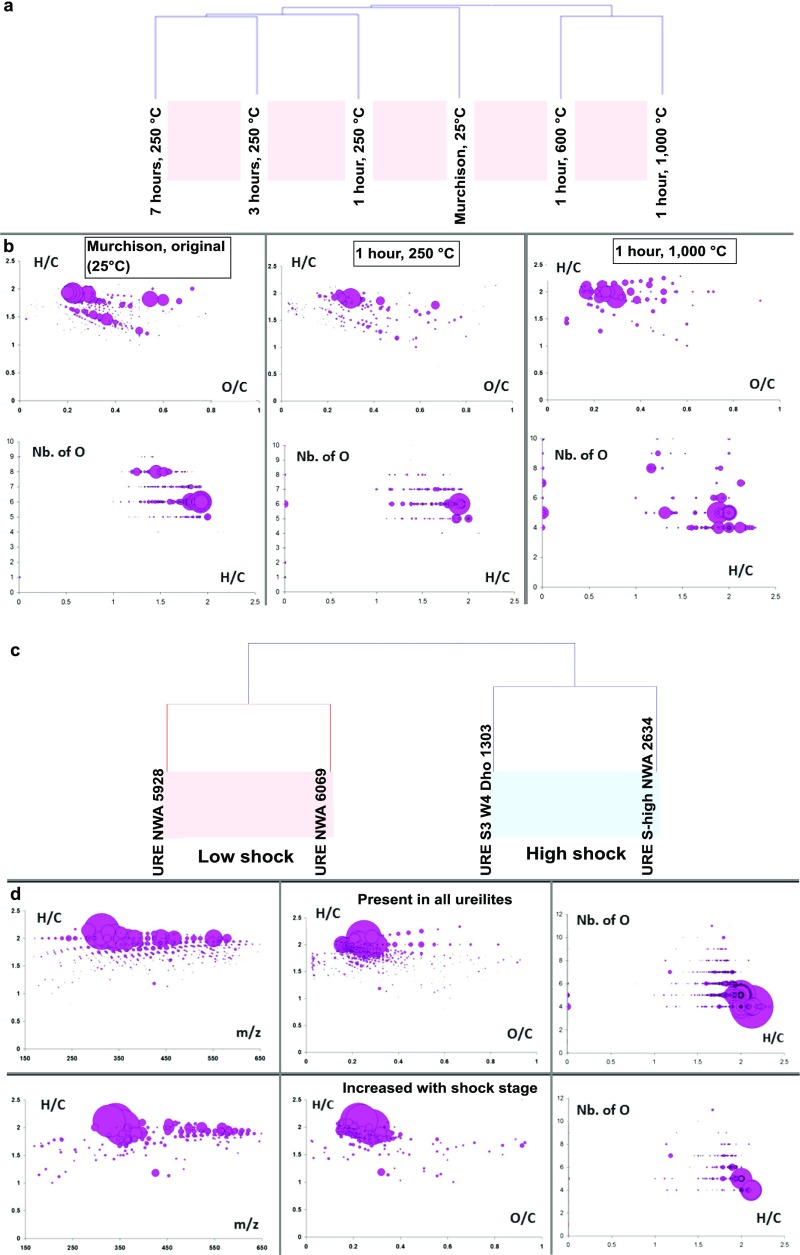
Simulated thermal metamorphism of Murchison and CHOMg-based shock stage differentiation. (A) Laboratory experiment, in which a Murchison meteorite sample was heated to selected temperatures for variable durations (25 °C, 250 °C, 600 °C, and 1,000 °C). Number and distribution of organomagnesium compounds enabled reconstruction of thermal exposure by means of HCA. The simulation of thermal metamorphism grades by increasing the temperature narrows the oxygen number in organomagnesium compounds to the MgO4R class (R = hydrocarbon CxHy and x, y ∈ ), which dominates the entire CHOMg chemical space. This effect of convergence with increasing temperature is depicted in modified van Krevelen diagrams in B, resulting from negative ionization ESI-FT-ICR-MS data. The bubble size represents the relative intensity of the mass peaks. HCA organizes the samples, as a graphical output, into a dendrogram (cluster tree) whose branches are the desired clusters. Based on different similarity rules the clusters are defined. Similar samples are within a cluster. The samples clustered according their elevated temperatures (25 °C, 250 °C, 600 °C, and 1,000 °C). Sampling the effect of time-dependency on the variation of the CHOMg chemical space, three different time points were sampled for temperature 250 °C and clustered together. (C) Detailed differentiation of metamorphic states is illustrated, deduced from CHOMg-based HCA. Four ureilite meteorites were studied (NWA 5928, NWA 6069, Dhofor 1303, and NWA 2634), which had experienced high thermal and shock conditions (62). (D) (Top) CHOMg chemical spaces of four ureilite methanolic extracts (overlapped CHOMg compounds) are shown on top. (Bottom) CHOMg compositions, which increased in abundance in the higher-shocked ureilite meteorites Dhofor 1303 and NWA 2634.
Fig. S8.
Fig. S8.
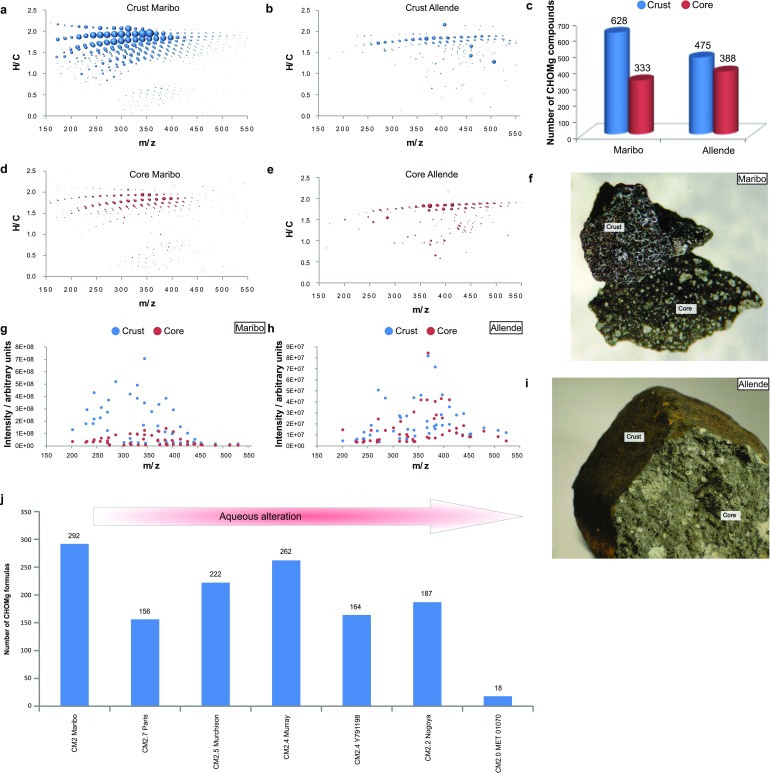
Crust-core comparison and their influences on the CHOMg synthesis and dependency of CHOMg formulas on the aqueous alteration. (A) Number of CHOMg compounds in crust and core sections of the Maribo and Allende meteorites. The mass-edited H/C ratios (BE) illustrate the increased coverage within the CHOMg chemical space for the crust, compared with the core (interior) region. Among the specific organomagnesium molecules, some are unique for the crust and for the core regions, respectively, indicative of a preferential spatial accumulation for certain CHOMg (F and G). The bubble size represents the relative intensity of the mass peaks. Pictures of the Maribo and the Allende specimens are shown in H and I, to reflect the different morphology of their outer crusts and their interiors. (J) Number of CHOMg molecular formulas in methanolic extracts of several CM2 meteorites that had been subjected to variable extents of aqueous alteration [classified from CM2.7 (left) to CM2.0 (right)]. No significant correlation between the extent of aqueous alteration of a meteorite and the number of organomagnesium compounds was retrieved, suggesting that the CHOMg synthesis is not directly dependent on the aqueous alteration.

References

    1. Sephton MA. Organic compounds in carbonaceous meteorites. Nat Prod Rep. 2002;19(3):292–311. - PubMed
    1. Cronin JR, Pizzarello S. Enantiomeric excesses in meteoritic amino acids. Science. 1997;275(5302):951–955. - PubMed
    1. Cooper G, et al. Carbonaceous meteorites as a source of sugar-related organic compounds for the early Earth. Nature. 2001;414(6866):879–883. - PubMed
    1. Meierhenrich UJ, Muñoz Caro GM, Bredehöft JH, Jessberger EK, Thiemann WH-P. Identification of diamino acids in the Murchison meteorite. Proc Natl Acad Sci USA. 2004;101(25):9182–9186. - PMC - PubMed
    1. Schmitt-Kopplin P, et al. High molecular diversity of extraterrestrial organic matter in Murchison meteorite revealed 40 years after its fall. Proc Natl Acad Sci USA. 2010;107(7):2763–2768. - PMC - PubMed

Publication types