Review
. 2017 Apr 19;372(1718):20160197.
doi: 10.1098/rstb.2016.0197.

Neural circuitry for behavioural arrest

Affiliations
Review

Neural circuitry for behavioural arrest

Thomas Roseberry et al. Philos Trans R Soc Lond B Biol Sci. .

Abstract

The ability to stop ongoing movement is fundamental to animal survival. Behavioural arrest involves the hierarchical integration of information throughout the forebrain, which ultimately leads to the coordinated inhibition and activation of specific brainstem motor centres. Recent advances have shed light on multiple regions and pathways involved in this critical behavioural process. Here, we synthesize these new findings together with previous work to build a more complete understanding of the circuit mechanisms underlying suppression of ongoing action. We focus on three specific conditions leading to behavioural arrest: goal completion, fear and startle. We outline the circuitry responsible for the production of these behaviours and discuss their dysfunction in neurological disease.This article is part of the themed issue 'Movement suppression: brain mechanisms for stopping and stillness'.

Keywords: action suppression; behavioural arrest; freezing; startle; stopping.


Figures

Figure 1.
Figure 1.
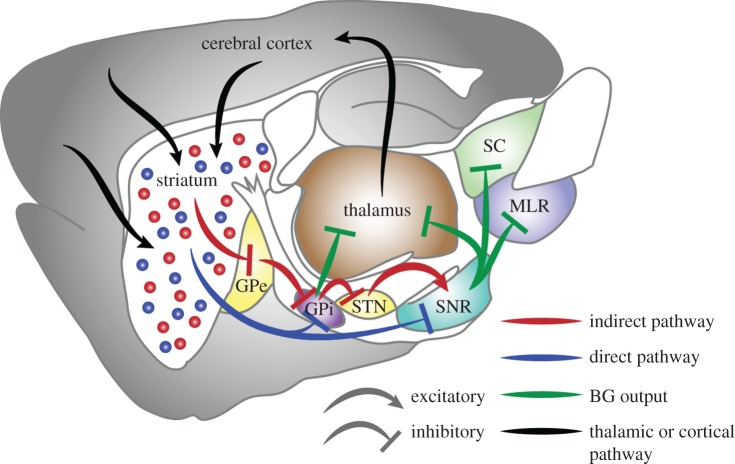
Simplified basal ganglia circuit diagram shown in sagittal view with many connections omitted for simplicity. Blue arrows and dots, direct pathway and dMSNs; red arrows and dots, indirect pathway and iMSNs; green arrows, BG output; black arrows, thalamic or cortical connections. GPe, globus pallidus, pars externa; GPi, globus pallidus, pars interna; MLR, mesencephalic locomotor region; SC, superior colliculus; SNr, substantia nigra, pars reticulata; STN, subthalamic nucleus.
Figure 2.
Figure 2.
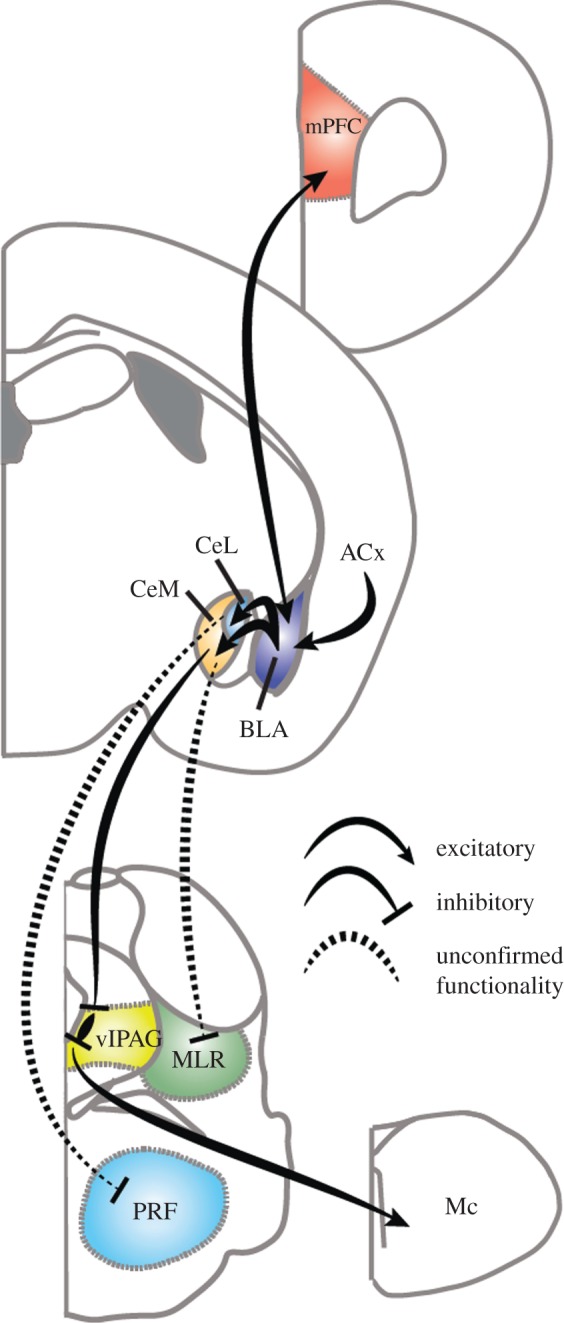
Schematic of fear-induced behavioural arrest pathways. Much of the amygdala circuitry is omitted for simplicity. ACx, auditory cortex; BLA, basolateral amygdala; CeL, centrolateral nucleus of the amygdala; CeM, centromedial nucleus of the amygdala; Mc, magnocellular nucleus; MLR, mesencephalic locomotor region; mPFC, medial prefrontal cortex; PRF, pontine reticular formation.

References

    1. Klemm WR. 2001. Behavioral arrest: in search of the neural control system. Prog. Neurobiol. 65, 453–471. (10.1016/S0301-0082(01)00016-8) - DOI - PubMed
    1. Pare D, Quirk GJ, Ledoux JE. 2004. New vistas on amygdala networks in conditioned fear. J. Neurophysiol. 92, 1–9. (10.1152/jn.00153.2004) - DOI - PubMed
    1. Herry C, Johansen JP. 2014. Encoding of fear learning and memory in distributed neuronal circuits. Nat. Neurosci. 17, 1644–1654. (10.1038/nn.3869) - DOI - PubMed
    1. Hikosaka O, Takikawa Y, Kawagoe R. 2000. Role of the basal ganglia in the control of purposive saccadic eye movements. Physiol. Rev. 80, 953–978. - PubMed
    1. Graybiel AM. 1997. The basal ganglia and cognitive pattern generators. Schizophr. Bull. 23, 459–469. (10.1093/schbul/23.3.459) - DOI - PubMed