


Effectiveness of the Gold Standard Programme compared with other smoking cessation interventions in Denmark: a cohort study
- PMID: 28242770
- PMCID: PMC5337720
- DOI: 10.1136/bmjopen-2016-013553
Effectiveness of the Gold Standard Programme compared with other smoking cessation interventions in Denmark: a cohort study
Abstract
Objectives: We compared the effectiveness of the Gold Standard Programme (a comprehensive smoking cessation intervention commonly used in Denmark) with other face-to-face smoking cessation programmes in Denmark after implementation in real life, and we identified factors associated with successful quitting.
Design: Prospective cohort study.
Setting: A total of 423 smoking cessation clinics from different settings reported data from 2001 to 2013.
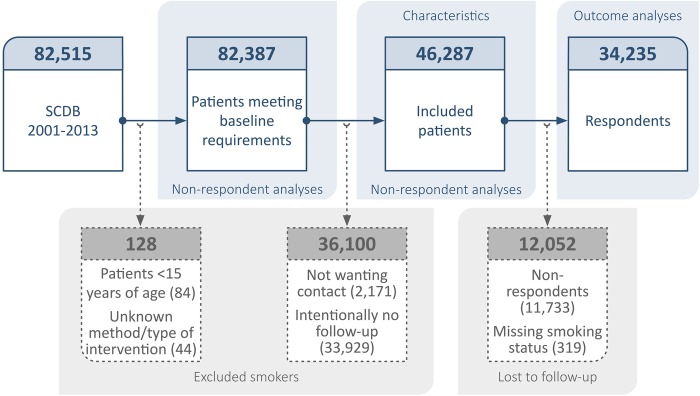
Participants: In total, 82 515 patients were registered. Smokers ≥15 years old and attending a programme with planned follow-up were included. Smokers who did not want further contact, who intentionally were not followed up or who lacked information about the intervention they received were excluded. A total of 46 287 smokers were included.
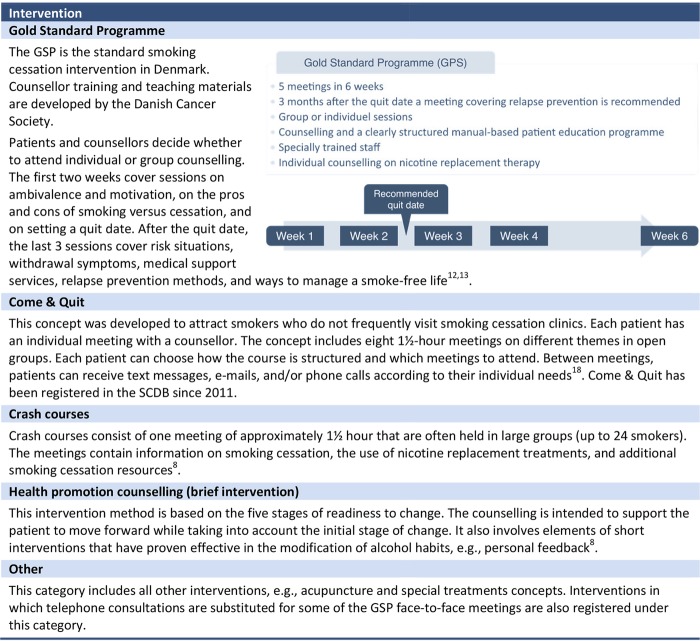
Interventions: Various real-life smoking cessation interventions were identified and compared: The Gold Standard Programme, Come & Quit, crash courses, health promotion counselling (brief intervention) and other interventions.
Main outcome: Self-reported continuous abstinence for 6 months.
Results: Overall, 33% (11 184) were continuously abstinent after 6 months; this value was 24% when non-respondents were considered smokers. The follow-up rate was 74%. Women were less likely to remain abstinent, OR 0.83 (CI 0.79 to 0.87). Short interventions were more effective among men. After adjusting for confounders, the Gold Standard Programme was the only intervention with significant results across sex, increasing the odds of abstinence by 69% for men and 31% for women. In particular, compliance, and to a lesser degree, mild smoking, older age and not being disadvantaged were associated with positive outcomes for both sexes. Compliance increased the odds of abstinence more than 3.5-fold.
Conclusions: Over time, Danish smoking cessation interventions have been effective in real life. Compliance is the main predictor of successful quitting. Interestingly, short programmes seem to have relatively strong effects among men, but the absolute numbers are very small. Only the comprehensive Gold Standard Programme works across sexes.
Keywords: Denmark; effectiveness; national database; smoking cessation; smoking cessation interventions.
Published by the BMJ Publishing Group Limited. For permission to use (where not already granted under a licence) please go to http://www.bmj.com/company/products-services/rights-and-licensing/.
Conflict of interest statement
Figures
References
-
- WHO report on the global tobacco epidemic. Raising taxes on tobacco 2015. http://apps.who.int/iris/bitstream/10665/178574/1/9789240694606_eng.pdf?... (accessed 25 Apr 2016).
-
- Lim SS, Vos T, Flaxman AD et al. A comparative risk assessment of burden of disease and injury attributable to 67 risk factors and risk factor clusters in 21 regions, 1990–2010: a systematic analysis for the Global Burden of Disease Study 2010. Lancet 2013;380:2224–60. 10.1016/S0140-6736(12)61766-8 - DOI - PMC - PubMed
-
- The Health Consequences of Smoking—50 Years of Progress A Report of the Surgeon General. United States Department of Health and Human Services 2014. http://www.surgeongeneral.gov/library/reports/50-years-of-progress/full-.... (accessed 25 Apr 2016).
-
- Eriksen M, Mackay J, Schluger NW et al. The Tobacco Atlas, 5th edition 2015. http://www.tobaccoatlas.org. (accessed 3 May 2016)
-
- World Health Organisation. Draft comprehensive global monitoring framework and targets for the prevention and control of noncommunicable diseases (A66/8) 2013. http://apps.who.int/gb/ebwha/pdf_files/WHA66/A66_8-en.pdf. (accessed 3 May 2016)
Publication types
MeSH terms
LinkOut - more resources
Full Text Sources
Other Literature Sources
Medical
