Review
. 2017 Aug 1;7(8):a026518.
doi: 10.1101/cshperspect.a026518.

TET2 in Normal and Malignant Hematopoiesis

Affiliations
Review

TET2 in Normal and Malignant Hematopoiesis

Robert L Bowman et al. Cold Spring Harb Perspect Med. .

Abstract

The ten-eleven translocation (TET) family of enzymes were originally cloned from the translocation breakpoint of t(10;11) in infant acute myeloid leukemia (AML) with subsequent genomic analyses revealing somatic mutations and suppressed expression of TET family members across a range of malignancies, particularly enriched in hematological neoplasms. The TET family of enzymes is responsible for the hydroxylation of 5-methylcytosines (5-mC) to 5-hydroxymethylcytosine (5-hmC), followed by active and passive mechanisms leading to DNA demethylation. Given the complexity and importance of DNA methylation events in cellular proliferation and differentiation, it comes as no surprise that the TET family of enzymes is intricately regulated by both small molecules and regulatory cooperating proteins. Here, we review the structure and function of TET2, its interactions with cooperating mutations and small molecules, and its role in aberrant hematopoiesis.


Figures

Figure 1.
Figure 1.
Reactions involved in TET-mediated oxidation of 5-methylcytosine (5-mC). Depicted here is cytosine-mediated methylation by the family of DNA methyltransferases (DNMT) with the substrate S-adenosyl methionine (SAM) leading to the formation of 5-mC. TET family members are then capable of mediating the iterative oxidation of 5-mC to 5-hydroxymethylcytosine (5-hmC), 5-formylcytosine (5-fC), and 5-carboxylcytosine (5-caC) in an Fe(II), O2, and α-ketoglutarate (α-KG)-dependent reaction. These α-KG-dependent reactions can be inhibited by the oncometabolite 2-hydroxyglutarate (2-HG), which is a neomorphic by-product of mutant IDH1 and IDH2. Each downstream product (5-hmC, 5-fC, and 5-caC) can serve as substrates for thymine DNA glycosylase (TDG) leading to base excision repair (BER) and eventual return to unmodified cytosine.
Figure 2.
Figure 2.
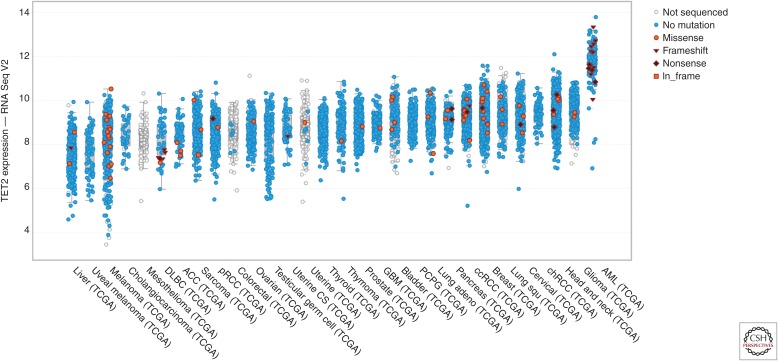
TET2 expression across malignancy. Normalized RNA-Seq counts (log2) are shown for the indicated malignancies ranked from lowest to highest mean expression of TET2. Samples with frameshift mutations are denoted with an inverted triangle, nonsense mutations are denoted as a diamond, and in-frame mutations are shown with a square. Data was collected and graphed using the cBioPortal (see cbioportal.org/) (Gao et al. 2013).

References

    1. Abdel-Wahab O, Mullally A, Hedvat C, Garcia-Manero G, Patel J, Wadleigh M, Malinge S, Yao J, Kilpivaara O, Bhat R, et al. 2009. Genetic characterization of TET1, TET2, and TET3 alterations in myeloid malignancies. Blood 114: 144–147. - PMC - PubMed
    1. Abdel-Wahab O, Manshouri T, Patel J, Harris K, Yao J, Hedvat C, Heguy A, Bueso-Ramos C, Kantarjian H, Levine RL, et al. 2010. Genetic analysis of transforming events that convert chronic myeloproliferative neoplasms to leukemias. Cancer Res 70: 447–452. - PMC - PubMed
    1. Bejar R, Lord A, Stevenson K, Bar-Natan M, Pérez-Ladaga A, Zaneveld J, Wang H, Caughey B, Stojanov P, Getz G, et al. 2014. TET2 mutations predict response to hypomethylating agents in myelodysplastic syndrome patients. Blood 124: 2705–2712. - PMC - PubMed
    1. Bhutani N, Burns DM, Blau HM. 2011. DNA demethylation dynamics. Cell 146: 866–872. - PMC - PubMed
    1. Blaschke K, Ebata KT, Karimi MM, Zepeda-Martínez JA, Goyal P, Mahapatra S, Tam A, Laird DJ, Hirst M, Rao A, et al. 2013. Vitamin C induces Tet-dependent DNA demethylation and a blastocyst-like state in ES cells. Nature 500: 222–226. - PMC - PubMed