


Home hemodialysis: a comprehensive review of patient-centered and economic considerations
- PMID: 28243134
- PMCID: PMC5317253
- DOI: 10.2147/CEOR.S69340
Home hemodialysis: a comprehensive review of patient-centered and economic considerations
Abstract
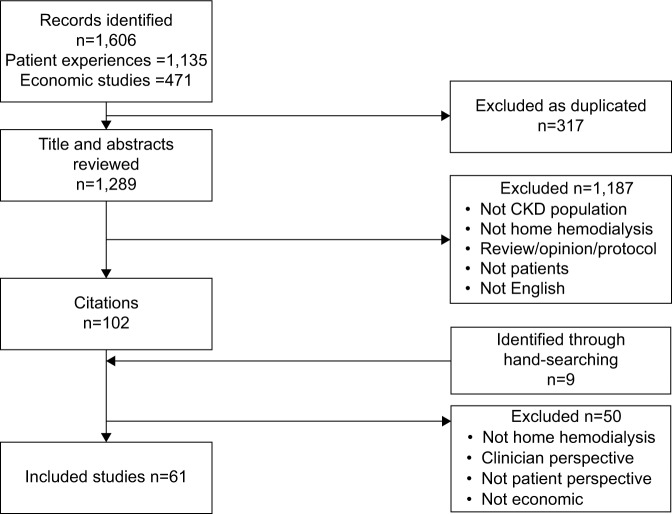
Internationally, the number of patients requiring treatment for end-stage kidney disease (ESKD) continues to increase, placing substantial burden on health systems and patients. Home hemodialysis (HD) has fluctuated in its popularity, and the rates of home HD vary considerably between and within countries although there is evidence suggesting a number of clinical, survival, economic, and quality of life (QoL) advantages associated with this treatment. International guidelines encourage shared decision making between patients and clinicians for the type of dialysis, with an emphasis on a treatment that aligned to the patients' lifestyle. This is a comprehensive literature review of patient-centered and economic impacts of home HD with the studies published between January 2000 and July 2016. Data from the primary studies representing both efficiency and equity of home HD were presented as a narrative synthesis under the following topics: advantages to patients, barriers to patients, economic factors influencing patients, cost-effectiveness of home HD, and inequities in home HD delivery. There were a number of advantages for patients on home HD including improved survival and QoL and flexibility and potential for employment, compared to hospital HD. Similarly, there were several barriers to patients preferring or maintaining home HD, and the strategies to overcome these barriers were frequently reported. Good evidence reported that indigenous, low-income, and other socially disadvantaged individuals had reduced access to home HD compared to other forms of dialysis and that this situation compounds already-poor health outcomes on renal replacement therapy. Government policies that minimize barriers to home HD include reimbursement for dialysis-related out-of-pocket costs and employment-retention interventions for home HD patients and their family members. This review argues that home HD is a cost-effective treatment, and increasing the proportion of patients on this form of dialysis compared to hospital HD will result in a more equitable distribution of good health outcomes for individuals with ESKD.
Keywords: economic considerations; end stage kidney disease; hemodialysis; home haemodialysis; patients; quality of life.
Conflict of interest statement
Disclosure RCW is supported by the University of Sydney APA Scholarship, Baxter Clinical Evidence Council research programme, and New Zealand Lotteries Health Research Grant. The other authors report no conflicts of interest in this work.
Figures
References
-
- Agar JW, Knight RJ, Simmonds RE, Boddington JM, Waldron CM, Somerville CA. Nocturnal haemodialysis: An Australian cost comparison with conventional satellite haemodialysis (Review Article) Nephrology. 2005;10(6):557–570. - PubMed
-
- Berns JS. Honoring patient preferences: The 2016 National Kidney Foundation Presidential Address. Am J Kidney Dis. 2016 - PubMed
-
- Blogg A, Hyde C. The experience of spouses caring for a person on home haemodialysis: an ethnography. Renal Society of Australasia Journal. 2008;4(3):75–80.
-
- Brill A. Economic Benefits of Increased Home Dialysis Utilization and Innovation. [Accessed August 25, 2016]. Available from: http://www.nephrologynews.com/wp-content/uploads/2016/03/MGAhomedialysis....
Publication types
LinkOut - more resources
Full Text Sources
Other Literature Sources
