. 2017 Feb 23:5:e3041.
doi: 10.7717/peerj.3041. eCollection 2017.

Tartrazine induces structural and functional aberrations and genotoxic effects in vivo

Affiliations

Tartrazine induces structural and functional aberrations and genotoxic effects in vivo

Latifa Khayyat et al. PeerJ. .

Abstract

Tartrazine is a synthetic organic azo dye widely used in food and pharmaceutical products. The current study aimed to evaluate the possible adverse effect of this coloring food additive on renal and hepatic structures and functions. Also, the genotoxic potential of tartrazine on white blood cells was investigated using comet assay. Twenty adult male Wistar rats were grouped into two groups of 10 each, control- and tartrazine-treated groups. The control group was administered orally with water alone. The experimental group was administered orally with tartrazine (7.5 mg/kg, b.wt.). Our results showed a marked increase in the levels of ALT, AST, ALP, urea, uric acid, creatinine, MDA and NO, and a decreased level of total antioxidants in the serum of rats dosed with tartrazine compared to controls. On the other hand, administration of tartrazine was associated with severe histopathological and cellular alterations of rat liver and kidney tissues and induced DNA damage in leucocytes as detected by comet assay. Taken together, the results showed that tartrazine intake may lead to adverse health effects.

Keywords: Genotoxicity; Histopathology; Serum biochemistry; Tartrazine; Ultrastructure.


Conflict of interest statement

The authors declare there are no competing interests.

Figures
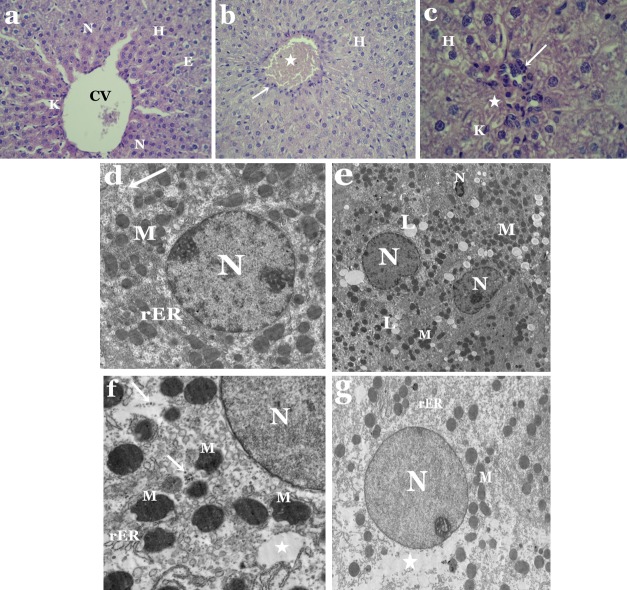
Figure 1
Figure 1
(A–C) Light micrographs of liver sections from control and tartrazine-treated rats stained with H&E. (A) Section from control rat showing hepatocytes (H) with central spherical nucleus (N), central vein (CV), endothelial cells (E) and Kupffer cells (K). X400. (B) Section from rat treated with tartrazine showing necrosis of most hepatocytes (H), congestion of blood vessel (star) and leucocytic infiltration (arrow). X400. (C) Section from rat treated with tartrazine showing vacuolated hepatocytes (H), others devoid of nuclei (star), leucocytic infiltration (arrow) and Kupffer cells (K). X1000. (D–G) Electron micrographs of liver sections from control and tartrazine-treated rats. (D) Section from control rat, showing part of the hepatocyte with nucleus (N), rough endoplasmic reticulum (rER), numerous mitochondria (M) and glycogen particles (arrows). X2500. (E) Section from rat treated with tartrazine, showing irregular and pyknotic nuclei (N), numerous lipid droplets (L) and electron dense mitochondria (M). X1500. (F) Section from rat treated with tartrazine, showing abnormal shaped mitochondria (M), dilated rough endoplasmic reticulum cisternae (rER), scattered ribosomes (arrows) and clear area of cytoplasm (star). X4000. (G) Section from rat treated with tartrazine, showing less electron dense nucleus (N), clear area of cytoplasm (star), electron dense mitochondria (M) and fragmented endoplasmic reticulum cisternae (rER). X2000.
Figure 2
Figure 2
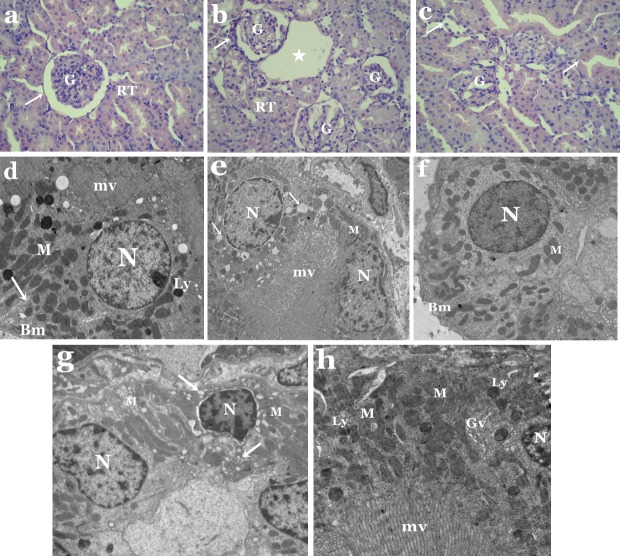
(A–C) Light micrographs of kidney sections from control and tartrazine-treated rats stained with H&E. (A) Section from control rat showing Malpighian corpuscles with its glomerulus (G), Bowman’s capsule (arrow) and renal tubules (RT). X400. (B) Kidney section from rat treated with tartrazine showing degenerated glomeruli (G), loss of renal tubules integrity (RT), huge cavity with fragmented areas (star) and inflammation (arrow). X400. (C) Kidney section from rat treated with tartrazine showing damage in renal tubules membrane (arrows) and degenerated glomeruli (G). X400. (D–H) Electron micrographs of kidney sections from control and tartrazine-treated rats. (D) Kidney section from control rat showing proximal tubular cells with apical microvilli (mv), basement membrane (Bm), basal infoldings (arrow), nucleus (N), numerous mitochondria (M) and lysosomes (Ly). X2000. (E) Kidney section from rat treated with tartrazine showing disrupted proximal tubular cells with irregular nucleus (N), vacuolated cytoplasm (arrows) and disordered mitochondria (M). X2000. (F) Kidney section from control rat showing distal tubular cell with nucleus (N), mitochondria (M) and basement membrane (Bm). X2000. (G) Kidney section from rat treated with tartrazine showing disrupted distal tubular cells with nucleus (N), mitochondria (M) and vacuoles (arrows). X 2500. (H) Enlarged part of proximal tubular cell from rat treated with tartrazine showing part of pyknotic nucleus (N), destructed mitochondria (M), numerous lysosomes (Ly), Gologi vesicles (Gv) and microvilli (mv). X4000.
Figure 3
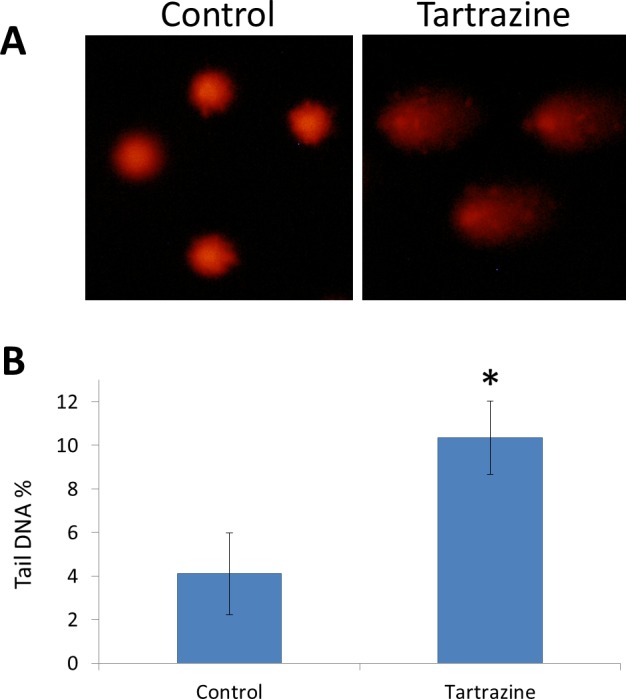
Figure 3. The genotoxic effect of tartrazine on leucocytes of rats.
(A) Fluorescence micrograph representing nuclei of leucocytes after the comet assay. Control nuclei of untreated animals appear intact with no detectable DNA damage. Nuclei of tartrazine-treated animals appear damaged. (B) Bar graph showing the tail DNA damage in percentage in nuclei of leucocytes of control and tartrazine-treated animals subjected to comet assay. Data are Mean ± SD (n = 3, t-test, p < 0.05).

References

    1. Abass MA, Abd El-Haleem MR. Evaluation of monosodium glutamate inducedneurotoxicity and nephrotoxicity in adult male albino rats. Journal of American Science. 2011;7(8):264–276.
    1. Afeefy A, Mahmoud M, Arafa M. Effect of honey on monosodium glutamate induced nephrotoxicity (histological and electron microscopic studies) Journal of American Science. 2012;8(1s):146–156.
    1. Aktac T, Kaboglu A, Kizilay G, Bakar E. The short-term effects of single toxic citric acid doses on mouse tissues—histopathological study. Fresenius Environmental Bulletin. 2008;17:311–315.
    1. Amin KA, Abdel Hameid H, AbdElsttar AH. Effect of food azo dyes tartrazine and carmoisine on biochemical parameters related to renal, hepatic function and oxidative stress biomarkers in young male rats. Food and Chemical Toxicology. 2010;48(10):2994–2999. doi: 10.1016/j.fct.2010.07.039. - DOI - PubMed
    1. Ashour AA, Abdelaziz I. Role of fast green on the blood of rats and the therapeutic action of vitamins C or E. International Journal of Integrative Biology. 2009;6(1):6–11.

LinkOut - more resources