


Long-Term Patient-Reported Outcomes From a Phase 3 Randomized Prospective Trial of Conventional Versus Hypofractionated Radiation Therapy for Localized Prostate Cancer
- PMID: 28244407
- PMCID: PMC5331910
- DOI: 10.1016/j.ijrobp.2016.12.034
Long-Term Patient-Reported Outcomes From a Phase 3 Randomized Prospective Trial of Conventional Versus Hypofractionated Radiation Therapy for Localized Prostate Cancer
Abstract
Purpose: To assess the long-term quality of life (QoL) outcomes from a phase 3 trial comparing 2 modes of intensity modulated radiation therapy (IMRT): conventional IMRT (CIMRT) versus hypofractionated IMRT (HIMRT) in patients with localized prostate cancer.
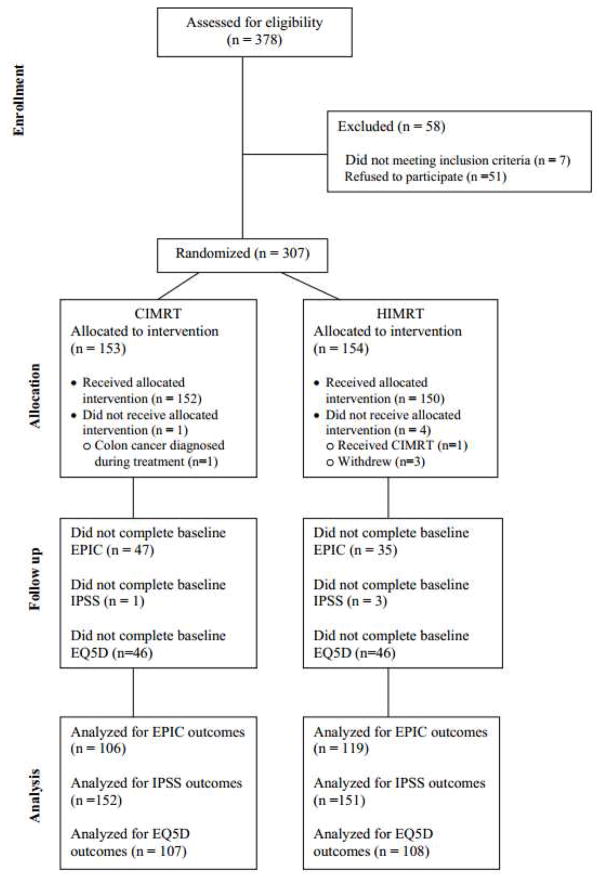
Methods and materials: Between 2002 and 2006, 303 men with low-risk to high-risk prostate cancer were randomized to 76 Gy in 38 fractions (CIMRT) versus 70.2 Gy in 26 fractions (HIMRT). QoL was compared by use of the Expanded Prostate Cancer Index Composite (EPIC), the International Prostate Symptom Score (IPSS), and EuroQoL (EQ5D) questionnaires. The primary outcome of the QoL analysis was a minimum clinically important difference defined as a 0.5 standard deviation change from baseline for each respective QoL parameter. Treatment effects were evaluated with the use of logistic mixed effects regression models.
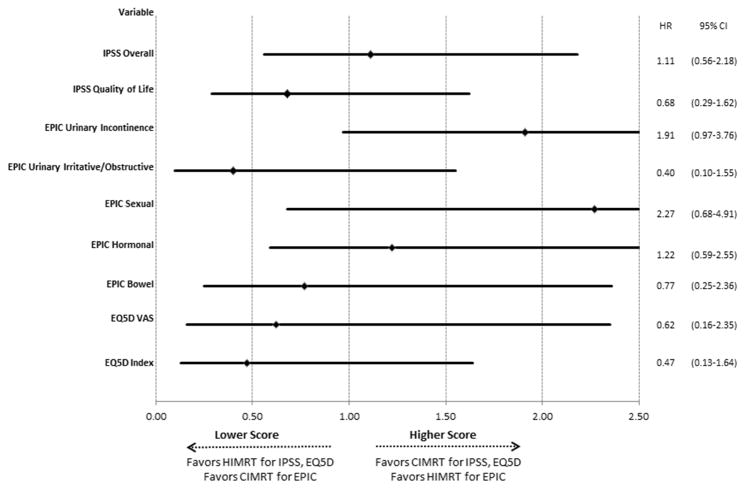
Results: A total of 286, 299, and 218 patients had baseline EPIC, IPSS, or EQ5D data available and were included in the analysis. Overall, there was no statistically significant difference between the 2 treatment arms in terms of EPIC, IPSS, or EQ5D scores over time, although there was a trend toward lower EPIC urinary incontinence scores in the HIMRT arm. More patients in the HIMRT arm had a lower EPIC urinary incontinence score relative to baseline versus patients in the CIMRT arm with long-term follow-up. On multivariable analysis, there was no association between radiation fractionation scheme and any QoL parameter. When other clinical factors were examined, lymph node radiation was associated with worse EPIC hormonal scores versus patients receiving no lymph node radiation. In general, QoL outcomes were generally stable over time, with the exception of EPIC hormonal and EQ5D scores.
Conclusions: In this randomized prospective study, there were stable QoL changes in patients receiving HIMRT or CIMRT. Our results add to the growing body of literature suggesting that HIMRT may be an acceptable treatment modality in clinically localized prostate cancer.
Copyright © 2016 Elsevier Inc. All rights reserved.
Conflict of interest statement
Figures
References
-
- Siegel RL, Miller KD, Jemal A. Cancer statistics, 2015. CA Cancer J Clin. 2015;65(1):5–29. - PubMed
-
- Kuban DA, et al. Long-term results of the M. D. Anderson randomized dose-escalation trial for prostate cancer. Int J Radiat Oncol Biol Phys. 2008;70(1):67–74. - PubMed
-
- Brenner DJ, Hall EJ. Fractionation and protraction for radiotherapy of prostate carcinoma. Int J Radiat Oncol Biol Phys. 1999;43(5):1095–101. - PubMed
-
- Arcangeli G, et al. A prospective phase III randomized trial of hypofractionation versus conventional fractionation in patients with high-risk prostate cancer. Int J Radiat Oncol Biol Phys. 2010;78(1):11–8. - PubMed
Publication types
MeSH terms
Grants and funding
LinkOut - more resources
Full Text Sources
Other Literature Sources
Medical
