


Appendicular Lean Mass and Mortality among Prefrail and Frail Older Adults
- PMID: 28244576
- PMCID: PMC5515463
- DOI: 10.1007/s12603-016-0753-7
Appendicular Lean Mass and Mortality among Prefrail and Frail Older Adults
Abstract
Objective: Prefrail and frail older adults are a heterogeneous population. The measurement of appendicular lean mass (ALM) may distinguish those at higher versus lower risk of poor outcomes. We examined the relationship between ALM and mortality among prefrail and frail older adults.
Design: This was a population-based cohort study.
Setting: The Third National Health and Nutrition Survey (NHANES III; 1988-1994).
Participants: Older adults (age ≥65 years) with pre-frailty or frailty defined using the Fried criteria.
Measurements: ALM was quantified using bioimpedance analysis. Multivariable-adjusted Cox regression analysis examined the relationship between ALM and mortality. Logistic regression analysis was used to determine if ALM added to age and sex improved the predictive discrimination of five-year and ten-year mortality.
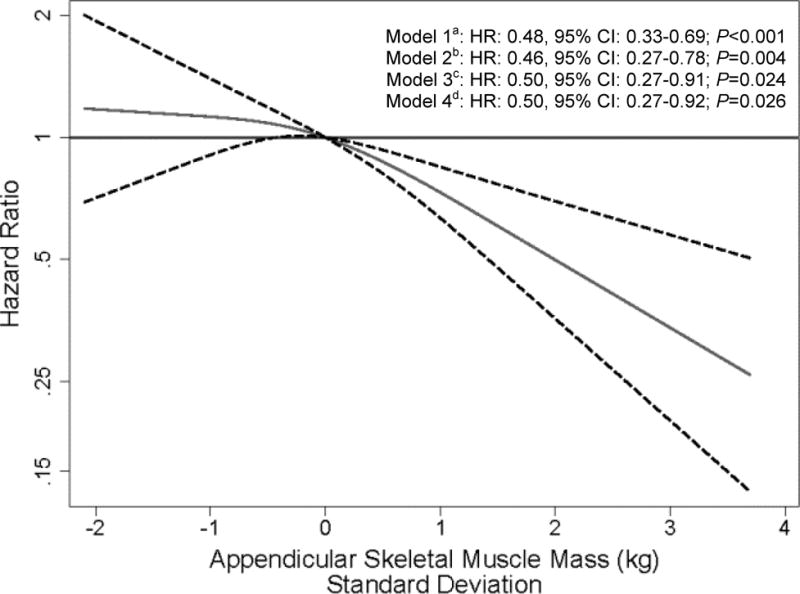
Results: At baseline, the average age was 74.9 years, 66.7% were female, 86.3% and 13.7% were prefrail and frail, respectively. The mean ALM was 18.9 kg [standard deviation (SD): 5.5]. During a median 8.9 years of follow-up, 1,307 of 1,487 study participants died (87.9%). Higher ALM was associated with a lower risk of mortality. In a multivariable-adjusted regression model that accounted for demographic, behavioral, clinical, physical function, and frailty characteristics, each SD increase in ALM was associated with an 50% lower risk of mortality [Hazard Ratio: 0.50 (95% CI: 0.27-0.92); P=0.026]. The addition of ALM to age and sex improved the predictive discrimination of five-year (P=0.027) and ten-year (P=0.016) mortality.
Conclusion: ALM distinguishes the risk of mortality among prefrail and frail older adults. Additional research examining ALM as a therapeutic target is warranted.
Keywords: Lean mass; bioimpedance analysis; geriatrics; population-based.
Conflict of interest statement
The authors report no conflicts of interest.
Figures
References
-
- Gallagher D, Visser M, De Meersman RE, et al. Appendicular skeletal muscle mass: effects of age, gender, and ethnicity. J Appl Physiol (1985) 1997;83:229–239. - PubMed
-
- Auyeung TW, Lee SWJ, Leung J, Kwok T, Woo J. Age-associated decline of muscle mass, grip strength and gait speed: A 4-year longitudinal study of 3018 community-dwelling older Chinese. Geriatrics & gerontology international. 2014;14:76–84. - PubMed
-
- Kitamura I, Koda M, Otsuka R, Ando F, Shimokata H. Six-year longitudinal changes in body composition of middle-aged and elderly Japanese: Age and sex differences in appendicular skeletal muscle mass. Geriatrics & gerontology international. 2014;14:354–361. - PubMed
-
- Marzetti E, Leeuwenburgh C. Skeletal muscle apoptosis, sarcopenia and frailty at old age. Exp Gerontol. 2006;41:1234–1238. - PubMed
-
- Idoate F, Cadore EL, Casas-Herrero A, et al. Adipose tissue compartments, muscle mass, muscle fat infiltration, and coronary calcium in institutionalized frail nonagenarians. Eur Radiol. 2014:1–13. - PubMed
MeSH terms
Grants and funding
LinkOut - more resources
Full Text Sources
Other Literature Sources
